that can cut the level of frequencies
below 800Hz by either 2dB or 4dB.
e rest of the controls, which
PreSonus call the ‘Acoustic Tuning’
controls, enable you to tweak the
response to your taste or to emulate the
sounds of dierent types of speaker.
e High control is a high-frequency
shelving lter that oers up to 6dB of
boost or cut for all frequencies above
4.5 kHz, while the Mid control is a
mid-frequency peak lter that boosts or
cuts frequencies centred on 1 kHz with
a bandwidth from an octave above to
an octave below. PreSonus’ own choice
is a at setting for both, so the rotary
knobs for each are detented at OdB.
If you want to tweak the bottom
end you get the ‘Low Cuto’ three-
way switch, which oers, besides a
at response, a low frequency roll o
at a slope of -12 dB/octave below a
frequency of either 80Hz or 100Hz —
useful if you want to add a subwoofer to
the system.
WB E8’s or a dirty limerick?
Listening to a variety of com-
mercially released tracks, mixes in
progress and individual instruments
through the E8 the impression was
that here is a speaker that could easily
take care of all recording and mixing
possibilities if it was the sole monitor
in a small studio. Clarity is good and
the overall balance of frequencies is
one that you can work with, the top
end coming through prominently
and clearly revealing the detail, while
the bottom end is tight and focussed
and extends down far enough to
allow you to make those important
mix decisions.
As for the Acoustic Tuning controls,
the at sound worked just ne for us,
but we could appreciate how a small
cut or boost of the High control might
appeal to some tastes or be useful
to compensate for room conditions,
although we’d have preferred switch-
ing rather than a small rotary control
to keep left and right consistent.
PreSonus propose that use of the Mid
control can emulate other speaker
systems. ey say that turning it
down will emulate the smiley face
curve of a car stereo while turning
it up (in combination with the low
Cuto switch) will emulate a cheap
portable radio. It’s an unusual feature
to add to a studio monitor and it’s
probably no bad thing to have an
extra tool in the box... as long as you
remember to reset it. e thing about
having your own set of studio mon-
itors is familiarity, letting you make
sound mixing decisions based on the
consistency of your listening experi-
ence. e E8 will let you do that but
we’d just set the EQ at or tweak it to
taste, leave it and get used to it.
God, planet or dog?
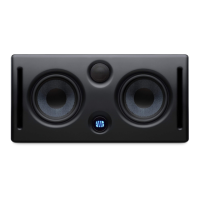
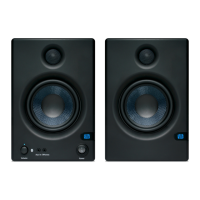
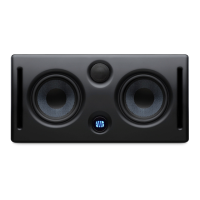
OK, so we looked up what Eris
meant. ere are a couple of things,
one being the Greek goddess of
chaos, strife and discord, which
doesn’t sound quite right for a studio
monitor, although it is designed to
help you transmute the chaos and
discord of an unmixed track into a
thing of beau-
ty. en there’s
Eris, the most
massive known
dwarf planet in
the Solar System.
Massive dwarf?
Big sound from a
little speaker, perhaps? Or maybe the
designer named it after his dog...
Our view favours the rst two
over the latter. e Eris E8s are no
dogs, we’d be very happy to use
them to mix our tracks and yes they
can sound quite massive for such
a compact cabinet. What you are
getting here is a monitor that should
t tidily into most rooms and will let
you hear the detail in your mixes. At
a street price of around £400 a pair it
has quite a lot of competition, but is a
valid choice in that price range.
BONEDO.DE
September 2013
By Felix Klostermann
(translated from German)
e PreSonus Eris 5 and 8 are quality
made, well -equipped and good-
natured active speakers for near eld.
e fairly linear tuning of the boxes
allows an amazingly balanced and
transparent sound reproduction, and
for a very attractive price.
RESIDENT ADVISOR
SEPTEMBER 2013
By Phil Moa
[Eris monitors] denitely sound
comparable to or better than other
speakers in their class and also have
plenty of useful features. Being able
to tune them is a huge plus, and
they’re equipped to be connected to
pretty much any setup…ese are
certainly worthy of consideration for
anyone on a budget.
PreSonus Eris E5 Studio Monitors
By Paul Lau
e PreSonus Eris monitors are part
of a new initiative for a company gen-
erally known for its stellar hardware
interfaces. I was pleasantly surprised
when I got the call to review these
new near eld monitors. I have been
on the tail end of nishing a lm
score and mixing and mastering a
separate album, so test-driving these
monitors with my PreSonus Studio-
Live was certainly an appealing idea.
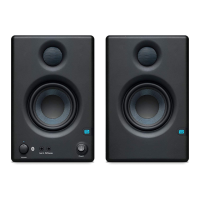
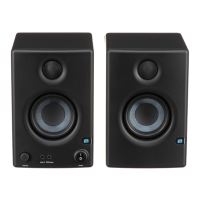
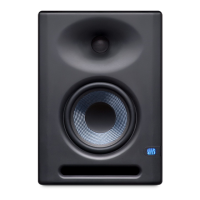
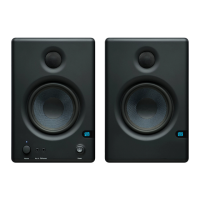
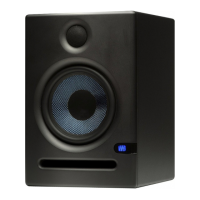
So what are these Eris E5s? ey
are billed as individually powered
“high denition active studio mon-
itors,” weigh in at about 10 lbs, and
denitely have a bit of a kick with a
5.25-in. Kevlar low-frequency driver
and 45 W Class AB amp. ey also
have a 1-in. silk dome tweeter pow-
ered by a 35 W Class AB amp. eir
peak is at 102 dB SPL with a frequen-
cy response from 53 Hz-22 kHz.
All of the speakers in the Eris series
have front-ported enclosures made
of vinyl-laminated, medium-density
berboard, which also helps with
proximity to walls.
e E5s welcome three types of
inputs: balanced XLR, balanced ¼-in.
TRS, and unbalanced RCA line-level
inputs. When both balanced connec-
tions are in use, the TRS input will
supersede the XLR input. e RCA
input is summed into the signal path.
So what is it that makes the E5 a good
monitor? Actually, what makes any
monitor good or bad? My philosophy
is that most monitors intrinsically
serve a purpose; the question lies
with the listener and whether or not
you’ve learned what your monitors
sound like in reference to other play-
back sources.
Many monitors on the market
are celebrated for a very particular
sound, but the E5 can easily be set
up to have dierent sound charac-
teristics thanks to its selection of
controls. e rst control is the input
gain stage, which allows you to set
the signal level and, in that, set a
clean signal level. You have to be able
to produce a natural, non-distorted
sound between dierent frequencies
at dierent volumes. e E5 sounds
very clean and generally round to me.
Next, the E5 provides three EQ
controls in its Acoustic Tuning sec-
tion: high, mid, and low cuto. With
these controls, you can adjust the
settings into dierent frequencies
and produce dierent characteristics
for playback. A simple example is to
make the monitors sound really at
— easy enough to do with the E5 — to
give a trueness of sound, say for the
mixing process.
In mixing and mastering sessions,
you also really want to get referenc-
es from multiple sources - laptop
speakers, car speakers, etc. I found it
quite convenient simply dialing those
tones up through one set of monitors
like the E5s. ese varied EQ settings
not only give you a at/linear sound,
but can also give a more boomy,
much rounder response, too. You can
also detail with the bass control if you
are using a subwoofer.
e E5 also has a three-position
Acoustic Space switch. is switch
controls a second order for frequency
control. e low shelving lter cuts
the levels below 800 Hz by a specied
amount (-2 or -4dB) to compensate
for the boundary bass boost that
occurs when the monitor is placed
near a wall or corner. Hence, you can
control the bass response relative to
the proximity of your speakers to a
nearby wall. e E5s are also light-
weight and can be used in various
situations and locations. e controls
allow you to give a great sounding
playback in just about any situation.
On my
own proj-
ects, I have
been using
the E5s and
then refer-
encing back
over to larger
boxes and
it’s impres-
sive how the
“…a monitor that should fit
tidily into most rooms and
will let you hear the detail
in your mixes.”
“Overall, the E5s pack a punch,
yet have subtle qualities akin
to those of more expensive
oerings. The depth of control
allows the Eris E5 to act as a
‘monitor chameleon’.”
CANADIAN MUSICIAN
September 2013
E5 translates — very true in sound
colours and contours.
e E5 also has built-in current
output limiting and over-tempera-
ture protection to avoid heat-related
issues and also prevent any damage
from a short circuit. ere is also a
current output limiting and subson-
ic protection to lter out extremely
low-frequency vibrations that could
interfere with the woofer’s perfor-
mance. Another feature to mention is
that the power ampliers have a “soft
startup” so that you don’t get any
damaging pops in the speakers when
you power them up.
Overall, the E5s pack a punch, yet
have subtle qualities akin to those of
more expensive oerings. e depth
of control allows the E5 to act as a
“monitor chameleon.” All monitors
serve a purpose, especially if you
learn how they operate. I mix to
sound good and the PreSonus Eris
E5s make me sound great.


 To Next Page
 Loading...