7
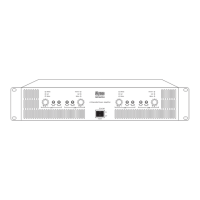
AM860
BRIEF NOTES ON ACOUSTIC
Diffusing sound into an environment means to distribute sound signals to a given audience and the results
are dependent on several ambient factors (room shape, volume, etc...), the number of the people present
and their precise location, the type of sound source (live or recorded music or speech), and the level of the
background ambient noise.
Eciency
Sound pressure (SPL) of a speaker depends on three factors: efficiency, dimensions and use in combination
with other speakers. Efficiency, the quantity of energy generated by the amplifier trasformed into sound,
determines the volume that can be obtained by an amplifier of a given power rating. A 50W amplifier com-
bined with highly efficient speakers may be able to produce a higher volume than a 100W amplifier com-
bined with less efficient speakers.
Impedance
One of the electrical features of a speaker is its impedance (resistance to the passage of alternate current).
Both resistance and impedance varies at different frequencies so different frequencies can be delivered
with different soiund pressure levels. In some cases, confusion may arise when combining impedence val-
ues of power amplifiers with those of loudspeakers. Adapting the output impedance of the amplifier to
the loudspeaker’s input impedance means that all the energy from the amplifier will be transferred to the
speakers with no signal losses, so that the system works in optimum conditions (and the risk of damage is
minimised). A louspeaker having an higher impedance than power amplifier’s may be used, although this
will result in a power reduction; loudspeakers with an impedance lower than amplifier’s minimum load,
must not be connected. If more complex systems (e.g. several speakers connected to the sameamplifier) are
adopted, you must be sure that the overall speaker impedance value corresponds to the amplifier output
impedance. There are 2 possible connection systems: serial or parallel mode. Connecting two speakers in
series means to connect the positive pole of the first speaker to the negative pole of the second one and
then to connect the two free poles to the amplifier. In this case the impedance values are summed up: e.g.
Two 8 Ohm speakers connected in parallel give a 16 Ohm load. To connect two speakers in parallel mode,
simply interconnect the two speakers terminals of the same sign. To obtain the total value, in this case a
calculation is required. Indicating R1 and R2 as the two loudspeaker values, the following formula has to be
used: (R1xR2)/(R1+R2). E.g.: with two 8 Ohm speakers, we have that: (8x8)/(8+8)= 64/16= 4 Ohm, that is to
say that when identical speakers are connected in parallel, the impedance value is halved.
Choosing the right amplier
According to the AES standard, tests run on the components require a two-hour stressing of a filtered pink
noise signal with a pass band of a decade and with a crest factor (average value and peak value ratio) of 6 dB.
For common applications which require both a high power and a high reliability level, it is advisable to use
power amplifiers with an output rating equivalent to the AES power rating of the enclosures. This ensures
that the enclosures will operate within their thermal limit specification. For applications where the user
desires to take advantage of the full applicable power of the enclosures, it is possible to use amplification
with output power ratings equal to the program output rating of the enclosures. In this configuration, the
full capacity of the system to handle transient power is utilised, however it will be necessary to constantly
monitor and regulate the system very carefully in order to avoid overloading the speakers. It is also neces-
sary to avoid that loudspeakers are subject to signals which could cause them to exceed their mechanical
limits or their applicable frequency limits. In practice, it is possible to damage a loudspeaker with a power
well below its AES applicable power rating if it is required to reproduce a distorted signal at a low frequency
that causes a cone excursion beyond the physically consented limit.
Glossary
SPL: Sound pressure level is a logarithmic measure of the rms sound pressure of a sound relative to a ref-
erence value. It is measured in decibels (dBSPL). AES: Established in 1948, the Audio Engineering Society


 To Next Page
 Loading...