Need help?
Do you have a question about the Pro Fitness EB1000 and is the answer not in the manual?
Key points for safe setup and placement of the exercise bike.
Rules for operating the equipment to ensure user safety during exercise.
Precautions regarding battery installation, use, and disposal.
Advice on preparing for exercise based on physical condition and goals.
Guidelines for setting and maintaining target heart rate zones for effective workouts.
Diagram and list showing muscles worked during exercise.
Recommended procedures for pre-exercise warm-up and post-exercise cool-down.
Explanation of console features, buttons, and display functions.
How to change the exercise resistance level using the tension knob.
Instructions for adjusting the seat height and fore/aft position.
Guide on how to adjust the handlebar position for user comfort.
This document provides comprehensive instructions for the assembly, use, and maintenance of the EB1000 Exercise Bike, a fitness equipment designed for domestic use. It emphasizes safety precautions, proper assembly procedures, workout guidance, and care instructions to ensure optimal performance and longevity of the product.
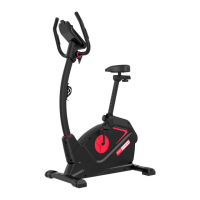
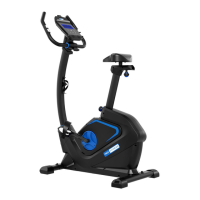
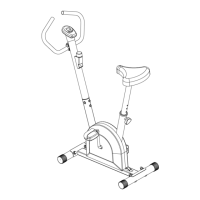
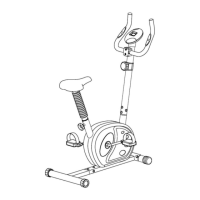
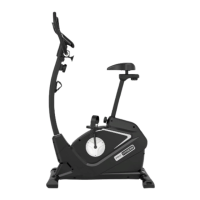
The EB1000 Exercise Bike is a stationary training equipment designed to provide a cardiovascular workout and strengthen lower body muscle groups. It features an adjustable resistance system, allowing users to tailor the intensity of their exercise. The bike is equipped with a console that displays various workout metrics such as speed, distance, time, calories burned, and heart rate (HR). This console also includes a recovery function to assess fitness levels. The bike's design incorporates a saddle and handle that can be adjusted to suit individual user preferences and ensure a comfortable and effective workout posture. Transport wheels are integrated into the design for easy relocation of the equipment.
Before starting any exercise program, users are strongly advised to consult a doctor, especially if they are over 35 or have pre-existing health problems. The manual stresses the importance of reading all instructions thoroughly before assembly, operation, or use.
The assembly process requires careful attention to detail and is best performed by two people. Users should ensure they have a stable and level surface for installation, preferably with a mat underneath to protect the floor. All components and fixings must be checked against the provided parts list, noting that some smaller components may be pre-fitted. The assembly steps involve attaching the front and rear stabilizers to the main frame, connecting the front post, installing the pedals, and finally, attaching the console and handle. The levelling feet on the stabilizers can be rotated to ensure the bike sits flat on the ground.
The saddle and handle are adjustable to accommodate different user heights and preferences. The seat height is correct when the knee is slightly angled with the pedal vertically down and the foot parallel to the floor. The handle position can also be adjusted by loosening and tightening a lock knob. The resistance level of the bike can be adjusted by turning an 8-level tension knob clockwise to increase resistance or counter-clockwise to decrease it.
The console automatically switches on when the exercise bike is in motion. It displays various metrics and includes a "SCAN" mode to cycle through functions. Users can manually select and lock onto a particular function using the "MODE" key. The "RESET" key clears all data. The recovery function measures fitness recovery by holding hand pulse sensors for one minute, displaying a fitness value from F1.0 (excellent) to F6.0 (very poor). Heart rate sensors on the handle measure beats per minute, with the heartbeat symbol flashing when a signal is received. If no signal is input for 4 seconds, the speed display will show 0.
An effective exercise program should include three parts: a warm-up (5-10 minutes of stretching and light exercise), training zone exercise (20-30 minutes with heart rate in the target zone), and a cool-down (5-10 minutes of stretching). The target heart rate zone (65% to 85% of maximum heart rate) is crucial for aerobic exercise benefits and can be determined using an age-based chart provided in the manual. Users are advised to start slowly and gradually increase intensity. Stretching exercises for calves, quadriceps, hamstrings, and inner thighs are detailed for proper warm-up and cool-down.
Several safety guidelines are highlighted:
A free area of at least 0.6m greater than the training area is required around the equipment to allow for safe dismount in emergencies. This space can be shared if two pieces of equipment are positioned adjacent to each other.
Regular maintenance is essential for the safety and longevity of the EB1000 Exercise Bike.
The console's battery life is approximately 10 months under normal usage. To replace batteries:
Users are advised not to attempt to repair the equipment themselves. If any difficulty arises with assembly, operation, or use, or if parts are missing, the Customer Helpline (0345 600 1714) or www.argos-support.co.uk should be contacted.
The manual indicates that the equipment and batteries should not be disposed of as general household waste. Users should utilize local collection systems or facilities for appropriate recycling. The "Pb" sign below the battery symbol indicates that the battery contains lead.
The product comes with a one-year guarantee against manufacturing defects from the date of original purchase. This covers replacement, refund, or free repair for faults due to materials or workmanship. The guarantee is subject to conditions, including correct installation and operation, domestic use only, and excludes accidental damage, misuse, or inexpert repair.
 General
| Resistance | Magnetic |
|---|---|
| Display | LCD |
| Adjustable Handlebars | Yes |
| Seat Type | Padded |
| Drive System | Belt |
| Adjustable Seat | Yes |
| Warranty | 12 months |
| Maximum User Weight | 300 lbs |
| Weight Capacity | 300 lbs |

 To Next Page