OPERATION PROCEDURES
DC Voltage Measurement
WARNING: WITH EXTREME CARE WHEN MAKING MEASUREMENTS
FOR HUGH VOLTAGE, AND DO NOT TOUCH TERMINAL OR PROBE
ENDS.
1. Set the selector switch to the appropriate DCV range to be used.
2. Connect the BLACK test lead to the “-COM” jack and the RED test lead
to the “+” jack.
3. If you know the polarity of the circuit to be tested, connect the black
probe to the negative side.
4. If you don’t know the polarity, connect the probes to opposite sides of the
circuit and watch the pointer. If it goes to the left, reverse the probes. The
RED probe will be connected to the positive.
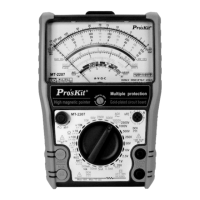
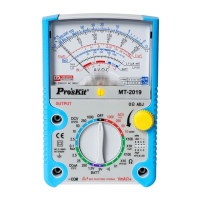
5. Check the needle position and the get the reading on V.A scale.
AC Voltage Measurement
WARNING: WITH EXTREME CARE WHEN MAKING MEASUREMENTS
FOR HUGH VOLTAGE, AND DO NOT TOUCH TERMINAL OR PROBE
ENDS.
1. Set the selector switch to the appropriate ACV range to be used and
connect the test leads across the circuit or load under measurement.
(Polarity of the test probes is unimportant on ACV test.)
2. Connect the BLACK test lead to the “-COM” jack and the RED test lead
to the“+” jack.
3. Check the needle position and the get the reading on V.A scale.
DC Current Measurement
WARNING: DO NOT APPLY VOLTAGE TO MEASURING TERMINAL WHILE
RANGE SWITCH IS IN CURRENT POSITION DO NOT ATTEMPT TO
MEASURE AC CURRENT.
1. Set the selector switch to the appropriate DC mA range to be used and
connect the test leads in series with the circuit or the load under
measurement. If the pointer deflects to the left, reverse the probes.
2. Connect the BLACK test lead to the “-COM” jack and the RED test lead
to the Red “+” jack for Current at/less than 0.25A.
3. Check the needle position and the get the reading on V.A scale.
Note:
Excessive current input across mA range will blow the fuse that must be
replaced by a same fuse rating 0.5A/250V.
Note: If connected incorrectly with the voltage at these ranges, quickly
remove the test leads from the circuit and can avoid the damage to this


 To Next Page