Need help?
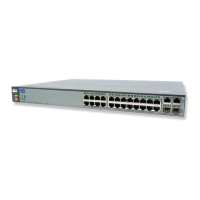
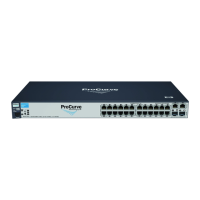
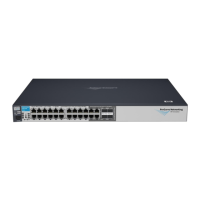
Do you have a question about the ProCurve 2910al-24g and is the answer not in the manual?
Provides an overview of the management interfaces available for the switches and the advantages of using each interface.
Details the benefits of using the menu interface for switch configuration and performance features.
Explains the benefits of using the Command Line Interface (CLI) for switch management.
Highlights the benefits of using the web browser interface for accessing and managing the switch.
Describes the features and benefits of ProCurve Manager and ProCurve Manager Plus for network management.
Explains how to configure custom login banners for console and web browser access to the switch.
Provides an overview of the menu interface, its operation, and key features.
Describes how to start and end a menu interface session on the switch.
Details the various features accessible from the main menu interface.
Explains the structure of menu interface screens and how to navigate through them.
Covers the process of rebooting the switch from the menu interface.
Provides an overview of the Command Line Interface (CLI) for switch configuration and monitoring.
Explains the methods for accessing the Command Line Interface (CLI).
Details the privilege levels available at the CLI logon and how they control access.
Describes the Manager privileges, including Manager, Global Configuration, and Context Configuration levels.
Explains how to list available commands and their options in the CLI.
Covers CLI control features like executing prior commands and editing shortcuts.
Introduces the ProCurve web browser interface and its capabilities for managing the switch.
Lists the general features available in the web browser interface for switch management.
Guides on how to start a web browser interface session with the switch.
Outlines essential tasks for the initial configuration of the web browser interface.
Details how to create usernames and passwords for browser interface security.
Describes the status reporting features available in the web browser interface.
Explains the Alert Log, its entries, and how to sort them.
Covers setting the fault detection policy to control alert severity in the Alert Log.
Explains how switch memory manages configuration changes, CLI, menu, and web interfaces.
Details the running-config and startup-config files and their operation.
Describes how to use the CLI to view and reconfigure switch features.
Explains the use of primary and secondary flash memory for storing switch software images.
Covers rebooting the switch and options like boot, reload, and fastboot.
Details managing multiple startup-config files and configuring reboot policies.
Provides an overview of switch interface access and system information features.
Details interface access features like console, web, and inbound Telnet.
Covers system information features including System Name, Contact, Location, and Time.
Guides on viewing and configuring system information parameters via the menu interface.
Explains how to view and configure system information using CLI commands.
Provides an overview of IP addressing configuration on the switch.
Lists the IP configuration features available through Menu, CLI, and Web interfaces.
Details IP addressing configuration when multiple VLANs are in use.
Guides on configuring IP address, gateway, and TTL via the menu interface.
Explains how to configure IP address, gateway, and TTL using CLI commands.
Describes how to configure and use user-defined loopback interfaces on the switch.
Introduces time synchronization, TimeP, SNTP, and the timesync command.
Guides on selecting SNTP or TimeP, enabling protocols, and configuring parameters.
Details how to view, select, and configure SNTP time synchronization.
Explains how to view, select, and configure TimeP time synchronization.
Describes how to view current port configuration and configure ports to non-default settings.
Covers viewing port status and configuring port parameters like mode and flow control.
Explains port speed and duplex settings, and supported modes.
Guides on configuring port settings using the menu interface.
Explains how to assign alphanumeric port names to augment numeric port names.
Details UDLD operation, configuration, and troubleshooting for detecting link failures.
Introduces PoE technology, its capabilities, and related publications.
Covers PoE operation, including configuration, monitoring, and event logs.
Explains how to configure PoE operation, including priority and thresholds.
Details how LLDP interacts with PoE for power negotiation and management.
Shows how to display the switch's global PoE power status.
Provides details on displaying PoE status for all ports on the switch.
Offers considerations for planning a PoE application, including port assignments and security.
Describes creating and modifying port trunk groups, including non-protocol and LACP trunks.
Explains LACP and non-protocol trunk features and their operation.
Details dynamic LACP and static trunk configuration methods.
Guides on viewing and configuring static port trunk groups via the menu interface.
Explains how to view and configure port trunk groups using CLI commands.
Covers dynamic and static LACP trunk group configuration and operation.
Describes the default LACP operation when it is not explicitly configured.
Introduces port traffic controls, including Rate-Limiting and Jumbo Frames.
Details rate-limiting for all traffic on a per-port basis to control bandwidth usage.
Explains jumbo frames, MTU settings, and configuration for inbound jumbo traffic.
Guides on configuring jumbo frame operation, including VLAN membership and port speed.
Describes how to manage the switch using SNMP from a network management station.
Lists the SNMP management features supported by the switch.
Details the steps for configuring SNMP version 1 and 2c access management.
Explains the steps for configuring SNMP version 3 access management.
Covers configuring the switch to send network security and link-change notifications.
Describes RMON support for network troubleshooting and optimization.
Explains configuring sFlow instances via CLI for flow sampling and counter-polling.
Details LLDP operation, configuration, and standards compatibility.
Explains LLDP-MED extensions for VoIP, including its features and benefits.
Provides an overview of methods for transferring files to and from the switch.
Guides on downloading switch software using TFTP, Xmodem, USB, and Switch-to-Switch methods.
Explains how to copy software images using TFTP, Xmodem, and USB.
Details methods for transferring switch configuration files using TFTP, Xmodem, and USB.
Describes uploading and executing command files for configuring Access Control Lists (ACLs).
Explains how to copy switch data like command output and event logs to various destinations.
Details how to use USB autorun for auto-executing CLI commands from a USB flash drive.
Describes built-in tools for monitoring, analyzing, and troubleshooting switch operation.
Details status and counters screens available through console and web browser interfaces.
Guides on accessing port and trunk statistics via the menu interface.
Explains how to display port counter summary reports and detailed traffic summaries.
Describes how to view the switch’s MAC addresses on ports and VLANs.
Lists MSTP configuration, root data, and per-port data.
Details how to display IGMP status on a per-VLAN basis using the CLI.
Explains how to display VLAN status, including existing VLANs and port status.
Covers interface monitoring features like port monitoring and VLAN monitoring.
Addresses performance-related network problems caused by topology, configuration, or other devices.
Outlines methods to diagnose switch problems, including checking LEDs and network topology.
Helps diagnose issues with accessing the web browser or Telnet interface.
Addresses problems like slow networks, process failures, and duplicate IP addresses.
Troubleshoots issues with ACLs not filtering IP layer 3 packets correctly.
Addresses issues with enabling LACP on ports, especially when related to trunk configuration.
Troubleshoots issues related to 802.1X authentication, RADIUS, and port security.
Helps diagnose issues when the switch does not receive a response to RADIUS authentication requests.
Addresses issues related to SSH access, including client key problems and connection failures.
Explains how to use the Event Log for isolating and troubleshooting switch problems.
Details how to configure and use debug and Syslog messaging for network troubleshooting.
Lists and describes diagnostic tools like Ping, Link Test, Traceroute, and configuration viewing.
Explains how to view switch configuration files and operational data for troubleshooting.
Covers methods for resetting the switch to its factory default configuration.
Guides on how to recover from an empty or corrupted flash state by restoring a flash image.
Explains DNS configuration and using DNS-compatible commands for name resolution.
Explains how the switch assigns MAC addresses for management functions and internal operations.
Describes methods to view the switch's base MAC address and port MAC addresses.
Guides on viewing MAC and IP address assignments for VLANs via the menu interface.
Explains how to view port and VLAN MAC addresses using CLI commands.
Describes how to list MAC addresses of devices detected by the switch.
Covers viewing current usage and availability of resources in the Policy Enforcement engine.
Explains the hardware element managing QoS, ACLs, and other software features.
Shows how to display current resource usage using CLI commands.
Addresses situations where resources are fully subscribed or unavailable.
Details DST rules for Middle Europe and Portugal.
Details DST rules for the Southern Hemisphere.
Details DST rules for Western Europe.
Allows customization of DST by entering beginning and ending dates for time changes.
 General
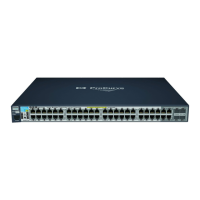
| Model | ProCurve 2910al-24G |
|---|---|
| Ports | 24 x 10/100/1000 |
| Switching Capacity | 128 Gbps |
| Forwarding Rate | 95.2 Mpps |
| Layer | Layer 3 |
| Jumbo Frame Support | Yes |
| Operating Temperature | 0°C to 45°C |
| Power Supply | Internal |
| Stacking | Yes |
| Routing Protocol | Static |
| Remote Management Protocol | SNMP, HTTP, HTTPS, SSH |
| Features | VLAN support, QoS, IPv6 support, Access Control Lists |
| Compliant Standards | IEEE 802.3, IEEE 802.3u, IEEE 802.3ab, IEEE 802.3z |
| Power | 100-240 VAC, 50/60 Hz |
| Operating Humidity | 15% to 90% non-condensing |
| Uplink Ports | 4 |

 To Next Page