PROLYTE PRODUCTS GROUP © 2001
Prolyte has made every effort to ensure the accuracy of this manual, no liability will be accepted for errors. Prolyte reserves the right to change or alter
their products or manuals without prior notice. No part of this manual may be reproduced in any form or by any means without prior written permission.
PROLYTE PRODUCTS GROUP - phone +31 (0)594 85 15 15 - fax +31 (0)594 85 15 16 - www.prolyte.com
pages 9 of 12
Performance in aluminium
Manual-MPT Tower
8. Additional assembly requirements for a stand alone tower
1. Always use four (4) long outriggers (MPT–012).
2. Attach a span of at least 7 meters of H30V or H40V at one side of the sleeve block.
3. Lay the mast on top of this span before erecting. The horizontal span prevents the mast from
falling over during erection.
4. Never exceed 7 meters of height, due to stability requirements. For outdoor applications ballast
and/or guy wires might be needed. Contact your local dealer or Prolyte.
5. The loading must be equally divided on the cantilever truss at either side of the sleeve block.
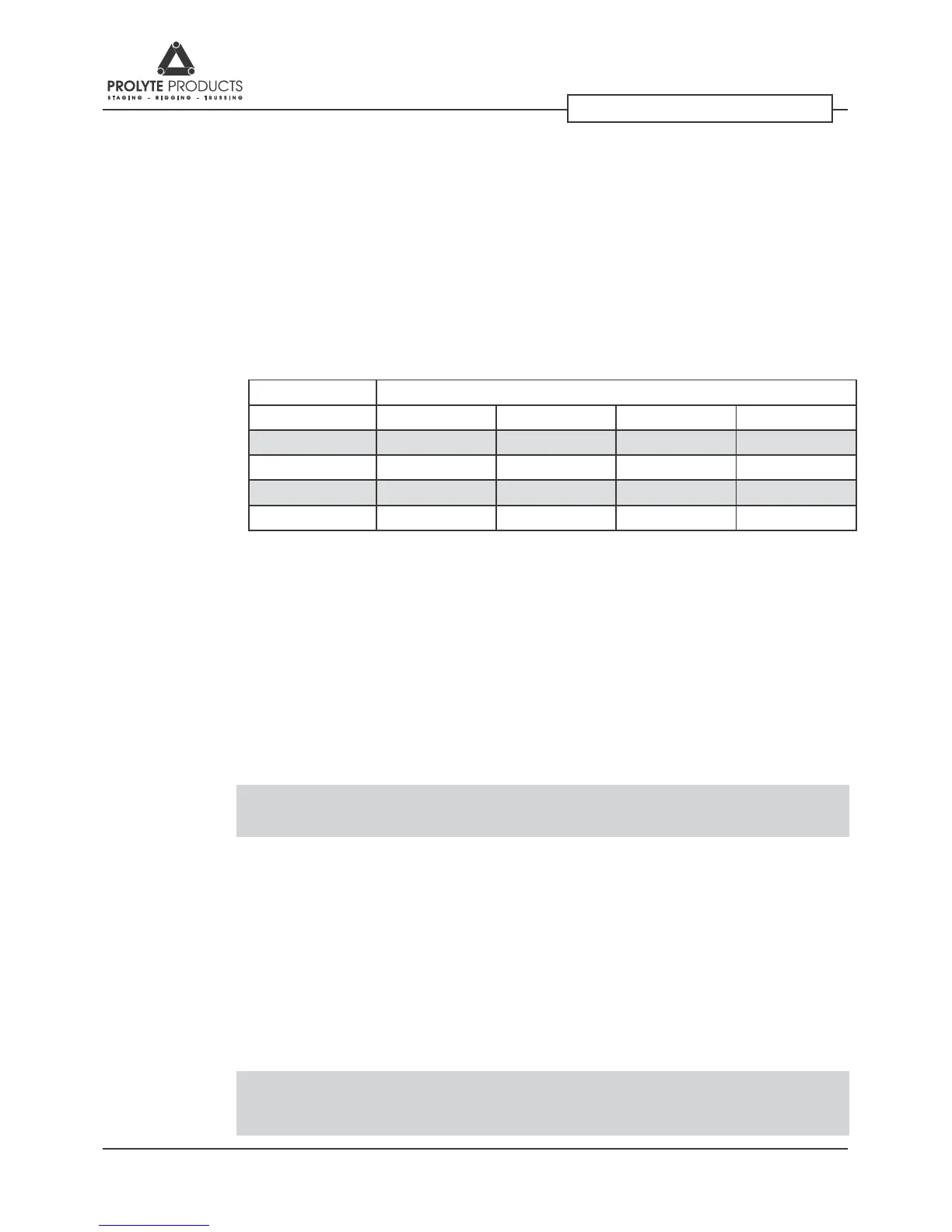
The table below shows the maximum point load at the end of the cantilever.
Type of truss length of cantilever
L =200 cm L =150 cm L =100 cm L = 50 cm
H40V / X40V 100 kg 130 kg 200 kg 400 kg
H40D / X40D 40 kg 50 kg 80 kg 160 kg
H30V / X30V 100 kg 130 kg 200 kg 400 kg
H30D / X30D 30 kg 40 kg 65 kg 130 kg
9. Additional assembly requirements for a Goal post set up
A goal post is a set up of two towers with an interconnecting truss span.
1. Always use four long outriggers (MPT–012) per tower.
2. Attach a span between the two sleeve blocks.
3. Place each mast on top of this span before erecting. The horizontal span prevents the tower from
falling over during erection.
4. Never exceed 7 meters of height, due to stability requirements. For outdoor applications ballast
and/or guy wires might be needed. Contact your local dealer or Prolyte.
5. The loading must be equally divided on the cantilever truss at either side of the sleeve block.
The table above shows the maximum point load at the end of the cantilever.
WARNING
Do not use the towers or this system outdoors, without adequate safety and stability measures.
10. Additional requirements for outdoor use
Outdoor use of towers or ground support systems is always under risk of deterioration of weather
conditions. Each of these inuences (wind, rain, snow etc) or a combination of them can generate
extra loading on the structure.
Wind generates a lot of extra vertical and/or horizontal force onto a structure even when it
is a permeable frame like truss. Trusses are calculated as a 50% permeable surface.
Equipment like lighting xtures is catching wind as well.
Appropriate measures have to be taken to prevent structures from falling/tipping over or
being blown away. For most outdoor applications an additional structural report is needed.
Always anticipate all the actions needed.
NOTE
None of the Prolyte structures or components is calculated based on snow or ice loading.
In case this might occur snow or ice has to be removed or the structure has to be dismantled.



 To Next Page