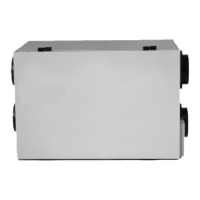
This manual describes the Protech™ HRV / ERV Ventilation Systems, specifically models 84-HRV100, 84-HRV200, 84-ERV100, and 84-ERV200. These units are designed to provide fresh, warmed outdoor air to a home while exhausting stale, humid air, thereby maintaining optimum air quality and ideal relative humidity by eliminating accumulated pollutants and humidity. The system can operate as part of a forced air system or independently.
Function Description:
The core function of these ventilation systems is air exchange and recovery.
- HRV (Heat Recovery Ventilator) models (84-HRV100, 84-HRV200): These units are equipped with a polypropylene heat recovery core. They are specifically designed to control excess humidity and reduce ventilation costs by recovering heat energy from exhausted air and using it to warm the fresh incoming air. The stale air is never mixed with the fresh air. In winter, for example, stale air at 22°C/72°F from the building might be exhausted at 4°C/40°F, while fresh air from outside at 0°C/32°F is supplied to the building at 18°C/64°F, thanks to heat recovery.
- ERV (Energy Recovery Ventilator) models (84-ERV100, 84-ERV200): These units feature an enthalpic (heat and humidity) recovery core, which helps reduce ventilation costs in both winter and summer.
- During the heating season: The unit draws humidity and heat from stale air and transfers them to the cold incoming air, preventing dryness and enhancing comfort. To preserve the enthalpic core's structure, the unit will only exchange air for 20 minutes per hour when temperatures drop below -15°C (5°F). For instance, stale air from the building at 22°C/72°F might be exhausted at 4°C/40°F, while fresh outside air at 0°C/32°F is supplied to the building at 18°C/64°F.
- During the cooling season: The process reverses, preventing outside humidity from entering the house. For example, stale air from the building at 25°C/77°F might be exhausted at 30°C/86°F, while fresh outside air at 32°C/90°F is supplied to the building at 27°C/80°F.
Defrosting:
When outside temperatures fall below 0°C (32°F), frost can form in the recovery core. To maintain proper operation, the unit is programmed to defrost the core. Defrosting cycles last 6 minutes, during which the unit shifts to maximum speed and the dampers close. The frequency of defrosting varies with the outside temperature. After defrosting, the unit reverts to the user-selected operating mode.
Important Technical Specifications:
| Model 84 |
HRV100 / ERV100 |
HRV200 / ERV200 |
| Width |
30 1/4" (768 mm) |
30 1/4" (768 mm) |
| Height |
20" (508 mm) |
20" (508 mm) |
| Depth |
13 3/4" (349 mm) |
19" (483 mm) |
| Weight |
65 lbs (30 kg) |
73 lbs (33 kg) |
| Electrical Supply |
120 V, 60 Hz |
120 V, 60 Hz |
| Power Consumption |
150 Watts |
225 Watts |
Usage Features:
The units offer different control options:
- ECONOMY Main Control: Located in the busiest area of the house, this control adjusts air supply and reduces window condensation.
- Air Supply Control: A switch (A) allows selection of "MIN." or "MAX." speed.
- In "MIN." speed, if knob B (Condensation Control) is set above the click, the unit exchanges air at low speed. If set below the click, it exchanges at high speed until the desired humidity is reached.
- In "MAX." speed, the unit exchanges air at high speed regardless of knob B's setting.
- Turning Off: Selector A can be set to "OFF." Optional controls may remain active.
- Condensation Control (Knob B):
- Summer: Set to "SUMMER" position as condensation is typically not an issue.
- Fall, Winter, Spring: Determine home humidity by turning knob B counterclockwise to -20°C, then slowly clockwise until a "click" is heard. Set knob B one notch below this temperature or "click." Avoid settings below -20°C to prevent excessive dryness. When humidity is high, the unit automatically operates at maximum speed; manual changes to knob B will take effect once humidity is reduced. Condensation may still occur during drastic temperature changes; allow a few days for stabilization.
- VALUE Main Control: Also located in the busiest area of the house, this control offers similar functionality with additional indicators.
- Air Supply Control (Push Button A): Press until "MIN.", "MAX.", or "INTERMITTENT" light indicator appears.
- "MIN." and "MAX." speeds function similarly to the ECONOMY control, influenced by knob B.
- "INTERMITTENT" mode (20 minutes minimum speed exchange every hour) is suitable for when away from home or when indoor air is too dry.
- Turning Off: Press button A until all light indicators ("MIN.", "MAX.", "INTERMITTENT") are off. Optional controls may remain active (indicator C will light up if an optional control is active).
- Condensation Control (Knob B):
- Summer: Set to "SUMMER."
- Fall, Winter, Spring: Maintain humidity within the "Comfort Zone" (dark area around knob B, between 5°C and -20°C). To reduce humidity, turn knob B clockwise a notch below the click. The unit will switch to high speed, and the humidity light (D indicator) will illuminate. Repeat if excess humidity persists after the light turns off. If air is too dry, set knob B back to the "Comfort Zone" or use "INTERMITTENT" mode, or turn off the unit. If the humidity light (D) is ON, mode changes will only take effect after it turns OFF.
- Light Indicators (VALUE Main Control):
- Humidity Light (D): Lights up when excess humidity is detected, forcing high-speed operation. Turns off when humidity drops to the selected level.
- Air Exchange Light (C): Lights up when the system is operating (exhausting stale air, drawing in fresh air).
- Intermittent Mode Light: Lights up when intermittent mode is selected. Flashes when maintenance is required (see Section 3).
- Defrosting Cycle Light: Flashes when the defrosting cycle is malfunctioning (see Section 3).
- Optional Wall Control (20/40/60-min. Push-Button Timer): Located in bathrooms or other areas with temporary excess humidity or pollutants.
- Activation: Push the button once for 20 minutes, twice for 40 minutes, or three times for 60 minutes of activation.
- Results: Motor speed goes to high for the selected duration. The indicator light turns ON and flashes every 5 seconds (once for 20 min, twice for 40 min, thrice for 60 min). The air exchange indicator light (on VALUE wall control) turns ON.
- Deactivation: Push the button one more time to stop activation.
Maintenance Features:
Regular maintenance is crucial for optimal performance and should be performed every three months, with annual maintenance in the fall. Always disconnect power before maintenance.
- Every Three Months:
- Disconnect power supply.
- Unlatch and open the door (lift panel, hit right side, slide left).
- Clean the inside of the door with a damp cloth.
- Clean Filters: Remove filters, vacuum dust, then wash with warm water and mild soap (bleach can be added for disinfection, 1 tbsp per gallon). Rinse thoroughly, shake off excess water, and let dry. Filters can be washed in the top tray of a dishwasher, but the aluminum frame may tarnish.
- Clean the condensation tray with a damp cloth.
- Check Exterior Air Intake Hood: Ensure it's free of leaves, twigs, ice, or snow. Clean if necessary. A partial blockage can cause malfunction.
- Reassemble components: filters, then door (secure until a click is heard).
- Reconnect power supply.
- Annual Maintenance (Fall):
Repeat steps 1-6 from the "Every Three Months" procedure, then continue:
- Clean the Recovery Core: Handle with care.
- Polypropylene core (HRV100/HRV200): Remove, soak in cold or lukewarm water with mild soap (dishwashing liquid), rinse thoroughly, shake off excess water, and let dry.
- Enthalpic paper core (ERV100/ERV200): This type cannot be washed with water. Remove and clean dust using a vacuum cleaner with a soft brush attachment.
- Clean the Centrifugal Fan Wheels:
- Remove the wing nut.
- Disconnect the fan motor wires.
- Remove the fan assembly.
- Check for dust accumulation on the blades.
- Clean with a small brush if necessary. Do not oil the motor; it is permanently lubricated.
- Reassemble: Fan assembly (connect wires, secure wing nut), recovery core, filters, door.
- Reconnect power supply.
Troubleshooting:
The manual provides a troubleshooting guide for common issues:
- Nothing works: Check if plugged in, check circuit breaker/fuse.
- All light indicators on wall control flashing (every 8 seconds): Unplug, wait 30 seconds, reconnect. If problem persists, contact installer.
- Noisy unit: Clean fan assembly (see Section 3.2). If problem persists, contact installer.
- Condensation on windows (Air too humid): Adjust humidity control knob (Section 2), operate at maximum speed during high-humidity activities, leave curtains half-open for air circulation, store firewood in a well-ventilated room or outside, maintain house temperature above 18°C (64°F).
- Air too dry: Do not adjust humidity control below -20°C (-4°F), operate at low speed (MIN.), temporarily switch to intermittent mode, temporarily use a humidifier.
- Air too cold at air supply grille: Ensure outside hoods are not blocked, operate at low speed (MIN.), have system balancing checked, have defrost system checked, install a duct heater.
If problems persist, contact the installer or local distributor.


 To Next Page

 General