10
QM7430 - User Manual
13.Notes
•How it Works
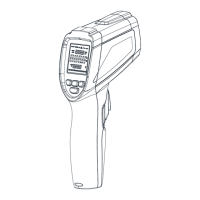
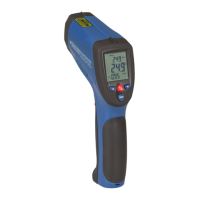
Infrared thermometers measure the surface temperature of an object. The unit’s
optics sense emitted, reflected, and transmitted energy, which is collected and
focused onto a detector. The unit’s electronics translate the information into a
temperature reading, which is display on the unit. In units with a laser, the laser
is used for aiming purposes only.
•Field of View
Make sure that the target is larger than the unit’s spot size. The smaller the target,
the closer you should be to it. When accuracy is critical, make sure the target is at
least twice as large as the spot size.
•Distance & Spot Size
As the distance (D) from the object increases, the spot size (S) of the area measured
by the unit becomes larger.
•Locating a hot Spot
To find a hot spot aim the thermometer outside the area of interest, then scan across
with an up and down motion until you locate hot spot.
•Reminders
Not recommended for use in measuring shiny or polished metal surfaces ( stainless
steel, aluminum, etc.).See Emissivity
The unit cannot measure through transparent surfaces such as glass. It will measure
the surface temperature of the glass instead.
Steam, dust, smoke, etc., Can prevent accurate measurement by obstructing the
unit’s optics.
•Emissivity
Emissivity is a term used to describe the energy-emitting characteristics of materials.
Most (90% of typical applications) organic materials and painted or
oxidized surfaces
have an emissivity of 0.95 (pre-set in the unit). Inaccurate readings will result from
measuring shiny or polished metal surfaces. To compensate, cove the surface to be
measured with masking tape or flat black paint. Allow time for the tape to reach
the same temperature as the material underneath it. Measure the temperature of
the tape or painted surface.


 To Next Page