Need help?
Do you have a question about the Proteus EEC-1800 and is the answer not in the manual?
Attach stabilizer foot caps to the front and rear stabilizer ends.
Connect cables and attach handlebar post for EEC-1800 model.
Connect monitor cables for EEC-1850 model.
Install axle spacer, wave washer, pivot caps, and handrails using bolts.
Connect arm, adjust pedal arm height, and secure with knob.
Assemble and attach the tension control unit and cable to the handlebar post.
Connect extension and grip pulse wires to the computer for EEC-1800.
Connect monitor and grip pulse wires to the computer for EEC-1850.
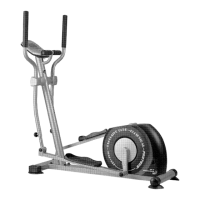
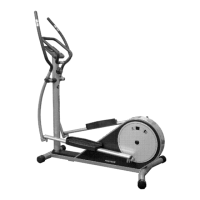
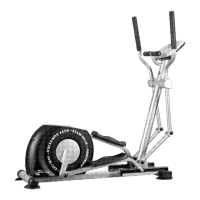
This document is an owner's manual for a Proteus Programmable Elliptical machine, specifically models EEC-1800 and EEC-1850. The manual provides detailed assembly instructions, which implicitly describe the device's components and how they function together.
The Proteus Programmable Elliptical is a fitness innovation designed for cardiovascular exercise, offering a full-body workout with low impact on joints. Its programmable nature suggests a range of workout options and intensity levels, catering to various fitness goals and user preferences. The elliptical motion simulates walking, running, or stair climbing without the jarring impact, making it suitable for users of different fitness levels, including those with joint sensitivities or recovering from injuries.
The core function of this elliptical trainer is to provide a comprehensive cardiovascular workout. Users stand on two foot pedals and grip two handlebars, moving their legs and arms in a synchronized, elliptical motion. This engages major muscle groups in both the upper and lower body, including the quadriceps, hamstrings, glutes, calves, chest, back, shoulders, and arms.
The "programmable" aspect indicates that the machine likely features a console with pre-set workout programs, allowing users to select routines that vary in resistance and duration. These programs can simulate different terrains or training styles, such as interval training, hill climbs, or fat-burning sessions. Users can typically adjust the resistance level manually during a workout to increase or decrease the intensity, simulating uphill or downhill strides.
The elliptical's design emphasizes a smooth and continuous motion, which is crucial for effective and comfortable exercise. The flywheel and drive system, though not explicitly detailed in the provided pages, are fundamental to this smooth operation, providing inertia and consistent resistance. The tension control mechanism, as described in the assembly steps, allows users to modify the workout intensity. For the EEC-1800 model, a mechanical tension control cable (46) is used, which connects to a tension control unit (45) on the handlebar post. This suggests a manual adjustment of resistance, likely through a knob that tightens or loosens the cable, thereby affecting the resistance applied to the flywheel. In contrast, the EEC-1850 model uses a "monitor cable (A)" (43) and "monitor cable (B)" (44), implying an electronic resistance control system, likely managed through the computer console (07). This electronic control allows for more precise and automated resistance changes, especially within programmable workouts.
The inclusion of "grip pulse wire" (10) on both models indicates that the handlebars are equipped with pulse sensors. These sensors allow the machine to monitor the user's heart rate during exercise, providing valuable feedback for optimizing workouts within target heart rate zones. This feature is particularly useful for cardiovascular training, allowing users to maintain an effective intensity level for their fitness goals, whether it's fat burning, endurance building, or peak performance.
The computer console (07) serves as the central interface for the user. While its full capabilities are not detailed, it typically displays key workout metrics such as time, distance, speed, calories burned, and heart rate. For programmable models, it also allows users to select and customize workout programs, track progress, and potentially store user profiles. The console's ability to connect to various cables (tension control, monitor, grip pulse) highlights its role in integrating all functional aspects of the machine.
The structural components, such as the main frame (01), handlebar post (02), handrails (3L, 3R), connecting arms (04), and pedal arms (05), are designed to provide stability and support during vigorous exercise. The front and rear stabilizers, with their respective foot caps (21, 23) and foot adjust base (22), ensure the machine remains level and stable on various floor surfaces, preventing wobbling or tipping during use.
The assembly instructions reveal several features that enhance the usability and adaptability of the elliptical.
The detailed, step-by-step assembly instructions, complete with figures (FIG. A through J), are a key usage feature in themselves. They aim to make the initial setup straightforward for the end-user. The use of common hardware like M8 carriage bolts, washers, and nylon nuts suggests a robust and secure construction.
The distinction between EEC-1800 and EEC-1850 models regarding tension control and cable connections highlights different levels of sophistication.
While the provided pages primarily focus on assembly, some aspects hint at maintenance considerations:
The use of durable materials and secure fastening methods (M8 bolts, washers, nylon nuts) throughout the assembly process suggests a design intended for longevity and minimal maintenance. Components like axle spacers (13) and wave washers (49) are used to ensure smooth movement and reduce wear on pivot points, which are critical for the machine's performance and lifespan.
The assembly process itself demonstrates that key components, such as cables (extension cable wire, lower cable wire, tension cable, monitor cables, grip pulse wire), are routed and connected in a way that might allow for relatively straightforward access if replacement or servicing is needed. For instance, the tension cable (46) is inserted "inside of handlebar post (02)," and the monitor cables are connected at specific points, implying a design where these parts can be accessed.
The adjustable foot adjust base (22) and pedal arm height (24) are not only usage features but also maintenance-related, as they allow users to keep the machine in optimal working condition by ensuring it is level and ergonomically suited to the user. Proper leveling reduces strain on the machine's moving parts and prevents premature wear.
For the EEC-1850 with its electronic tension control, the computer console (07) might also serve as a basic diagnostic tool, potentially displaying error codes or indicators if there are issues with the electronic resistance system or sensor connections.
Although not explicitly stated in these assembly instructions, typical elliptical maintenance would involve:
In summary, the Proteus Programmable Elliptical (EEC-1800/1850) is a well-designed fitness machine focused on providing an effective and comfortable full-body workout. Its programmable features, adjustable components, and heart rate monitoring capabilities cater to diverse user needs and fitness goals. The detailed assembly instructions highlight a robust construction and user-friendly setup, with implicit considerations for long-term usability and maintenance.
 General
| Resistance Levels | 16 |
|---|---|
| Stride Length | 18 inches |
| Display Type | LCD |
| Resistance Type | Magnetic |
| Maximum User Weight | 300 lbs |
| Programs | 12 |
| Display Functions | Time, speed, distance, calories, pulse |
| Warranty | 1 year |

 To Next Page