GROUNDED TOOLS: TOOLS WITH
THREE PRONG PLUGS
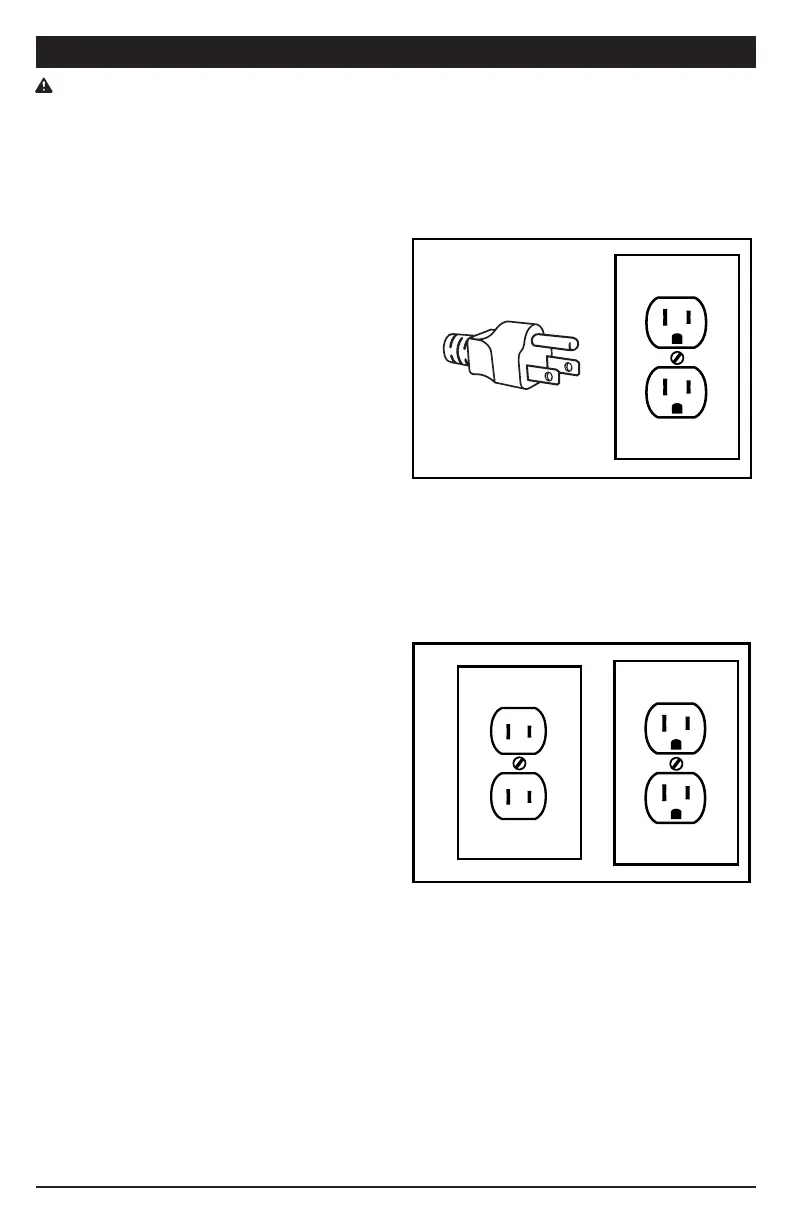
1. Tools marked with “Grounding Required”
have a three wire cord and three prong
grounding plug. The plug must be con-
nected to a properly grounded outlet. If
the tool should electrically malfunction or
break down, grounding provides a low
resistance path to carry electricity away
from the user, reducing the risk of electric
shock. (See Figure A.)
2. The grounding prong in the plug is con-
nected through the green wire inside the
cord to the grounding system in the
tool.The green wire in the cord must
be the only wire connected to the tool’s
grounding system and must never be
attached to an electrically “live” terminal.
(See Figure A.)
DOUBLE INSULATED TOOLS: TOO
WITH TWO PRONG PLUGS
1. Tools marked “Double Insulated” do not
require grounding. They have a special
double insulation system which satisfies
OSHA requirements and complies with
the applicable standards of Underwrit-
ers Laboratories, Inc., the Canadian
Standard Association, and the National
Electrical Code. (See Figure B.)
2. Double insulated tools may be used in
either of the 120 volt outlets shown in the
following illustration. (See Figure B.)
3. This appliance has a polarized plug (one
blade is wider than the other). To reduce
the risk of electric shock, this plug is
intended to fit into a polarized outlet only
one way.
6
Figure A
Figure B
WARNING: TO PREVENT ELECTRIC SHOCK AND DEATH FROM INCORRECT
GROUNDING WIRE CONNECTION.
Check with a qualified electrician if you are in doubt as to whether the outlet is properly
grounded. Do not modify the power cord plug provided with the tool. Never remove the
grounding prong from the plug. Do not use the tool if the power cord or plug is
damaged. If damaged, have it repaired by a service facility before use. If the plug will
not fit the outlet, have a proper outlet installed by qualified electrician.
GROUNDING
3. Your tool must be plugged into an ap-
propriate outlet, properly installed and
grounded in accordance with all codes
and ordinances. The plug and outlet
should look like those in the following
illustration. (See Figure A)
If the plug does not fit fully into the
outlet, reverse the plug. If it still does not
fit, contact qualified electrician. Do not to
modify the plug in any way.



 To Next Page