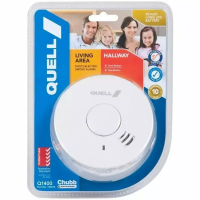
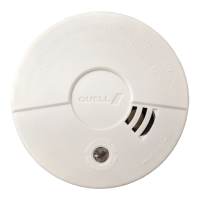
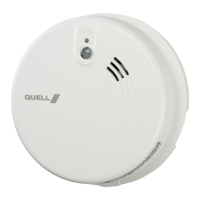
This document is a user manual for the Quell Model Q910 Ionisation Sealed Smoke Alarm. It provides comprehensive information regarding the alarm's function, installation, operation, maintenance, and safety guidelines.
Function Description:
The Quell Model Q910 is an ionisation smoke alarm designed to detect invisible particles associated with fast flaming fires. It features a permanently sealed 10-year lithium battery, eliminating the need for battery replacement throughout the alarm's lifespan. The alarm is equipped with a HUSH™ control feature, which allows for temporary desensitisation of the alarm circuit for approximately 8 minutes in cases of nuisance alarms (e.g., smoke from cooking). This feature helps prevent unnecessary evacuations while still providing protection. The alarm also includes an "alarm memory" feature, indicated by a rapid red LED flash when the test button is pressed, to inform users if the alarm has sounded since the last test. The unit is designed for easy installation on ceilings or walls, with specific guidelines to ensure optimal placement and performance. It automatically activates upon mounting to the bracket for the first time.
Important Technical Specifications:
- Alarm Type: Ionisation smoke alarm.
- Battery: Permanently sealed 10-year lithium battery. No battery installation or replacement is required.
- Alarm Sound Level: Loud 85 dB pulsating alarm.
- HUSH™ Control Duration: Approximately 8 minutes of temporary desensitisation.
- LED Indicator Modes:
- Flashing every 40-45 seconds: Normal operation, receiving power.
- Flashing (1.5 seconds on - 1.5 seconds off): Alarm condition (smoke detected).
- Flashing slowly (1.5 seconds on - 8 seconds off): Hush mode activated.
- Rapid flashing when test button pressed: Alarm memory (alarm has sounded since last test).
- Operating Temperature Range: 5°C to 45°C.
- Relative Humidity (RH) Range: Less than 85%.
- Radioactive Material: Americium 241, 1.0 microcuries.
- Compliance: Australian Standard AS 3786 Lic 1377 SAI Global.
Usage Features:
- Installation:
- Recommended Locations:
- Immediate area of bedrooms, protecting the exit path.
- Stairways (act as chimneys for smoke and heat).
- Every floor level.
- Every bedroom where a smoker sleeps.
- Every room with large electrical appliances (portable heaters, humidifiers).
- Every room where someone sleeps with the door closed.
- Ceiling mounting (centre of room) is preferred in ordinary residential construction.
- Mobile homes: Carefully select locations to avoid thermal barriers; install on an inside wall if insulation is poor or outer walls/ceiling are hot/cold.
- Sloped, peaked, or cathedral ceilings: Between 500mm and 1500mm from the highest point; on the high side of the room if slope is greater than 1m in 8m horizontally.
- Ceiling mounting: Minimum 30cm (12") from side wall, 61cm (2 feet) from any inside corner.
- Wall mounting: Top edge minimum 10cm (4") and maximum 30cm (12") below ceiling, 61cm (2 feet) from any inside corner.
- Both ends of a bedroom hallway or large room if over 9.1m (30 feet) long.
- Locations to Avoid:
- Within 0.9m (3 ft) of kitchen/bathroom doors (with tub/shower), forced air supply ducts, ventilating fans, or high air-flow areas.
- Where curtains or objects block the sensor.
- Within 30cm (12 in) of fluorescent lights (electronic noise).
- Insect infested, dusty, dirty, or greasy areas.
- Temperatures colder than 5°C or hotter than 45°C (garages, unfinished attics).
- Relative humidity greater than 85% (humid areas, steam).
- Kitchen areas (normal cooking may cause nuisance alarms); if desired, use an alarm with silencer or photoelectric type.
- Garages (combustion particles from automobiles).
- With detector guards unless evaluated for suitability.
- Dead air spaces (e.g., peak of "A" frame ceiling) where smoke may not reach the alarm in time.
- Activation: Automatically activates when mounted to the mounting bracket for the first time. Rotate clockwise until it ratchets into place.
- Testing: Weekly testing is required. Press and hold the test button for a minimum of 5 seconds (or until the alarm sounds). Stand an arm's length away due to loudness (85 decibels).
- HUSH™ Control: Press the HUSH® button on the cover to temporarily silence nuisance alarms for 8 minutes. Dense smoke will override this feature.
- Tamper Resist Feature: Break out 4 tamper-resist blocks on the mounting plate to deter removal. To remove the alarm when engaged, press down on the tamper resist tab and rotate anti-clockwise.
- Low Battery Indication: The alarm will "chirp" approximately every 40-45 seconds for a minimum of 30 days at the end of its life, indicating replacement is needed.
- Deactivation: To deactivate for disposal, remove from mounting bracket, locate the crosshatched area on the product label, break it out with a screwdriver, and slide the exposed piece towards the centre of the alarm. This drains the batteries and renders the alarm safe for disposal. WARNING: Once deactivated, it cannot be reactivated or mounted.
Maintenance Features:
- Cleaning:
- Vacuum the alarm once a month.
- Remove the alarm from its mounting bracket.
- Clean the interior (sensing chamber) using compressed air or a vacuum cleaner hose through the perimeter openings.
- Wipe the outside with a damp cloth.
- After cleaning, reinstall and test the alarm.
- DO NOT paint the unit. Paint will seal vents and interfere with smoke detection.
- DO NOT attempt to disassemble or clean inside the unit. This voids the warranty.
- Alarm Removal: Refer to the Tamper Resist Feature section for instructions. Rotate the alarm anti-clockwise in the direction of the "OFF" arrow on the cover to remove it from the mounting plate.
- Battery: The sealed 10-year lithium battery requires no maintenance or replacement.
Fire Safety Guidelines:
- Install both ionisation and photoelectric alarms for maximum protection against fast flaming and slow smouldering fires.
- Smoke alarms have limitations; they may not detect fires in chimneys, walls, roofs, behind closed doors, or on different floors.
- Alarms outside bedrooms or on different floors may not wake sound sleepers.
- Alcohol or drugs can impair the ability to hear the alarm.
- Smoke alarms are not a substitute for insurance.
- Develop and practice a fire escape plan, including:
- Installing fire extinguishers on every level.
- Creating a floor plan with two escape routes per room.
- Discussing the plan with family.
- Designating an outside meeting place.
- Familiarising everyone with the alarm sound and training them to evacuate.
- Practicing fire drills at least every six months, including at night.
- What to do when the alarm sounds:
- Alert small children.
- Evacuate immediately via your escape plan.
- Before opening inside doors, feel their surface; if hot or smoky, use an alternate exit.
- Stay low to the floor in smoky conditions, breathing through a cloth.
- Meet at the designated outside meeting place.
- Call the Fire Brigade (000 in Australia) from a neighbour's home.
- Do not re-enter the home until fire officials declare it safe.
- Smoke alarms may not be effective in situations like smoking in bed, leaving children home alone, or cleaning with flammable liquids.
- Manufacturer: Chubb Fire & Security Pty Ltd (Australia) / Chubb New Zealand Limited (New Zealand).
- Warranty: Ten-year limited warranty covering defects in materials and workmanship under normal use.
- Contact (Australia): Telephone 1800 654 435, Website www.quell.com.au.
- Contact (New Zealand): Telephone 09 270 7288, Website www.quell.co.nz.
- Disposal: For small numbers of smoke alarms, the preferred method of disposal is to include them in domestic rubbish after deactivation.

 Need help?
 General

 To Next Page