EasyManua.ls Logo

Rabbit 2000 - Page 17

Rabbit 2000
45 pages
Print Icon
To Next Page IconTo Next Page
To Previous Page IconTo Previous Page
Loading...
Designer’s
Handbook 13
to
flash
memory.
It
may
be
mapped
to
RAM
for
debugging,
or
if
it
is
decided
to
copy
code
to
RAM
to
take
advantage
of
faster
access
time
offered
by
RAM.
The
root
segment
holds
a
mixture
of
code
and
constants.
C
functions
or
assembly
language
programs
that
are
com-
piled
to
the
root
segment
are
interspersed
with
data
constants.
Data
constants
are
inserted
between
blocks
of
code.
Data
constants
defined
inside
a
C
function
are
emitted
after
the
end
of
the
code
belonging
to
the
function.
Data
constants
defined
outside
of
C
functions
are
emitted
as
encountered
in
the
source
code.
Except
in
small
programs,
the
bulk
of
the
code
is
executed
using
the
extended
memory
window.
But
the
root
segment
has
special
properties
that
make
it
better
for
some
types
of
code.
The
types
of
subroutines
and
functions
that
are
best
placed
in
the
root
segment
are
as
follows.
1. Short
subroutines
of
about
20
instructions
or
less
that
are
frequently
called
will
use
sig-
nificantly
less
execution
time
if
placed
in
the
root
because
of
the
faster
calling
linkage
for
16-bit
versus
20-bit
addresses.
A
call
and
return
using
16-bit
addressing
requires
20
clocks,
compared
to
32
clocks
for
20-bit
addressing.
2. Interrupt
routines.
Interrupts
use
16-bit
addressing
so
the
entry
to
an
interrupt
routine
must
be
in
root.
3. Functions
called
indirectly
using
traditional
C
pointers.
4. The
BIOS
core.
A
certain
part
of
the
BIOS
must
be
at
the
start
of
the
root
segment.
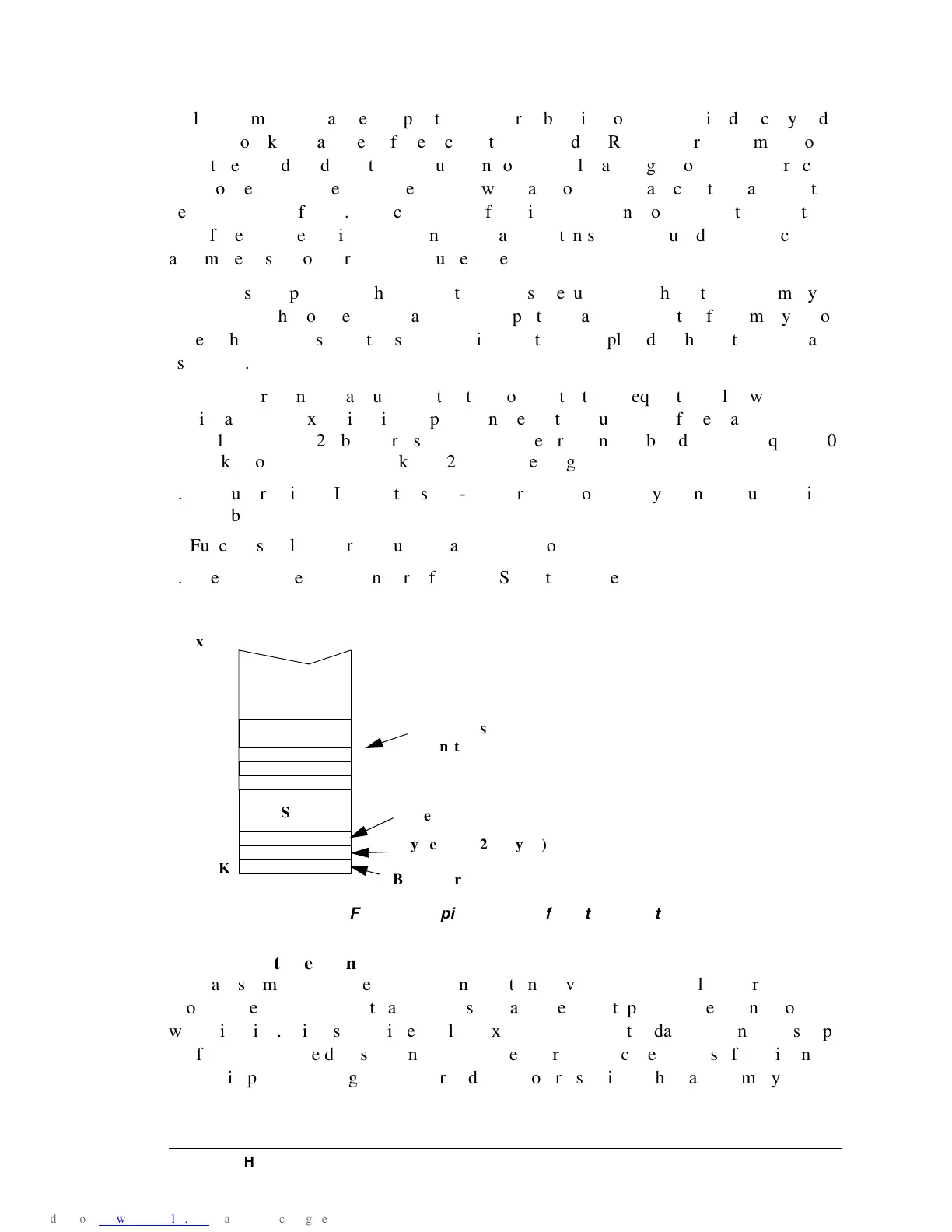
Figure
3.
Typical
Layout
of
Root
Segment
4.1.2
The
Data
Segment
The
data
segment
is
mapped
to
RAM
and
contains
C
variables.
Typically
it
starts
at
8K
or
above
and
ends
at
52K.
Data
allocation
starts
at
or
near
the
top
and
proceeds
in
a
down-
ward
direction.
It
is
also
possible
to
place
executable
code
in
the
data
segment
if
it
is
cop-
ied
from
flash
to
the
data
segment.
This
can
be
desirable
for
code
that
is
self
modifying,
code
to
implement
debugging
aids
or
code
that
controls
write
to
the
flash
memory
and
0K
System
Constants
BIOS
Start
System
ID
(256
bytes)
BIOS
Functions
Constant
defs
Max
48K

Other manuals for Rabbit 2000