EasyManua.ls Logo

Rabbit 2000 - 8 Low-Power Design and Support

Rabbit 2000
45 pages
Print Icon
To Next Page IconTo Next Page
To Previous Page IconTo Previous Page
Loading...
Rabbit
Version 341
8.
Low-Power
Design
and
Support
To
get
the
most
computation
for
a
given
power
level,
the
operating
voltage
should
be
approximately
3.3
V.
At
a
given
operating
voltage,
the
clock
speed
should
be
reduced
as
much
as
possible
to
obtain
the
minimum
power
consumption
that
is
acceptable.
Some
applications,
such
as
a
control
loop,
may
require
a
continuous
amount
of
computa-
tional
power.
Other
applications,
such
as
slow
data
logging
or
a
portable
test
instrument,
may
spend
long
periods
with
low
computational
requirements
interspersed
with
short
peri-
ods
of
high
computational
load.
The
current
(and
thus
power)
consumption
of
a
microprocessor-based
system
generally
consists
of
a
part
that
is
independent
of
frequency
and
a
part
that
depends
on
frequency.
The
part
that
is
independent
of
frequency
consists
of
leakage
or
current
or
current
drawn
by
special
circuits
such
as
pullup
resistors
or
circuits
that
continuously
draw
power.
Ordi-
nary
CMOS
logic
uses
power
when
it
is
switching
from
one
state
to
another,
and
this
is
the
power
that
is
dependent
on
frequency.
The
power
drawn
while
switching
is
used
to
charge
capacitance
or
is
used
when
both
N
and
P
FETs
are
simultaneously
on
for
a
brief
period
during
a
transition.
Floating
inputs
or
inputs
that
are
not
solidly
either
high
or
low
can
also
draw
current
because
both
N
and
P
FETs
are
turned
on
at
the
same
time.
To
avoid
excessive
power
con-
sumption,
floating
inputs
should
not
be
included
in
a
design
(except
that
some
inputs
may
float
briefly
during
power-on
sequencing).
Most
unused
inputs
on
the
Rabbit
can
be
made
into
outputs
by
proper
software
initialization
to
remove
the
floating
property.
Pullup
resis-
tors
will
be
needed
on
a
few
inputs
that
cannot
be
programmed
as
outputs.
An
alternative
to
a
pullup
resistor
is
to
tie
an
unused
output
to
the
unused
inputs.
If
pullup
(or
pulldown)
resistors
are
required,
they
should
be
made
as
large
as
possible
if
the
circuit
in
question
has
a
substantial
part
of
its
duty
cycle
with
current
flowing
through
the
resistor.
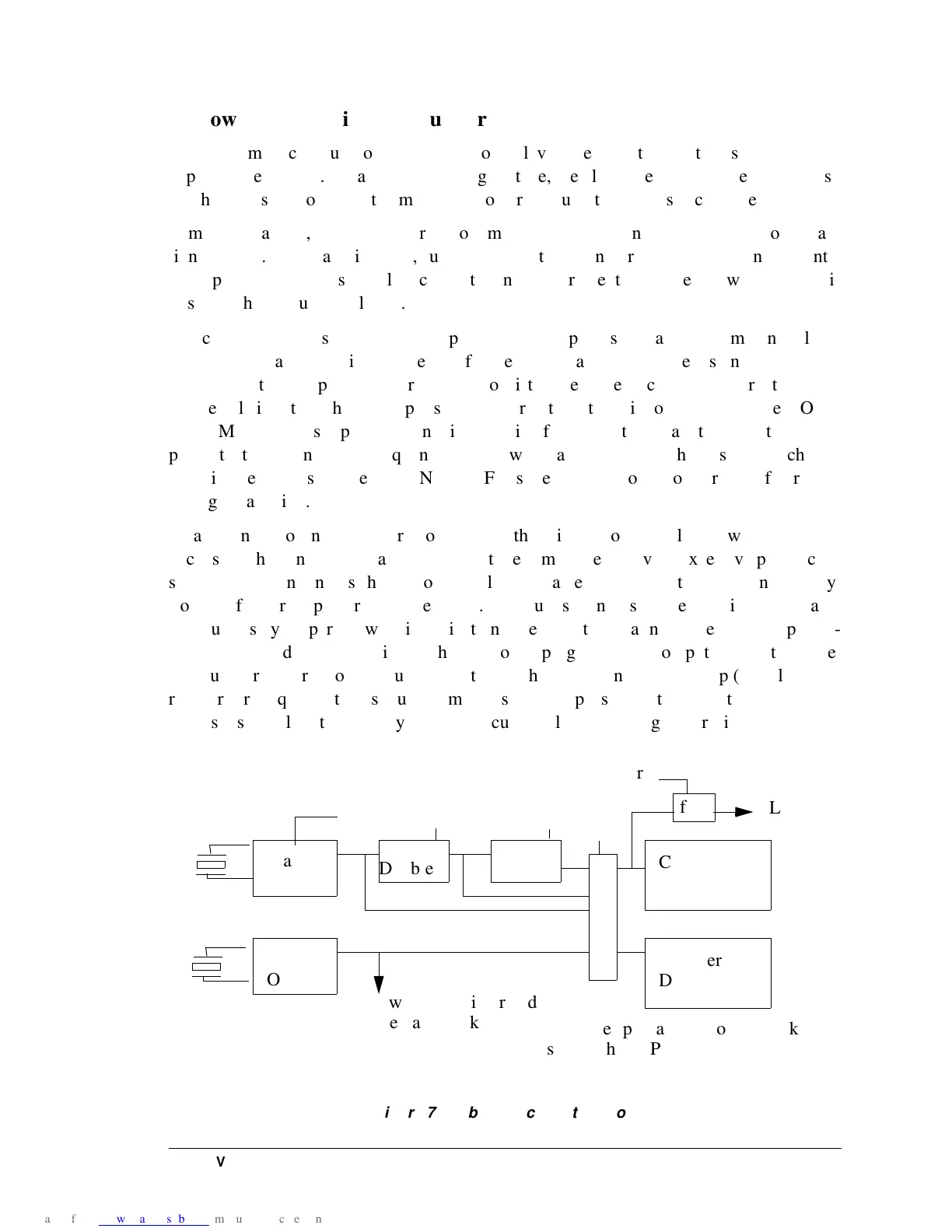
Figure
7.
Rabbit
Clock
Distribution
Main
Osc
32
kHz
Osc
CPU
Peripheral
Devices
Clock
Doubler
f/8
To
watchdog
timer
and
time/date
clock
Note:
Peripherals
cannot
be
clocked
slower
than
CPU.
disable
f/2
ext
pin
CLK
f
or
f/2

Other manuals for Rabbit 2000