True to the Music
JDX User Guide
Radial Engineering
4
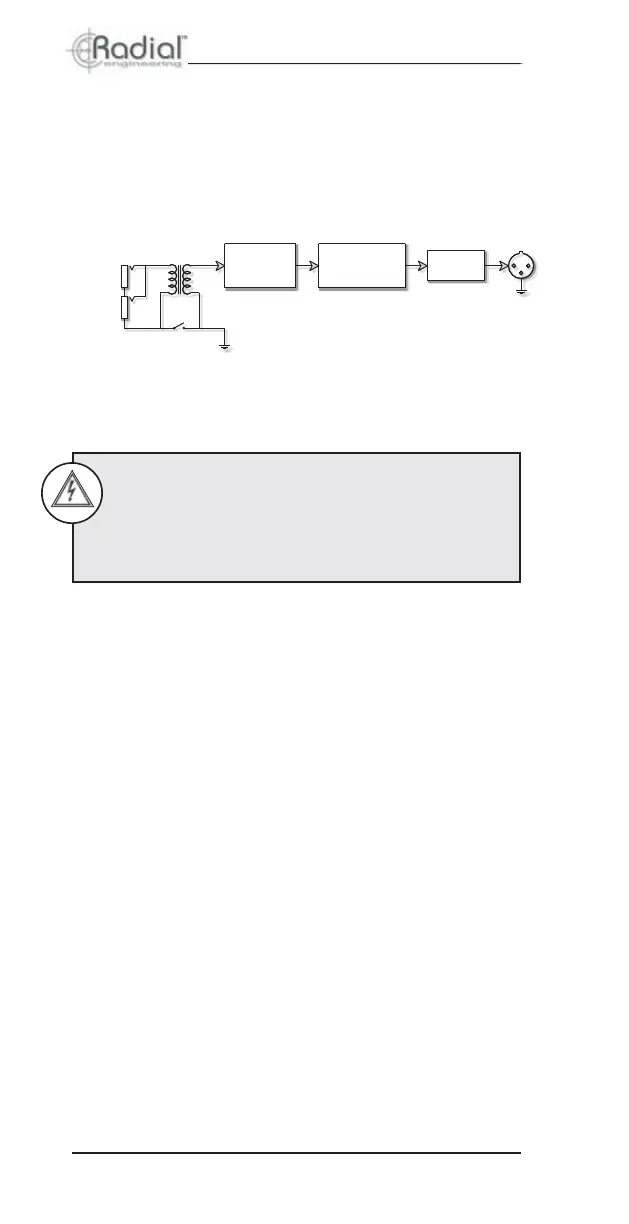
BLOCK DIAGRAM
To help you understand how the JDX works take a few moments
to trace the signal fl ow through the block diagram.
CAUTION, THE JDX IS NOT A LOAD BOX
Please read the saftey disclosure statement on the
inside cover of this manual before connecting or
operating the JDX.
FROM AMP
TO SPEAKER
ACTIVE
BANDPASS
FILTER
ACTIVE
BALANCED
DRIVER
POLARITY
REVERSE
BALANCED
XLR OUTPUT
TRANSFORMER
REACTIVE LOAD
GROUND
LIFT
Parallel Amplifi er Input and Speaker Thru-put
The FROM AMP input and TO SPEAKER thru-put jacks are
paralleled together and provides the means to patch the JDX
in-between the amp output and loudspeaker.
Transformer
The transformer is the front end of the JDX reactive circuit and
is used as a reactive load that responds into the various electri-
cal phenomena that dictate how a particular amplifi er and loud-
speaker sound together.
This is what makes the JDX unique when compared to the “load
box” approach. A load box simply burns off the excess energy
into heat and completely ignores the amp and loudspeaker in-
teraction. By capturing the reactive effect between the amp and
loudspeaker the JDX comes closer to the original tone than any
other interface system.
The transformer also pulls double duty by electrically isolating
the signal passing through it, effectively blocking noise caused by
ground loops. This is important because the JDX connects a guitar
amplifi er to a recording or PA system that may be powered from
a different AC main circuit. Without the transformer a ground loop
may form that can cause buzz and hum in sound systems.



 To Next Page