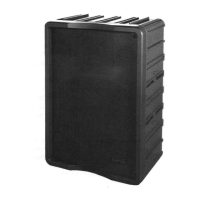
The WS-A550 is intended to be used as a modular
component in subwoofer arrays. Because of the WS-A550's
diminutive size, a large quantity of modules can be placed
in close proximity to one-another, and their outputs will sum
coherently at subwoofer frequencies. Fortunately, when
multiple WS-A550S are used in coherent subwoofer arrays, the
performance capabilities change dramatically (see 'Subwoofer
Arrays').
For small system planning purposes, the following
rule-of-thumb
guidelines should be observed:
• For wide-range sound reinforcement or playback
applications, the subwoofer system should be capable of
20 dB greater acoustic output than the average operating
levels of the main loudspeakers.
• Always use the WS-SP2A with WS-A550s. Without the
WS-SP2A,
the displacement limits of the WS-A550 will be
easily exceeded. Never operate the WS-A550 without the
WS-SP2A, or use another make of subwoofer processor.
• When used with a pair of
RAMSA
model WS-A500
loudspeaker systems, between 4 and 8 model WS-A550
subwoofer modules WS-A550 will be needed, depending
upon the very low frequency program content.
• When used with a pair of
RAMSA
model WS-A80
loudspeaker systems, between 2 and 4 model WS-A550
subwoofer modules will provide an appropriate balance,
depending upon the very low frequency program content.
• Carefully consider the mechanical displacement limits
of the WS-A550. In small arrays, the transducer
displacement limits will restrict the maximum acoustic
output well before reaching the thermal power capacity
of the array. Damage from diaphragm over-excursion is
likely to occur when an inadequate number of subwoofer
modules are provided for the application.
Source-induced Failure Precautions
Loudspeaker systems can be exposed to several potentially
hazardous non-program signals in professional use. Some
of these signals are outside of the audio frequency range,
and represent special conditions for which the power ratings
don't apply. Care should be taken to assure that loudspeaker
systems aren't subjected to these signals.
• Ultrasonic and RF oscillations — very high frequency
(inaudible) electrical energy at high power can rapidly heat
voice coils to the failure point. Because there is little or no
diaphragm movement with RF energy, there will be little or
no cooling air movement, and voice coils can be expected
to fail at less then rated (audio frequency) power.
• High-speed tape noise — Some analog audio tape
machines allow fast forward or rewind operations with
the tape in contact with the heads. This will result in
excessive high frequency energy when conducted at high
levels, which can be hazardous to transducers.
• Acoustic feedback — especially when sustained. When
unchecked,
acoustic feedback will grow in intensity until
the power amplifier(s) are fully clipped. This condition is
almost certain to result in transducer failures.
• Turn-on/turn-off transients — from low-level audio
equipment. Most low-level audio equipment (mixers,
equalizers, signal processing) have outputs that are
unprotected from internal turn-on /turn-off transients,
and can send several volts of switching noise (including
DC and RF) to the power
amplifiers^)
during switching.
Adopting a last-on, f irst-off policy for the power
amplifiers
will protect transducers from these signals.
• Connections and disconnections — should always be
performed with audio levels down to prevent shock noise
or (worse) electrical oscillations caused by ground loops
or ground interruptions.
• Poor house keeping — can create unforeseen hazards.
Keep equipment working areas free from cables and
power cords that may be tripped over and
accldently
disconnected.
-6-


 To Next Page
 Loading...