EasyManua.ls Logo

Ramsey Electronics 2000 - Techniques of Operation

Default Icon
12 pages
Print Icon
To Next Page IconTo Next Page
To Previous Page IconTo Previous Page
Loading...
Techniques
of
Operation
The
best
way
to
get
acquainted
with
how
your
winch
operates
is
to
make
a
few
test
runs
before
you
ac
tually
need
to
use
It.
Plan
your
test
In
advance.
Remember,
you
hear
your
winch
as
well
as
see
it
operate.
Get
to
recognize
the
sounds
of
a
light
steady
pull,
a
heavy
pull,
and
sounds
caused
by
load
jerking
or
shifting.
Soon
you
will
gain
confidence
in
operating
your
winch
and
its
use
will
become
second
nature
with
you.
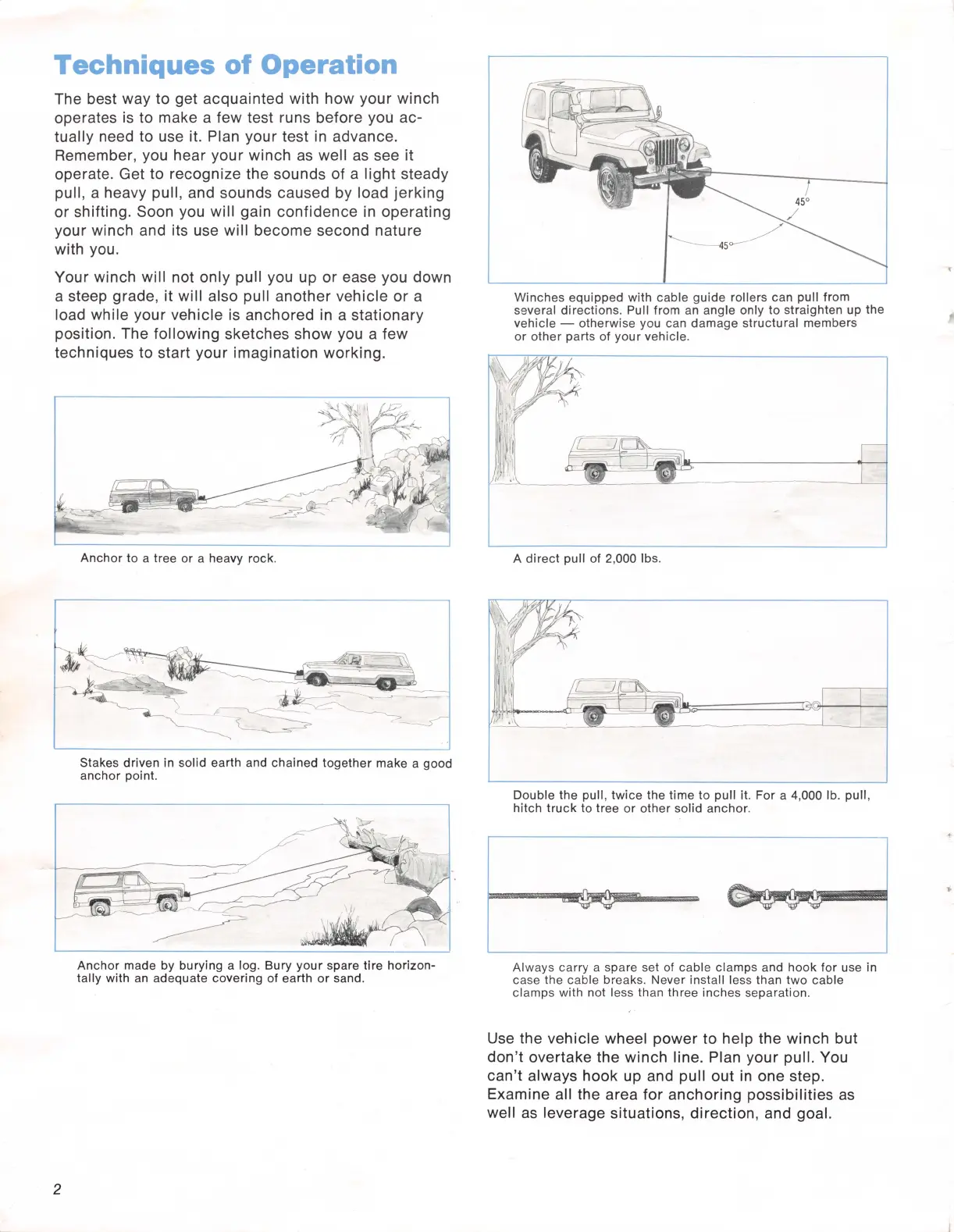
Your
winch
will
not
only
pull
you
up
or
ease
you
down
a
steep
grade,
it
will
also
pull
another
vehicle
or
a
load
while
your
vehicle
Is
anchored
in
a
stationary
position.
The
following
sketches
show
you
a
few
techniques
to
start
your
imagination
working.
r.
a
Winches
equipped
with
cable
guide
rollers
can
pull
from
several
directions.
Pull
from
an
angle
only
to
straighten
up
the
vehicle
otherwise
you
can
damage
structural
members
or
other
parts
of
your
vehicle.
Anchor
to
a
tree
or
a
heavy
rock.
A
direct
pull
of
2,000
lbs.
ailAf
_
V
Stakes
driven
in
solid
earth
and
chained
together
make
a
good
anchor
point.
Anchor
made
by
burying
a
log.
Bury
your
spare
tire
horizon
tally
with
an
adequate
covering
of
earth
or
sand.
Double
the
pull,
twice
the
time
to
pull
it.
For
a
4,000
lb.
pull,
hitch
truck
to
tree
or
other
solid
anchor.
Always
carry
a
spare
set
of
cable
clamps
and
hook
for
use
in
case
the
cable
breaks.
Never
install
less
than
two
cable
clamps
with
not
less
than
three
inches
separation.
Use
tfie
vefiicle
wheel
power
to
help
the
winch
but
don't
overtake
the
winch
line.
Plan
your
pull.
You
can't
always
hook
up
and
pull
out
in
one
step.
Examine
all
the
area
for
anchoring
possibilities
as
well
as
leverage
situations,
direction,
and
goal.

Related product manuals