EasyManua.ls Logo

Ramsey Electronics 2000 - Suggestions for Maintenance; Troubleshooting Guide

Default Icon
12 pages
Print Icon
To Next Page IconTo Next Page
To Previous Page IconTo Previous Page
Loading...
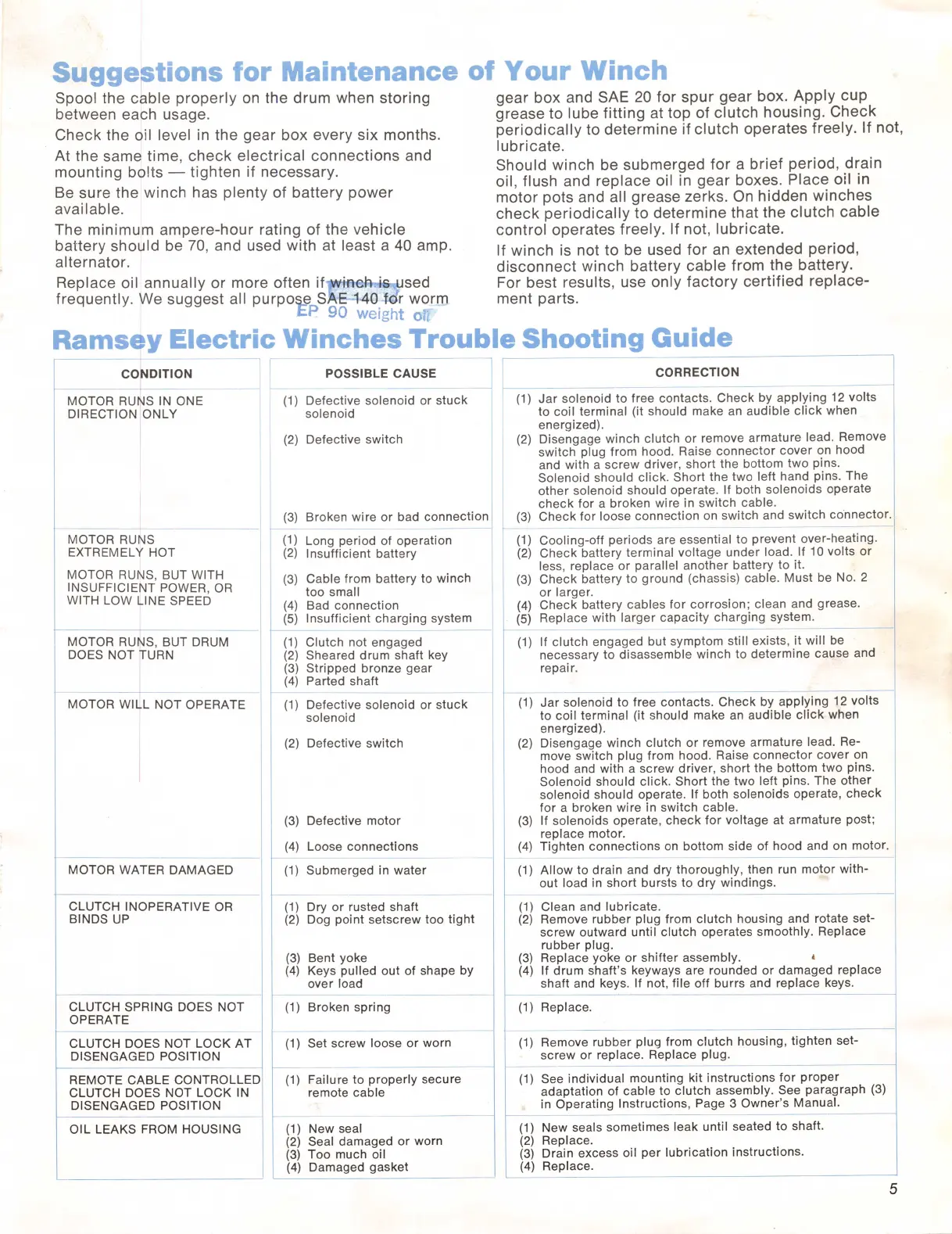
Suggestions
for
Maintenance
of
Your
Winch
Spool
the
cable
properly
on
the
drum
when
storing
between
each
usage.
Check
the
oi
l
level
in
the
gear
box
every
six
months.
At
the
same
time,
check
eiectricai
connections
and
mounting
bolts
—
tighten
if
necessary.
Be
sure
the
winch
has
pienty
of
battery
power
availabie.
The
minimum
ampere-hour
rating
of
the
vehicie
battery
should
be
70,
and
used
with
at
ieast
a
40
amp.
alternator.
Replace
oil
annually
or
more
often
ifwincl>:-is.used
frequently.
We
suggest
all
purpo^
SAE
TAOWr
worm
EP
90
weight
t\Vi
90
weight
oii
gear
box
and
SAE
20
for
spur
gear
box.
Apply
cup
grease
to
lube
fitting
at
top
of
ciutch
housing.
Check
periodicaiiy
to
determine
if
ciutch
operates
freeiy.
If
not,
lubricate.
Should
winch
be
submerged
for
a
brief
period,
drain
oil,
flush
and
replace
oil
in
gear
boxes.
Place
oil
in
motor
pots
and
ail
grease
zerks.
On
hidden
winches
check
periodicaiiy
to
determine
that
the
ciutch
cable
control
operates
freeiy.
If
not,
lubricate,
if
winch
is
not
to
be
used
for
an
extended
period,
disconnect
winch
battery
cable
from
the
battery.
For
best
results,
use
only
factory
certified
replace
ment
parts.
Ramsey
Electric
Winches
Trouble
Shooting
Guide
t'
CON
cond
ition
MOTOR
RUNS
IN
ONE
DIRECTION
ONLY
MOTOR
RUNS
EXTREMELY
HOT
MOTOR
RUNS,
BUT
WITH
INSUFFICIENT
POWER,
OR
WITH
LOW
LINE
SPEED
MOTOR
RUNS,
BUT
DRUM
DOES
NOT
TURN
MOTOR
WILL
NOT
OPERATE
MOTOR
WATER
DAMAGED
CLUTCH
INOPERATIVE
OR
BINDS
UP
CLUTCH
SPRING
DOES
NOT
OPERATE
CLUTCH
DOES
NOT
LOCK
AT
DISENGAGED
POSITION
REMOTE
CABLE
CONTROLLED
CLUTCH
DOES
NOT
LOCK
IN
DISENGAGED
POSITION
OIL
LEAKS
FROM
HOUSING
POSSIBLE
CAUSE
(1)
Defective
solenoid
or
stuck
solenoid
(2)
Defective
switcfi
(3)
Broken
wire
or
bad
connection
(1)
Long
period
of
operation
(2)
Insufficient
battery
(3)
Cable
from
battery
to
wlncti
too
small
(4)
Bad
connection
(5)
Insufficient
cfiarging
system
(1)
Ciutcti
not
engaged
(2)
Stieared
drum
stiaft
key
(3)
Stripped
bronze
gear
(4)
Parted
sfiaft
(1)
Defective
solenoid
or
stuck
solenoid
(2)
Defective
switcti
(3)
Defective
motor
(4)
Loose
connections
(1)
Submerged
in
water
CORRECTION
(1)
Jar
solenoid
to
free
contacts.
Cfieck
by
applying
12
volts
to
coll
terminal
(It
sftould
make
an
audible
click
when
energized).
(2)
Disengage
winch
ciutch
or
remove
armature
lead.
Remove
switch
plug
from hood.
Raise
connector
cover
on
hood
and
with
a
screw
driver,
short
the bottom
two
pins.
Solenoid
should
click.
Short
the
two
left
hand
pins.
The
other
solenoid
should
operate.
If
both
solenoids
operate
check
for
a
broken
wire
In
switch
cable.
Check
for
loose
connection
on
switch
and
switch
connector.
Gooling-off
periods
are
essential
to
prevent
over-heating.
Check
battery
terminal
voltage
under
load.
If
10
volts
or
less,
replace
or
parallel
another
battery
to
it.
Check
battery
to
ground
(chassis)
cable.
Must
be
No.
2
or
larger.
Check
battery
cables
for
corrosion;
clean
and
grease.
Replace
with
larger
capacity
charging
system.
(3)
(1)
(2)
(3)
(4)
(5)
(1)
If
ciutch
engaged
but
symptom
still
exists,
it
will
be
necessary
to
disassemble
winch
to
determine
cause
and
repair.
(1)
Dry
or
rusted
shaft
(2)
Dog
point
setscrew
too
tight
(3)
Bent
yoke
(4)
Keys
pulled
out
of
shape
by
over
load
(1)
Broken
spring
(1)
Set
screw
loose
or
worn
(1)
Failure
to
properly
secure
remote
cable
(1)
New
seal
(2)
Seal
damaged
or
worn
(3)
Too
much
oil
(4)
Damaged
gasket
(1)
Jar
solenoid
to
free
contacts.
Check
by
applying
12
volts
to
coil
terminal
(it
should
make
an
audible
click
when
energized).
(2)
Disengage
winch
clutch
or
remove
armature
lead.
Re
move
switch
plug
from
hood.
Raise
connector
cover
on
hood
and
with
a
screw
driver,
short
the
bottom
two
pins.
Solenoid
should
click.
Short
the
two
left
pins.
The
other
solenoid
should
operate.
If
both
solenoids
operate,
check
for
a
broken
wire
in
switch
cable.
if
solenoids
operate,
check
for
voltage
at
armature
post;
replace
motor.
Tighten
connections
on
bottom
side
of
hood
and
on
motor.
(3)
(4)
(1)
Allow
to
drain
and
dry
thoroughly,
then
run
motor
with
out
load
in
short
bursts
to
dry
windings.
(1)
(2)
(3)
(4)
Clean
and
lubricate.
Remove
rubber
plug
from
ciutch
housing
and
rotate
set-
screw
outward
until
ciutch
operates
smoothly.
Replace
rubber
plug.
Replace
yoke
or
shifter
assembly.
'
If
drum
shaft's
keyways
are
rounded
or
damaged
replace
shaft
and
keys.
If
not,
file
off
burrs
and
replace
keys.
(1)
Replace.
(1)
Remove
rubber
plug
from
clutch
housing,
tighten
set-
screw
or
replace.
Replace
plug.
(1)
See
individual
mounting
kit
Instructions
for
proper
adaptation
of
cable
to
ciutch
assembly.
See
paragraph
(3)
in
Operating
Instructions,
Page
3
Owner's
Manual.
(1)
New
seals
sometimes
leak
until
seated
to
shaft.
(2)
Replace.
(3)
Drain
excess
oil
per
lubrication
Instructions.
(4)
Replace.

Related product manuals