EasyManua.ls Logo

Ramsey Electronics FM35 - User Manual

Ramsey Electronics FM35
24 pages
Print Icon
To Next Page IconTo Next Page
Loading...
FM35 1
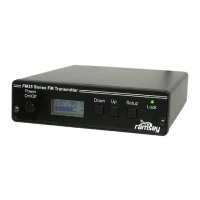
DIGITAL FM
STEREO
TRANSMITTER
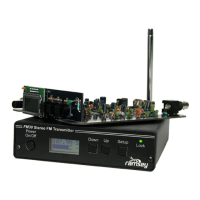
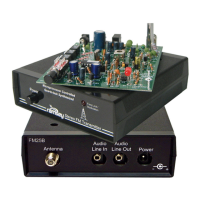
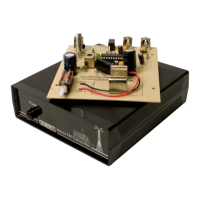
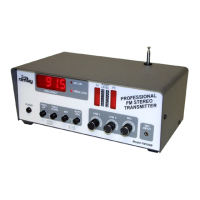
Ramsey Electronics Model No. FM35
 Synthesized 87.9MHz to 108.1MHz for no frequency drift! Direct
digital input of frequency, no jumpers or DIP switches!
 Designed for extruded, rugged metal case, all lines have RF
chokes, and fully regulated for the cleanest sounding low noise
performance yet!
 BNC style RF output for easy, reliable connections.
 Fully digitally controlled transmit power for custom coverage
capabilities!
 Digital volume and balance controls for easy audio level
adjustments.
 Runs from 13.8-16VDC, includes 15V DC adapter.
 Quality of signal indicator lets you know when you have a good
signal or over-modulated signal. Lets you know when to turn it up,
or down!
 Great for schools, health clubs, yard casting, drive-in movie
theaters, haunted rides, amusement parks, churches, etc!
A new and improved version of our popular stereo transmitters,
the FM35 is an ideal upgrade for improved performance and
ease of use! With a low-noise design and a metal case, the
FM35 suffers from much less interference for a better S/N ratio.
The FM35 also has full digital front panel control of output
power, volume, balance, stereo/mono, and frequency!
Question and Answer IconNeed help?

Do you have a question about the Ramsey Electronics FM35 and is the answer not in the manual?

Summary

Introduction

Circuit Description

FM35 Setup

Frequency, Mode, and Volume Settings

Adjust frequency, select audio mode, and set volume level.

Balance and Power Settings

Adjust audio balance and RF output power.

FM35 Schematic Centerfold

Antenna Ideas

Antenna Alternatives

Discusses alternative antenna setups for specific building situations like multi-level homes.

Appendix A: FCC Rules and Info

Appendix B: Understanding Legal Field Strength

Summary

Warranty

Overview

The Ramsey FM35 is a Digital FM Stereo Transmitter, an improved version of popular stereo transmitters designed for enhanced performance and ease of use. It features a low-noise design and a rugged metal case, which significantly reduces interference, leading to a better signal-to-noise (S/N) ratio. The FM35 offers full digital front panel control over output power, volume, balance, stereo/mono mode, and frequency.

Function Description:

The FM35 is a synthesized stereo FM broadcast transmitter that allows users to broadcast audio signals over the FM band. It is designed for various applications, including extending home stereo systems and computer audio wirelessly, serving as a listening aid in auditoriums and churches, operating student-run school radio stations, college dorm music services, drive-ins, haunted hayrides, amusement parks, and short-range, two-channel experiments and demonstrations. The device is built to comply with national telecommunications authority rules, such as FCC Part 15 in the U.S., for low-power broadcasting.

Important Technical Specifications:

  • Frequency Range: Synthesized 87.9MHz to 108.1MHz, ensuring no frequency drift. Frequency selection is done via direct digital input, eliminating the need for jumpers or DIP switches.
  • Output: BNC style RF output for easy and reliable connections.
  • Power Control: Fully digitally controlled transmit power, allowing for custom coverage capabilities.
  • Audio Controls: Digital volume and balance controls for precise audio level adjustments.
  • Power Supply: Operates from 13.8-16VDC and includes a 15V DC adapter.
  • Signal Quality Indicator: Provides feedback on signal quality (good signal or over-modulated), helping users adjust levels appropriately.
  • Case: Extruded, rugged metal case with RF chokes on all lines and full regulation for clean, low-noise performance.
  • Circuitry Highlights:
    • Power Supply: Features a low-pass filter (L1, C8, C7) to prevent RF interference, a reverse polarity protection diode (D1), and low-dropout regulators (VR1 for +12V, VR2 for +5V) for stable, low-noise power.
    • Audio Input: Audio is introduced at J8 (left) and J10 (right), with EMI filters (L2, C28) to maintain audio quality.
    • Digital Potentiometer (U2:A): Controls the gain of the opamp (U4:A) for digital volume and balance adjustments.
    • Low Pass Filter (U5:B): Reduces high-frequency audio signals to prevent mixing products with the stereo pilot signal, improving transmitted audio quality.
    • Peak Detectors (D9, D10, R39, U5:A): Sample left and right channels to detect audio peaks. A comparator (U5:A) compares these peaks against a 2.5V bias reference to determine if the audio exceeds +/-75kHz of deviation, indicating over-modulation.
    • Microcontroller (U1): The "brains" of the device, handling button presses, signal quality measurement, RF power measurement, display updates, frequency conversion, and control signals for the stereo modulator and digital-to-analog converters (DACs).
    • Stereo Modulator (U3 - BH1415F): Contains a stereo multiplexer, Phase Locked Loop (PLL), audio filters, and equalization (75uS for US standard).
    • Voltage Controlled Oscillator (VCO): Uses a varactor diode (D5) and a circuit board trace acting as an inductor (STUB) to form the VCO. The PLL adjusts the voltage across D5 to tune the oscillation frequency. The stub's low sensitivity to microphonics ensures stability.
    • DAC (U6): Corrects VCO tuning sensitivity across the broad frequency range, ensuring consistent +/-10kHz error.
    • RF Amplifier (U8): Boosts the signal level from U3.
    • Pin Diode (D8) and DAC (U7): D8 acts as a variable RF resistor, controlled by U7 DAC, which generates 0-5 volts in 256 steps, allowing for precise output level control.
    • RF Filter: A low-pass RF filter reduces harmonics before the signal reaches the output jack.

Usage Features:

  • Ease of Use: Simple operation with a [SETUP] button to cycle through screens and [UP]/[DOWN] buttons to adjust values.
  • Display: LCD display shows current power, frequency, clipping detector status, and VCO voltage. Contrast is adjustable via R1.
  • Frequency Selection: Users can select their desired operating frequency within the 87.9MHz to 108.1MHz range. It is recommended to choose an open or "dead" spot on the FM dial to avoid interference.
  • Mode Selection: Toggle between Stereo and Mono modes.
  • Volume and Balance: Digital controls for precise audio level and balance adjustments.
  • Clipping Detector: The display indicates modulation levels:
    • '-': <= +/-60kHz (under-modulated)
    • 'g': >+/-60kHz and <+/-75kHz (good modulation)
    • 'c': >+/-75kHz and <+/-90kHz (edge of clipping/slight distortion)
    • 'C': >+/-90kHz (over-modulated/clipping)
    • Users should aim for 'g' or 'c' occasionally for optimal sound.
  • Power Adjustment: Allows fine-tuning of RF output level for custom coverage.
  • Settings Save: The last setup screen allows saving all changes to internal FLASH memory using the [UP] button.
  • Antenna Connections: Connects to a dipole antenna (horizontal or vertical) via coaxial cable (RG-58, RG-59, or RG-174). Dipole lengths vary by frequency (e.g., 2.7 ft per side for 88 MHz, 2.2 ft per side for 108 MHz). A "ground plane" antenna is also an effective alternative.
  • Audio Source: Connects to line-level audio sources such as CD players or computer sound cards. Caution: Do not connect to speaker outputs of high-power stereo systems.
  • FCC Compliance: Users are responsible for operating the FM35 in accordance with FCC rules (Part 15 in the US), ensuring no interference with licensed broadcasts. The device's bandwidth is limited to 200 KHz, and field strength must not exceed 250 microvolts/meter at 3 meters from the transmitter.

Maintenance Features:

  • Rugged Design: Extruded metal case and fully regulated power supply contribute to durability and reliability.
  • Predictable VCO: The circuit board layout for the stub (inductor) provides a predictable value, eliminating the need for tuning in this section. Its low sensitivity to microphonics makes it immune to vibration.
  • Self-Correction: The DAC (U6) automatically corrects VCO tuning sensitivity across the frequency band, maintaining signal quality.
  • Troubleshooting Aids: The VCO voltage display helps diagnose locking problems. The clipping detector assists in setting optimal audio levels.

The FM35 is presented as a serious, capable device for sharing music and information, not a toy, with potential for widespread use in various community and educational settings, while emphasizing the importance of legal and responsible operation.

Ramsey Electronics FM35 Specifications

General IconGeneral
BrandRamsey Electronics
ModelFM35
CategoryTransmitter
LanguageEnglish

Related product manuals