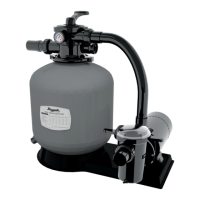
This document is an installation and operation manual for Raypak Sand Filtration Combo models RPSFP16, RPSFP18, RPSFP21, RPSFP181, and RPSFP211. It provides comprehensive instructions for the safe installation, operation, and maintenance of these swimming pool filter systems.
Function Description:
The Raypak Sand Filtration Combo is designed to extract suspended particles (dirt) from pool water, maintaining water clarity. The system consists of a sand filter and a centrifugal pump. The pump circulates pool water through the sand filter, where a special filter sand traps and collects particles. The filtered water is then returned to the pool. The system also supports backwash operations to clean the filter sand by reversing water flow, flushing trapped debris into a waste line. Some pump models offer dual-speed operation (high and low speed) for energy efficiency and varied performance needs.
Important Safety Instructions:
The manual emphasizes critical safety warnings, including:
- DANGER: Immediate hazards that can cause severe personal injury, death, or substantial property damage if ignored.
- WARNING: Hazards or unsafe practices that could cause severe personal injury, death, or substantial property damage if ignored.
- CAUTION: Hazards or unsafe practices that could cause minor personal injury or product or property damage if ignored.
- CAUTION (without alert symbol): Potentially hazardous conditions that could cause minor personal injury or product or property damage if ignored.
- NOTE: Special instructions on installation, operation, or maintenance.
Key safety points include:
- Always read and follow all warnings and instructions to prevent severe injury, death, or property damage.
- Improper installation, adjustment, alteration, service, or maintenance can cause property damage, personal injury, or loss of life.
- Installers, pool operators, and owners must read all instructions before using the sand filter.
- Serious bodily harm or death can result if the filter and pump combo is not installed and used correctly.
- High-pressure release from the sand filter can cause severe injury or major property damage; always release all pressure before working on the filter.
- Before working on the filter: stop the pump, open the air release valve, and release all pressure.
- Risk of electrical shock: more than one disconnect switch may be required to de-energize equipment.
- The filter and pump combination is intended for swimming pool applications.
- Comply with all state and local codes regulating pool and spa construction, installation, and operation.
- Children must be closely supervised when using this product.
- Do not increase pump size beyond the maximum flow rate stated on the drain cover.
- For non-single-family dwellings, a clearly-labeled emergency switch must be provided, accessible within 5 ft (1.52 m) of the filter.
- Do not use extension cords for pump connection; use a properly located outlet.
- Do not bury electrical cords; place them to avoid contact with lawnmowers, trimmers, or tripping hazards.
- A pool or spa pump must be installed by a qualified professional in accordance with the National Electrical Code and local ordinances.
- Pumps are not a substitute for properly installed and secured pool drain covers (ANSI/ASME A112.19.8 approved anti-entrapment drain cover required).
- DANGER: ELECTROCUTION OR ELECTRICAL SHOCK RISK. Disconnect electricity before working on the pump.
- Never work on the pump while it is running or powered.
- A suitable ground fault interrupter (GFCI) should always be installed at the power supply source.
- DANGER: Hazardous suction can trap hair and body parts, causing severe injury or death; do not block suction.
- Elevated water temperature can be hazardous (never exceed 104°F/40°C in spas).
- Replace damaged electrical cords immediately.
- The unit must be mounted to the base in accordance with installation instructions.
- Entrapment Prevention: The system must include at least two suction outlets connected to the pump when running. Maximum water velocity through suction fittings must not exceed 1.5 ft (.5 m) per second.
- All suction outlets must have screw-fastened, listed/certified covers (ANSI/ASME A112.19.8).
- Provide at least two hydraulically-balanced main drains, with covers, for each circulating pump suction line, with centers at least 3 ft (.9 m) apart.
- Fittings restrict flow; use the fewest possible fittings (but at least two suction outlets) and avoid air traps.
- Pool cleaner suction fittings must conform to IAPMO standards.
- The filter operates under high pressure; air in the system can cause the lid or control valve to separate, leading to injury or damage.
- Failure to operate the filter system or inadequate filtration can cause poor water clarity, obstructing visibility and leading to injury or death. Never swim in a pool with poor water clarity.
- NEVER run the pump dry! Fill the pump with water before starting the motor.
- Do not block pump suction! Children using the pool must always have close adult supervision.
- Always turn the pump off before changing valve positions to prevent damage to the control valve.
- CAUTION: Allowing water to freeze in the system will cause damage.
- CAUTION: The Multiport Valve should be left in the "Winterize" position during shutdown to prevent damage to the valve diverter seal.
Important Technical Specifications:
The manual provides a table of specifications for different combo models:
| Combo Model |
Filter Model |
Pump Model |
Power (HP) |
Speed |
Max Operating Pressure, PSI (bar) |
Max Flow Rate Pump + Filter, GPM (LPM) |
Turnover Rate, Gal. (L) (2/4/6 Hours) |
Valve Port |
Filter Dia., in (mm), "B" |
Silica Height, in (mm), "C" |
Silica 16/30* Weight, lb (kg) |
| RPSFP16 |
RPSF16 |
RPAGP75 |
0.75 |
Single |
28 (2) |
50 (187) |
6000 (22680) / 12000 (45360) / 18000 (68040) |
1.5" |
15.7 (399) |
6.9 (175) |
77 (35) |
| RPSFP18 |
RPSF18 |
RPAGP100 |
1 |
Single |
28 (2) |
63 (237) |
7560 (28577) / 15120 (57154) / 22680 (85731) |
1.5" |
17.7 (450) |
8.3 (211) |
99 (45) |
| RPSFP21 |
RFSF21 |
RPAGP150 |
1.5 |
Single |
28 (2) |
68 (258) |
8160 (30845) / 16320 (61690) / 24480 (92535) |
1.5" |
20.7 (526) |
9.3 (235) |
209 (95) |
| RPSFP181 |
RPSF18 |
RPAGP102 |
1 |
Dual |
28 (2) |
63 (237) |
7560 (28577) / 15120 (57154) / 22680 (85731) |
1.5" |
17.7 (450) |
8.3 (211) |
99 (45) |
| RPSFP211 |
RFSF21 |
RPAGP152 |
1.5 |
Dual |
28 (2) |
68 (258) |
8160 (30845) / 16320 (61690) / 24480 (92535) |
1.5" |
20.7 (526) |
9.3 (235) |
209 (95) |
*Suggested silica weight is for reference only and based on recommended filter media (16/30 Mesh Silica Sand / Silica #20 (0.5 - 0.8mm diameter)).
Usage Features:
- Filter Operation: Water enters through a valve, passes evenly through the sand filter, trapping particles, and exits through the bottom, up the standpipe, through the valve, and back to the pool.
- Backwash: Reverses water flow to flush trapped particles from the sand bed into a waste line.
- Rinse: Settles the sand bed after backwashing and carries remaining loose dirt to the waste line.
- Waste: Pumps excess water directly from the pool to the waste pipe, bypassing the filter. Useful for high water levels or vacuuming heavy debris.
- Recirculate: Circulates water directly back to the pool, bypassing the filter. Useful for chemical distribution without filtration.
- Closed: Prevents water flow through the tank, used for maintenance.
- Pump Models: Constant speed pumps operate continuously. Dual-speed pumps offer high speed for vacuuming, quick filtering, and priming, and low speed for quiet operation and energy savings (60% based on equal circulated water).
- Priming Pump: Essential to fill the pump with water before starting to prevent damage.
Maintenance Features:
- Regular Cleaning: The sand filter requires regular backwashing and rinsing to maintain clean, safe, and healthy swimming water. The frequency depends on pool size, bather usage, and environmental conditions.
- Pressure Gauge Monitoring: Backwash when the pressure gauge reading is 8-10 PSI higher than the initial "clean" pressure.
- Pump Strainer and Skimmer Baskets: Clean regularly to prevent damage to the pump and ensure proper operation.
- Trap Basket Cleaning: Stop the pump, close gate valves, release pressure, unscrew the trap lid, remove and clean the strainer basket, clean and inspect the O-ring, and replace the lid.
- Filter Winterizing: Drain all water from the pump, system equipment, and piping. Remove drain plugs and store them. Keep the motor covered and dry. Alternatively, remove the pump and motor and store indoors in a warm, dry location. Set the multiport valve to "Winterize" position to prevent damage to the diverter seal.
- Chemical Cleaning: Address algae, calcification, and sanitation issues as they affect filter efficiency.
- Troubleshooting Guide: Provides solutions for common problems like sand in the pool, cloudy water, filter leaks, pump not starting, low pump capacity, and high/low pressure.
Installation Requirements:
- Place the filter on a level concrete slab or firm ground.
- Locate the filter for convenient access to piping connections, control valve, and service.
- Pour filter sand media into the tank, ensuring the internal pipe is capped and centered.
- Assemble the filter control valve into the tank neck, aligning the center pipe and tightening clamps.
- Screw in the pressure gauge.
- Install the pump as close as possible to the pool, preferably 20" (0.5 m) below water level, in a dry, well-ventilated area away from direct sunlight, on a hard, level surface with drainage.
- Bolt the pump onto the platform.
- Connect suction and discharge pipes to the pool.
- Wire the pump motor according to the wiring diagram and local/National Electrical Code requirements, ensuring proper grounding and bonding.
- Allow for gate valves in suction and discharge piping.
- Ensure adequate access for servicing.
Warranty:
Raypak offers a Limited Warranty to the original owner for above-ground swimming pool cartridge filter systems or sand filter systems.
- Applicable Warranty Period (Unregistered): 90 days from the Effective Date (date of original installation or 30 days after purchase, not exceeding one year from manufacture date), parts only.
- Extended Warranty Period (Registered): One year from the Effective Date if registered within 90 days of installation in a single-family residential dwelling.
- Exclusions: Warranty does not cover travel/labor/shipping costs, systems moved from original installation, improper installation, altered/removed rating plates or serial numbers, unauthorized modifications or accessories, failure to properly install/operate/maintain, damage from abuse/act of nature/accident/fire/flood/freeze/lightning, damage from connected system control devices, or performance problems from improper sizing/electrical issues.
- Claim Process: Notify dealer immediately with proof of purchase, model, serial number, and date of installation. Obtain proper authorization PRIOR to any repairs. Raypak reserves the right to inspect defective systems.



 To Next Page
 General