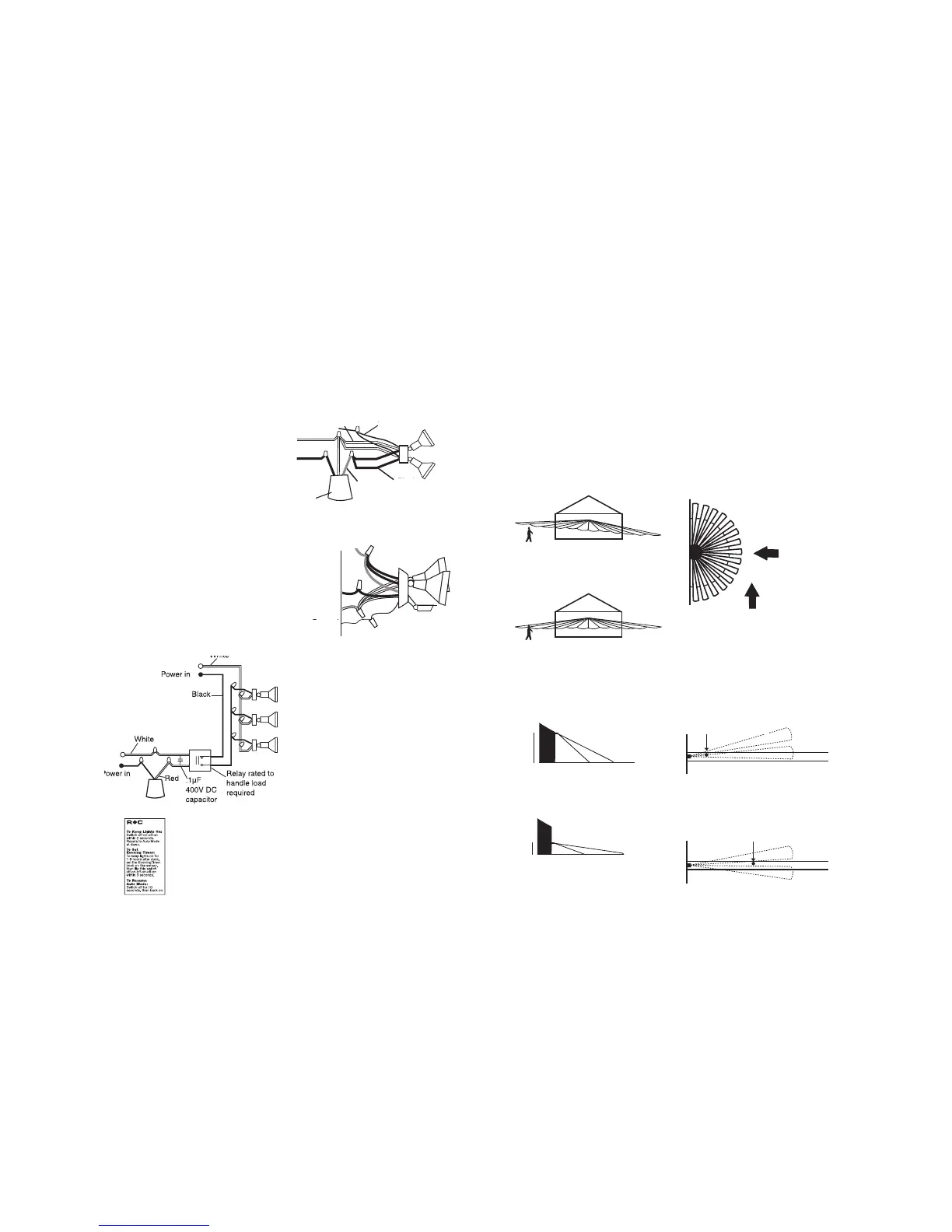
Multiple fixtures may be wired to a
single sensor.
To handle loads greater than 1,000
watts, a qualified electrician
should install a relay.
It is not recommended to install
sensors on a circuit that also feeds
motor loads such as HVAC equip-
ment, kitchen appliances, or garage
door openers. The Stealth circuit is
surge and transient protected to
IEC specifications. However, if
voltage varies significantly from
120 volts, sensor may malfunction.
Note: Pigtail is only used to switch
remote or additional light fixtures
Switchplate label with
self-adhesive backing.
Attach Stealth operating
instruction label to
switchplate for quick
and easy reference.
1. Check that the sensor is level
from side to side and pointed at the
area you desire. If unit is tilted, part
of the detection zone may be high
in the air over people’s heads.
Solution: Position sensor exactly
level from side to side.
2. Check that the sensor is not
mounted too high. If mounted
above 20 feet, much of the usable
range will be lost.
Solution: Mounting at 6 feet to
12 feet allows maximum range.
3. Check that movement is not
directly towards sensor. Sensor
will see movement across its
pattern more quickly. To fix,
move the sensor.
4. Check that movement far away
and directly towards sensor is not
entirely within one zone.
Sensor will not detect until
movement crosses zones
“Micro Adjust” sensor by moving
sideways 1/4". This may move the
zones to allow earlier detection.
PATHWAY
PATHWAY
Schémas de raccordement
Schéma de raccordement
de base
Multiple fixtures may be wired to a
single sensor.
To handle loads greater than 1,000
watts, a qualified electrician
should install a relay.
It is not recommended to install
sensors on a circuit that also feeds
motor loads such as HVAC equip-
ment, kitchen appliances, or garage
door openers. The Stealth circuit is
surge and transient protected to
IEC specifications. However, if
voltage varies significantly from
120 volts, sensor may malfunction.
Note: Pigtail is only used to switch
remote or additional light fixtures
Switchplate label with
self-adhesive backing.
Attach Stealth operating
instruction label to
switchplate for quick
and easy reference.
1. Check that the sensor is level
from side to side and pointed at the
area you desire. If unit is tilted, part
of the detection zone may be high
in the air over people’s heads.
Solution: Position sensor exactly
level from side to side.
2. Check that the sensor is not
mounted too high. If mounted
above 20 feet, much of the usable
range will be lost.
Solution: Mounting at 6 feet to
12 feet allows maximum range.
3. Check that movement is not
directly towards sensor. Sensor
will see movement across its
pattern more quickly. To fix,
move the sensor.
4. Check that movement far away
and directly towards sensor is not
entirely within one zone.
Sensor will not detect until
movement crosses zones
“Micro Adjust” sensor by moving
sideways 1/4". This may move the
zones to allow earlier detection.
PATHWAY
PATHWAY
Câblage de trousse de base
Note : Utiliser la queue de cochon
seulement pour commander les
luminaires à distance ou additionnels
Plaque d’interrupteur à
endos auto-adhésif.
Fixer l’étiquette de mode
d’emploi Stealth à la
plaque d’interrupteur
pour référence rapide et
simple.
Plusieurs luminaires
Multiple fixtures may be wired to a
single sensor.
To handle loads greater than 1,000
watts, a qualified electrician
should install a relay.
It is not recommended to install
sensors on a circuit that also feeds
motor loads such as HVAC equip-
ment, kitchen appliances, or garage
door openers. The Stealth circuit is
surge and transient protected to
IEC specifications. However, if
voltage varies significantly from
120 volts, sensor may malfunction.
Note: Pigtail is only used to switch
remote or additional light fixtures
Switchplate label with
self-adhesive backing.
Attach Stealth operating
instruction label to
switchplate for quick
and easy reference.
1. Check that the sensor is level
from side to side and pointed at the
area you desire. If unit is tilted, part
of the detection zone may be high
in the air over people’s heads.
Solution: Position sensor exactly
level from side to side.
2. Check that the sensor is not
mounted too high. If mounted
above 20 feet, much of the usable
range will be lost.
Solution: Mounting at 6 feet to
12 feet allows maximum range.
3. Check that movement is not
directly towards sensor. Sensor
will see movement across its
pattern more quickly. To fix,
move the sensor.
4. Check that movement far away
and directly towards sensor is not
entirely within one zone.
Sensor will not detect until
movement crosses zones
“Micro Adjust” sensor by moving
sideways 1/4". This may move the
zones to allow earlier detection.
PATHWAY
PATHWAY
Étiquette de plaque d’interrupteur
On peut raccorder plusieurs
luminaires à un seul détecteur.
Un électricien compétent
doit installer un relais afin de
supporter les charges supérieures
à 1 000 watts.
Qualité du courant
On déconseille d’installer les
détecteurs sur un circuit qui
alimentent aussi des charges
moteur comme de l’équipement
de climatisation, des appareils
de cuisine ou des ouvre-porte
de garage. Le circuit Stealth est
protégé contre les surtensions et
les parasites conformément aux
normes IEC. Le détecteur peut
toutefois défaillir si la tension
varie considérablement par
rapport à 120 volts.
Multiple fixtures may be wired to a
single sensor.
To handle loads greater than 1,000
watts, a qualified electrician
should install a relay.
It is not recommended to install
sensors on a circuit that also feeds
motor loads such as HVAC equip-
ment, kitchen appliances, or garage
door openers. The Stealth circuit is
surge and transient protected to
IEC specifications. However, if
voltage varies significantly from
120 volts, sensor may malfunction.
Note: Pigtail is only used to switch
remote or additional light fixtures
Switchplate label with
self-adhesive backing.
Attach Stealth operating
instruction label to
switchplate for quick
and easy reference.
1. Check that the sensor is level
from side to side and pointed at the
area you desire. If unit is tilted, part
of the detection zone may be high
in the air over people’s heads.
Solution: Position sensor exactly
level from side to side.
2. Check that the sensor is not
mounted too high. If mounted
above 20 feet, much of the usable
range will be lost.
Solution: Mounting at 6 feet to
12 feet allows maximum range.
3. Check that movement is not
directly towards sensor. Sensor
will see movement across its
pattern more quickly. To fix,
move the sensor.
4. Check that movement far away
and directly towards sensor is not
entirely within one zone.
Sensor will not detect until
movement crosses zones
“Micro Adjust” sensor by moving
sideways 1/4". This may move the
zones to allow earlier detection.
PATHWAY
PATHWAY
Noir
Rouge
Blanc
Mise à la terre
Détecteur
Entrée électrique
1. Attach the Universal Mounting
bar with the bar screws (provid-
ed) to the junction box. If you are
attaching your STL200 kit to a
surface mount weatherproof box,
you must use the metal plate with
the attached gasket. The gasket
faces the Junction Box.
2. Easy Wiring Tip:
Use the “S” shaped Hands Free
Hanging Hook to hold the EZ Plate
during wiring.
3. Bring power leads and sensor kit
leads through holes in all gaskets
into junction box.
4. Strip
1
/2" of insulation from all
leads.
5. Attach ground wire(s) to junction
box grounding screw. Connect
as shown in wiring diagram (pg 5).
6. Twist on wire nuts. Secure with
electrical tape.
7. Align EZ Plate and metal
mounting plate to insure
proper seal. Tighten EZ Plate
center screw (make sure O-Ring
gasket is on the screw) to attach
EZ Plate to the box. There are
2 screws supplied. Use the one
which suits your assembly
best.
8. Insert plastic Finishing Cap in
the center of the EZ Plate for a
we
atherproof seal.
9. Use silicone sealant around all
openings to insure a
weatherproof seal.
10. Screw in light bulbs. Turn on
power.
Conduct walk test to
adjust sensor response (pg 6).
Red pigtail is only used to switch remote or
additional fixtures.
1. Lights may turn on occasionally
during rain, snow and windstorms
because the sensor is detecting
changes in temperature.
Solution:
Mount sensor in protected area.
If false detections are a constant
problem, reduce sensitivity (turn
counterclockwise) until the problem
stops.
2. Tilt the sensor lower, it may be
seeing distant objects moving.
3. You may not be aware that
animals have triggered the sensor.
Check sensor aiming to reduce
nuisance triggering or mask the
lower part of the lens with opaque
weatherproof tape to create an
“Animal Alley”.
4. Although it is surge and transient
protected, the sensor may turn on
occasionally during extreme voltage
surges.
5. A possible source of “mysterious”
sensor activations are strong local
radio signals. Check for nearby CB,
Ham, VHF radio transmitters or
Cellular telephones. The sensor may
be activated but will not be perma-
nently impaired by these signals.
6. Check all the Solutions mentioned
under “Lights Turn On and Off”.
7. Check items #2, 4, 5, 6 and 7
under “Lights Do Not Turn Off.”
Noir
Noir
Blanc
Blanc
Rouge
Rouge
(queue de
cochon)
Mise à la terre
Mise à la terre
Entrée électrique
Multiple fixtures may be wired to a
single sensor.
To handle loads greater than 1,000
watts, a qualified electrician
should install a relay.
It is not recommended to install
sensors on a circuit that also feeds
motor loads such as HVAC equip-
ment, kitchen appliances, or garage
door openers. The Stealth circuit is
surge and transient protected to
IEC specifications. However, if
voltage varies significantly from
120 volts, sensor may malfunction.
Note: Pigtail is only used to switch
remote or additional light fixtures
Switchplate label with
self-adhesive backing.
Attach Stealth operating
instruction label to
switchplate for quick
and easy reference.
1. Check that the sensor is level
from side to side and pointed at the
area you desire. If unit is tilted, part
of the detection zone may be high
in the air over people’s heads.
Solution: Position sensor exactly
level from side to side.
2. Check that the sensor is not
mounted too high. If mounted
above 20 feet, much of the usable
range will be lost.
Solution: Mounting at 6 feet to
12 feet allows maximum range.
3. Check that movement is not
directly towards sensor. Sensor
will see movement across its
pattern more quickly. To fix,
move the sensor.
4. Check that movement far away
and directly towards sensor is not
entirely within one zone.
Sensor will not detect until
movement crosses zones
“Micro Adjust” sensor by moving
sideways 1/4". This may move the
zones to allow earlier detection.
PATHWAY
PATHWAY
Conseils techniques :
La portée semble limitée
1.Vérifier que le détecteur est
de niveau de gauche à droite et
pointée en direction de la zone
voulue. Si l’unité est inclinée, une
partie de la zone de détection
peut être relevée au-dessus de la
tête des gens.
Solution : Mettre le détecteur
parfaitement de niveau de gauche
à droite.
2. Vérifier que le détecteur n’est
pas installé trop haut. S’il est
installé à plus de 20 pieds, une
grande partie de la portée utile
est perdue.
Solution : Installer entre 6 pieds et
12 pieds pour obtenir une portée
maximale.
Multiple fixtures may be wired to a
single sensor.
To handle loads greater than 1,000
watts, a qualified electrician
should install a relay.
It is not recommended to install
sensors on a circuit that also feeds
motor loads such as HVAC equip-
ment, kitchen appliances, or garage
door openers. The Stealth circuit is
surge and transient protected to
IEC specifications. However, if
voltage varies significantly from
120 volts, sensor may malfunction.
Note: Pigtail is only used to switch
remote or additional light fixtures
Switchplate label with
self-adhesive backing.
Attach Stealth operating
instruction label to
switchplate for quick
and easy reference.
1. Check that the sensor is level
from side to side and pointed at the
area you desire. If unit is tilted, part
of the detection zone may be high
in the air over people’s heads.
Solution: Position sensor exactly
level from side to side.
2. Check that the sensor is not
mounted too high. If mounted
above 20 feet, much of the usable
range will be lost.
Solution: Mounting at 6 feet to
12 feet allows maximum range.
3. Check that movement is not
directly towards sensor. Sensor
will see movement across its
pattern more quickly. To fix,
move the sensor.
4. Check that movement far away
and directly towards sensor is not
entirely within one zone.
Sensor will not detect until
movement crosses zones
“Micro Adjust” sensor by moving
sideways 1/4". This may move the
zones to allow earlier detection.
PATHWAY
PATHWAY
3. Vérifier que le mouvement
n’est pas dirigé directement vers
le détecteur. Le détecteur verra
le mouvement plus rapidement
sur toute sa zone. Pour corriger,
déplacer le détecteur.
4. Vérifier que le mouvement
éloigné et directement en
direction du détecteur ne se
trouve pas complètement à
l’intérieur d’une zone.
Problème :
Le détecteur ne détectera pas
tant que le mouvement ne
traversera pas les zones
Solution :
“Micro-ajuster” le détecteur en le
déplaçant à gauche ou à droite sur 1/4
po. Ce faible ajustement peut déplacer
les zones de manière à permettre la
détection plus rapide.
Multiple fixtures may be wired to a
single sensor.
To handle loads greater than 1,000
watts, a qualified electrician
should install a relay.
It is not recommended to install
sensors on a circuit that also feeds
motor loads such as HVAC equip-
ment, kitchen appliances, or garage
door openers. The Stealth circuit is
surge and transient protected to
IEC specifications. However, if
voltage varies significantly from
120 volts, sensor may malfunction.
Note: Pigtail is only used to switch
remote or additional light fixtures
Switchplate label with
self-adhesive backing.
Attach Stealth operating
instruction label to
switchplate for quick
and easy reference.
1. Check that the sensor is level
from side to side and pointed at the
area you desire. If unit is tilted, part
of the detection zone may be high
in the air over people’s heads.
Solution: Position sensor exactly
level from side to side.
2. Check that the sensor is not
mounted too high. If mounted
above 20 feet, much of the usable
range will be lost.
Solution: Mounting at 6 feet to
12 feet allows maximum range.
3. Check that movement is not
directly towards sensor. Sensor
will see movement across its
pattern more quickly. To fix,
move the sensor.
4. Check that movement far away
and directly towards sensor is not
entirely within one zone.
Sensor will not detect until
movement crosses zones
“Micro Adjust” sensor by moving
sideways 1/4". This may move the
zones to allow earlier detection.
PATHWAY
PATHWAY
Aucune détection jusqu’à ce point
VOIE D’ACCÈS
VOIE D’ACCÈS
Détection beaucoup plus rapide


 To Next Page
 Loading...
