TECHNICAL
DATA
Output Impedance
250
ohms
may
be
changed to 30 or
150
ohms
Load
Impedance
Unloaded input
transformer
Effective
Output
Level
(all output connections)
Bi-
directional
(B)
-50 dbm' GM -144db
Uni -directional (U)
-53 dbm' GM -147db
Non
-directional (N)
-56
dbm' G M -150db
L -1,
L -2,
L -3, between
-50 and -53 dbm
(GM
=
RETMA rating)
Hum Pick -up
Level**
-128 dbm
Dimensions
and
Weight
Length -
11 -1/2
inches
Width
- 3 -3/4 inches
Depth
-
2 -1/2
inches
weight -
Total
-
4 -1/2
pounds
Less
cable
- 3 pounds
Cable
MI -43
-c, 3 conductor,
shielded,
30
feet
long, no
plug
Finish
TV
Gray and
Satin Chrome
(MI-
4045
-F)
TV
Gray
(MI-
11006
-C)
Stand Fitting
1/2 inch pipe thread
'Sound
Pressure
= 10
dynes
/cm2
"Referred
to a
hum field
of
1 x 10
-3 gauss.
DESCRIPTION
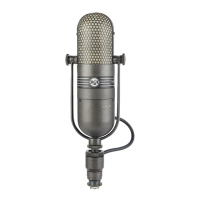
The RCA Type 77 -DX Polydirectional
Micro-
phones
MI-
4045 -F
and
MI-
11006
-C
are high -
fidelity
microphones of the ribbon type which
may easily be adjusted to obtain a
variety
of
directional
patterns. Since the MI-
4045 -F
microphone
is
primarily
intended for broad-
cast use,
it is finished in satin chrome and
a low
-gloss
umber
-gray
enamel. The MI-
11006 -C
microphone
is intended for television use
and
is
therefore completely
finished in a low
-
gloss umber -gray
enamel
which
eliminates
glaring reflections usually
seen on highly
polished
microphones.
1
Instead
of being open on both sides as
in
the conventional velocity microphone,
the
ribbon element in this microphone
is coupled
to
an
acoustic labyrinth
which
forms the body
portion of the microphone.
The tube connect-
ing the back of the ribbon
to the
labyrinth
is slotted directly
behind
the
ribbon and
fitted
with
an adjustable
shutter to secure
various
areas
of opening.
When
the opening
is
completely
closed,
the microphone
operates as
a
non -directional
pressure microphone;
at the
wide
-open position
the
microphone becomes
bi-
directional.
With
the proper size opening
the
pattern
becomes a cardioid
by
virtue
of
the
phase shift
which
occurs. Openings
smaller
or larger
than this critical
size
produce directional
patterns
with
various
sized rear
lobes.
Different amounts
of
low-
frequency attenu-
ation
are
obtained by a
reactor shunting
the
output.
APPLICATION
The microphones
are intended primarily
for
indoor
use
and if used
outdoors may require
some
additional
protection
against
the wind.
The
choice of
directional
patterns makes
possible
a considerable degree
of control
of
the
ratio
of direct sound
to
reverberant
sound
as
well
as the
possible reduction
of
unwanted sound such
as audience
noise in
a
studio.
The
wide
angle
of pick
-up provided
by
the
cardioid
pattern
is useful
in covering
large groups with
a
single
microphone. For
"close-
talking" applications
the
non -
directional
characteristic
is
of
considerable
value
since
the
low-
frequency
response is not
accentuated
as
in
the
case
of a velocity
microphone.
Numerous
other applications
of
the various directional
patterns
as
well
as
the
different response
curves
will no doubt
suggest
themselves
to the
user.
OPERATION
Mounting
The microphone will
mount on any stand
having
a 1/2
-inch
pipe
thread. Other stands
will
require
a
suitable
adaptor. The
micro-
phone
is cushion
-mounted, and
a fork
mounting
is
provided
so
that
the
microphone may
be
fitted to
the
desired
position.


 To Next Page
 Loading...