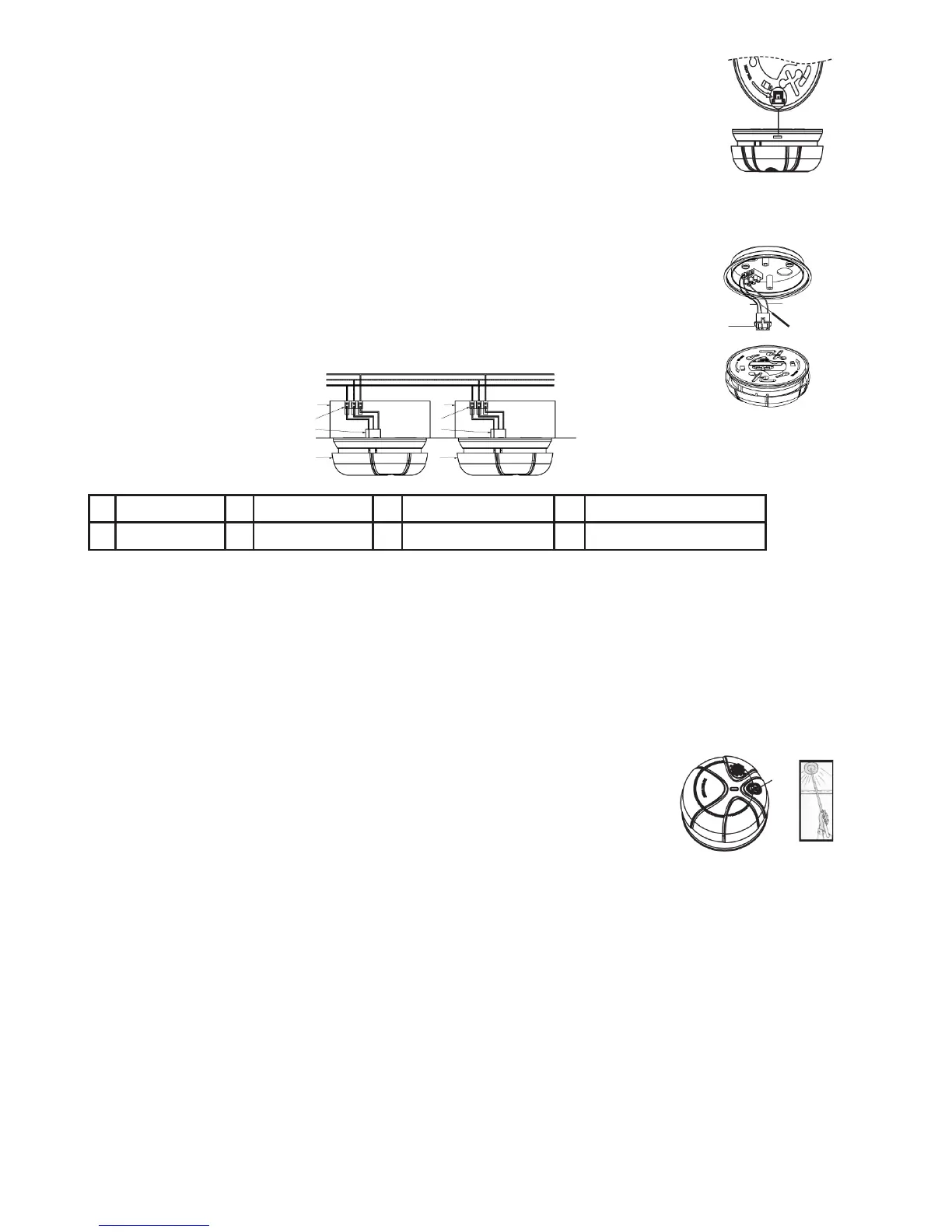
12. Position smoke alarm to mounting plate and turn clockwise to lock into place. To engage
tamper-resist feature, insert pin into notch on edge of smoke alarm after alarm is
properly positioned in base.
NOTE: Smoke alarm will not mount to plate if battery is not installed.
13. Turn on power at main fuse box or circuit breaker.
14. Push test button to test smoke alarm. See Testing The Smoke Alarm
Interconnecting Smoke Alarms
For interconnecting line, only use #14-#18 AWG minimum solid or stranded wire. When being
interconnected, maximum wire length between any two is 1500 feet for #18 AWG or 4000 feet for
#14 AWG (20 OHMS loop resistance). This smoke alarm can be interconnected with as many as 40
other DC or AC smoke alarms and / or heat alarms. Do not connect to any other type or model
smoke alarms except the ones we specify. And this smoke alarm is powered by 220-240V
AC 50Hz and with 9V DC battery back-up.
Operating Your Smoke Alarm
Once the smoke alarm has been installed a small GREEN indicator light (LED) should be visible through the alarm grill
indicating that AC supply is healthy. A RED indicator light (LED) should also flash approximately once a minute to
indicate the battery is healthy and the unit is operating properly. If smoke is detected, the unit will emit a load pulsating
alarm and a RED indicator light (LED) will be flashing quickly until the air is clear.
Testing The Smoke Alarm
1. Test each smoke alarm to be sure it is installed correctly and operating properly.
2. The push-to-test button accurately tests functions. Do not use an open flame to test this
smoke alarm. You may ignite and damage the smoke alarm or your home.
3. Test smoke alarms weekly and upon returning from vacation or when no one has been in the
household for several days.
4. Stand at arm’s length from the smoke alarm when testing.
DANGER: If alarm horn sounds, and smoke alarm is not being tested, the smoke alarm is sensing smoke. THE SOUND
OF THE ALARM HORN REQUIRES YOUR IMMEDIATE ATTENTION AND ACTION.
Maintenance and Cleaning
In addition to weekly testing, this smoke alarm requires yearly battery replacement and periodic cleaning to remove dust,
dirt, and debris.
Battery Replacement
Always turn off the AC supply to the smoke alarm before replacing the battery.
1 Smoke alarm 3 Power connector 5 Junction box 7 Interconnect (Yellow) wire
2 Ceiling or wall 4 Terminal 6 Live (Brown) AC wire 8 Neutral (Blue) AC wire
Interconnect
(Yellow)
Power Connector
Neutral (Blue)
Live
(Brown)
6
7
8
5
4
3
1
5
4
3
2
1
Test
Button


 To Next Page