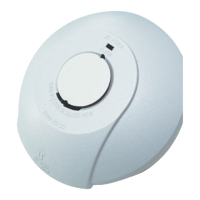
Replace the battery at least once a year or immediately when the low battery signal sounds once a minute, even though
the smoke alarm is receiving AC power. Batteries should be replaced regularly as neccessary.
WARNING: Do not use any other type of battery, except specified in this manual. Do not use rechargeable batteries.
CAUTION: Explosion will happen if battery is incorrectly replaced.
You’d better use good battery to make the alarm work long.
The battery should only be replaced by a qualified electrician or similarly qualified person.
1. Turn off AC power supply to the smoke alarm.
2. Turn smoke alarm counterclockwise to detach it from the mounting plate.
3. Gently pull down smoke alarm.
4. Remove battery from from the compartment.
5. Insert a new 9V battery to connector. NOTE POLARITY OF CONNECTIONS. Ensure the metal tab is fully depressed
when the battery has been fitted.
6. Using the Push-To-Test button, test the heat alarm to verify 9V DC battery back-up. See Testing The Smoke Alarm.
7. Reattach the smoke alarm to the mounting plate by turning smoke alarm clockwise until it snaps into place.
8. Turn on power supply and test smoke alarm using push-to-test button. See Testing The Smoke Alarm.
Choosing a Replacement Battery
This unit requires one standard 9V battery. The following batteries are acceptable as replacements:
Golden Power #6F22; Megaton #6F22; New Leader #6F22; Gold Peak #1604; Eveready #522, #1222;
Golden Power G6F22; Golden Power GL6F22A.
Cleaning
Clean the smoke alarm at least once a month to remove dust, dirt or debris. Using the soft brush or wand
attachment to a vacuum cleaner, vacuum all sides and cover of smoke alarm. Be sure all the vents are free of
debris. If neccessary, use a damp cloth to clean smoke alarm cover.
IMPORTANT: Do not attempt to remove the cover to clean inside the smoke alarm. This will void your warranty.
Practice Fire Safety
If the smoke alarm sounds its alarm horn, and you have not pushed the test button, it is warning of a dangerous situation.
Your immediate response is neccessary. To prepare for such occurrences, develop family escape plans, discuss them with
all household members, and practice them regularly.
1. Expose everyone to the sound of a smoke alarm and explain what the sound means.
2. Determine two exits from each room and an escape route to the outside from each exit.
3. Teach all household members to touch the door and use an alternative exit if the door is hot. Instruct them not to open
the door if the door is hot.
4. Teach household members to crawl along the floor to stay below dangerous smoke, fumes and gases.
5. Determine a safe meeting place for all members outside the building.
What To Do In Case Of Fire
1. Do not panic, stay calm.


 To Next Page