5
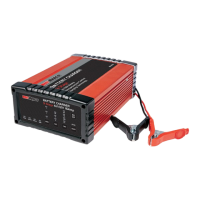
RBC16SS3
operated in any position and they have a very low
gas release during charging. These batteries are
however, sensitive to overcharging and require
a different charge algorithm than standard lead
acid batteries.
GEL - Gel batteries are a type of valve regulated
lead acid battery and are typically more costly
and do not offer the same power capacity as
AGM batteries of a similar size. The Gel Cell
Battery excels in slow discharge rates and
higher ambient operating temperatures. Gel Cell
Batteries must be recharged correctly or the
battery will suffer premature failure.
RUN / STOP:
After selecting the above parameters pressing
the RUN/STOP button starts and stops the Repco
Battery Charger. After commencing a charge
cycle, use the RUN/STOP button to stop the
Repco Battery Charger to change any of the
charge parameters, eg. current or chemistry.
Recommence the charge cycle by pressing the
RUN/STOP button.
FEATURES
MICROPROCESSOR TECHNOLOGY
The latest technology in battery chargers converts
240VAC to DC charging power using electronic
components, unlike traditional battery chargers
that rely on large heavy transformers. This allows
the charger to be lightweight and compact without
sacrificing performance. To increase safety,
polarity protection prevents the output leads from
sparking due to accidental reverse connection or
short circuit.
MAXIMISING BATTERY PERFORMANCE
Your battery will perform better when charged
using a 9-stage charger, maximising the output
from your battery.
MAXIMISE BATTERY LIFE
Batteries used regularly will last longer when
charged using a 9-stage charger, saving you
money on expensive batteries.
AUTOMATIC MICROPROCESSOR CONTROL
The charger can be left connected to the battery
without risk of overcharging. Once the battery is
full, the battery charger will automatically monitor
the battery and top up the battery when required,
ensuring it is always ready for use.
BATTERY CHEMISTRY SELECTION
The 9-stage Repco Battery Charger includes
intelligent chemistry technology to provide the
most suitable charge profile for the applicable
chemistry.
• WET (Lead Acid) - Bulk/Absorption 14.7V,
Recondition 15.8V
Conventional automotive “starting” batteries
provide a high current for short periods and are
ideally suited to automotive starting applications.
• GEL/AGM - Maximum voltage of 14.2V = GEL and
14.4V = AGM
GEL and absorbed glass mat (AGM) batteries
are types of valve regulated lead acid (VRLA)
batteries and due to their design can be orientated
in any position and exhibit very low gas release
during charging. These batteries do not allow
the replenishment of electrolyte levels and are
sensitive to over-charging, requiring lower charge
rates.
• CALCIUM - Bulk Absorption 14.7V, Equalisation/
Recondition 15.8V
Calcium batteries are essentially the same as lead
acid batteries however the inclusion of calcium
significantly reduces fluid loss, provides much
lower self-discharge characteristics, and lowers
internal resistance which increases it’s cold
cranking current (CCA) performance.
To ensure optimal battery condition and to
maintain a maximum state of charge, a special
profile is needed to balance cell voltages and/or
remove unique sulphation barriers caused when
Calcium batteries have a high demand or are left
discharged for a number of days,
To maximise your battery’s life and performance,
make sure you select the appropriate chemistry
technology.


 To Next Page
 Loading...