Need help?
Do you have a question about the RetroSound Grand Prix and is the answer not in the manual?
Lists AM/FM tuner capabilities, including presets and RDS.
Describes the DAB+ tuner with 30 presets, noting availability on export models.
Mentions HD Radio receiver availability for the Motor 4HD model.
Allows selection of international frequencies for the tuner.
Highlights the presence of an integrated MOSFET amplifier for audio output.
Notes rear-mounted auxiliary inputs, available on specific models.
Describes 3 EQ presets and manual controls for bass, mid, treble, fader, balance.
Features a 32,000 color LCD with user-selectable presets, model dependent.
Mentions rear USB ports supporting MP3, WMA, FLAC playback on select models.
Provides USB charging capability at 2.1 amps for devices, on select models.
Includes Bluetooth for hands-free calls and audio streaming, with microphone.
Offers multi-channel pre-amp outputs for front, rear, and subwoofer, model dependent.
Highlights SiriusXM®-ready feature for classic cars, requiring separate tuner/subscription.
Indicates compatibility for iPod®/iPhone® on the Motor 4HD model.
Supports wireless audio browsing from iPhone®/Android devices on Motor 4HD.
Refers to page 29 for details on the manufacturer's warranty.
General instructions to observe when operating the unit.
Directs users to the Installation Manual for installation procedures.
States Retro Manufacturing is not liable for issues from improper installation.
Provides support website, email, and chat options for installation questions.
Specifies 12-volt negative ground system requirement and inverter needs for 6-volt systems.
Warns against using the unit in marine environments or exposing it to moisture/dust.
Advises keeping volume low enough to hear surroundings and prevent hearing damage.
Explains the manual's purpose, notes model-specific features, and suggests checking for updates.
Introduces RetroSound speakers designed to match their radios for optimal audio.
Describes RetroSound amplifiers and subwoofers for enhanced low frequencies.
Features RetroPod speaker modules for vehicles without factory speaker locations.
Details the USB/Auxiliary extension cable with a 53" length.
Offers OE-quality replacement antennas with chrome plated brass masts.
Mentions RetroBelt seat belt systems for classic cars and trucks for added safety.
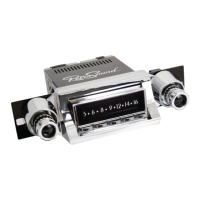
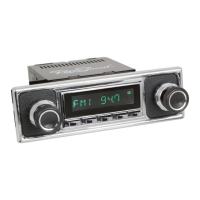
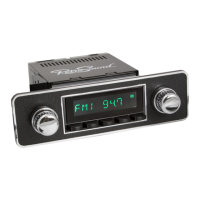
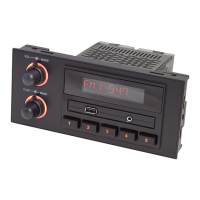
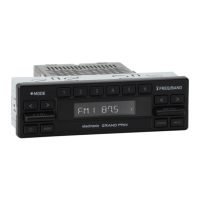
Identifies and illustrates the various controls on the front panel of the radio.
Outlines the critical first step for configuring the radio face with the motor.
Explains how to turn the radio unit on and off using the power button.
Describes how to adjust the volume using the volume paddle.
Explains how to select different audio sources like RADIO, AUX, USB, BT Audio.
Details how to tune to AM/FM, HD Radio, or DAB/DAB+ channels.
Explains how to cycle through AM and FM radio bands.
Describes the process of storing favorite radio stations into presets.
Explains how to recall previously stored radio presets.
Covers using the mute button to mute/unmute or pause/play audio.
Explains how to enter the System Settings sub-menu.
Allows switching between automatic and manual radio tuning modes.
Automatically fills FM presets with the strongest available stations.
Adjusts FM tuner sensitivity for local or distant reception.
Details how to set and adjust the unit's clock.
Option to change the clock display between 12-hour and 24-hour formats.
Selects whether the display shows the radio frequency or the current time.
Controls whether the clock is displayed when the radio is turned off.
Enables or disables the audible beep confirmation for operations.
Allows changing the display color, including custom RGB settings.
Adjusts the display brightness to High, Medium, or Low.
Turns the RDS function on/off to display station info, song titles, etc.
Selects program types to find similar stations using PTY SEEK.
Enables automatic re-tuning to a better frequency for weak signals.
Controls the traffic announcement feature for station broadcasts.
Synchronizes radio clock with station clock if supported.
Enables or disables the Bluetooth® connectivity feature.
Guides on connecting and disconnecting Bluetooth® devices.
Sets the broadcast reception area for regional tuning.
Configures the radio's volume level when it is turned on.
Changes the operating mode for specific radio faces.
Displays the current software version of the unit.
Resets the unit to its original factory default settings.
Configures DSP settings, including equalization presets like CLASSIC, POP, ROCK.
Allows adjustment of the radio's bass audio levels.
Allows adjustment of the radio's mid-range audio levels.
Allows adjustment of the radio's treble audio levels.
Adjusts the audio balance from left to right speakers.
Adjusts the audio fader from front to back speakers.
Enables or disables the XBASS function for enhanced bass tones.
Toggles the subwoofer RCA output on or off for Motor 4HD models.
Adjusts the bass tones' frequency crossover point.
Adjusts the mid-tones' frequency crossover point on select models.
Adjusts the treble tones' frequency crossover point.
Locates rear USB input ports and routing requirements for devices.
Explains using preset buttons for playback, pause, intro, shuffle, and folder navigation.
Basic playback controls applicable to all connected USB devices.
Details advanced controls for flash drives, like intro, shuffle, repeat, and folder navigation.
Instructions for enabling Bluetooth® and pairing a new device.
Guides on initiating and answering phone calls via Bluetooth®.
How to stream music from a paired Bluetooth® device.
Explains how to browse music libraries from connected devices.
Controls the automatic tuning to HD Radio stations.
How to tune to HD Radio signals and next/previous channels.
Explains navigating HD2, HD3, HD4 channels and subsequent HD signals.
Automatically fills FM presets with strongest HD Radio channels.
Describes information displayed during HD Radio broadcasts.
How to check HD Radio service information.
Lists requirements for SiriusXM® functionality (tuner, antenna, subscription).
How to check if the SiriusXM® tuner and antenna are installed correctly.
Steps to activate a SiriusXM® account using the Radio ID.
How to select SiriusXM® as the audio source.
How to change SiriusXM® channels using the auto paddle.
Explains storing up to 15 SiriusXM® channels across three bands.
Process for saving and retrieving favorite SiriusXM® channels.
Allows pause, play, skip, fast-forward, and rewind of SiriusXM® broadcasts.
How to cycle through text information (artist, song title, etc.) for SiriusXM®.
Accessing and navigating the SiriusXM® sub-menu options.
Searching for channels based on specific categories (music, news, sports).
Entering a channel number directly to tune to a specific SiriusXM® station.
Restricts access to mature content channels using a passcode.
How to change the existing passcode for the mature channel lock.
Shows the current signal strength of the SiriusXM® connection.
Addresses issues indicated by the "CHK TNR" message.
Addresses issues indicated by the "CHK ANT" message.
Solves issues related to weak satellite signals or acquisition problems.
Explains reasons for "CH UNAVL" and how to resolve them.
Addresses channels not included in the subscription package.
Explains how to unlock channels locked by the mature content filter.
Describes DAB/DAB+ digital radio broadcasting and its benefits.
Lists technical specifications for the DAB tuner, including tuning range.
Identifies the DAB/DAB+ input port on the radio body.
Details the adapter that converts AM/FM antennas for DAB reception.
Solutions for when the radio shows no lights or sound.
Addresses issues where the unit powers on but produces no audio.
Provides causes and solutions for the unit repeatedly blowing fuses.
Refers to page 12 for restoring factory defaults to resolve issues.
Clarifies that radios only work with 12-volt negative ground systems.
Explains power lead connections and voltage checks for turning the radio on.
Recommends using 16 gauge wire for connecting speakers.
Diagnoses no sound issues with 4 speakers, possibly due to wiring or impedance.
Explains that the radio's antenna wire is not compatible with semi-automatic antennas.
Identifies "out of phase" speaker wiring as a cause for poor sound.
Confirms that modifying InfiniMount Brackets does not void the warranty.
Advises against overtightening shaft nuts and mentions the backstrap for security.
Addresses engine RPM-related noise from external amplifiers.
Lists tuning range, sensitivity, selectivity, and frequency response for FM.
Lists tuning range and antenna terminal for AM.
Covers dimensions, power requirements, and current consumption.
Details output power for different Motor series (1, 2, 4).
Lists low-level output voltage for 4 channels.
Specifies the EROM (memory) type.
Details AUX input sensitivity and cable length.
Specifies the USB input type and female input.
Lists the USB charging current capability.
Lists product items and their corresponding warranty periods.
Details the duration of warranty coverage for different items.
Outlines what the warranty covers and what it excludes.
Excludes liability for incidental or consequential damages.
Identifies the manufacturer and their contact details.
Provides a URL for further information on the declaration.
 General
| Brand | RetroSound |
|---|---|
| Model | Grand Prix |
| Category | Car Receiver |
| Language | English |

 To Next Page