Need help?
Do you have a question about the RetroSound Model Two and is the answer not in the manual?
Lists specific iPod models and software versions supported by the radio.
Lists specific iPhone models and software versions supported by the radio.
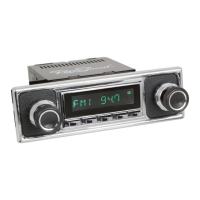
Introduction to the Model Two radio and its advanced features.
Highlights key capabilities like iPod/iPhone compatibility, Bluetooth, USB playback, and amplifier specs.
Lists all components and hardware provided with the Model Two radio for installation.
Describes the primary wire harness for connecting the radio.
Details the harnesses for power and speaker connections.
Components for mounting the radio shafts and brackets.
Kit containing plastic washers for installation.
Includes the microphone for hands-free Bluetooth calls.
Describes the adjustable shafts and L-brackets for flexible mounting.
Components for securing the radio's mounting structure.
Pack of nuts and washers for protecting shafts during installation.
Safety guidelines for operating the unit, including temperature and driver distraction.
Precautions on fuse replacement and operating a faulty unit.
Guidance on avoiding heat, moisture, dust, and seeking qualified installers.
Instructions on using correct parts, avoiding safety components, and protecting wires.
Emphasizes the requirement for +12V on specific wires for operation.
Procedure for disconnecting the battery and verifying vehicle ground.
Warning to connect the power connector only after completing wiring.
Guide for attaching and adjusting the InfiniMount brackets for optimal fit.
Instructions for mounting the radio shafts to the brackets using nuts and washers.
Directs users to the wiring instructions section for connecting the unit.
Steps for fitting the radio with faceplates or bezels into the vehicle dash.
Guidance on installing shaft covers and the front/rear knobs for a finished look.
Instructions for connecting the main, power, and speaker wire harnesses.
Key notes regarding power connection timing and system voltage requirements.
Information on connecting external audio sources via AUX inputs.
Guidance on routing USB cables for convenient device access.
Identification and basic function of the radio's front panel controls.
Detailed table mapping functions, knob presses, and modes for radio and USB playback.
Steps to enter and navigate the sound adjustment menu using the front knob.
Explanation of available EQ presets like Classic, Pop, and Rock for audio tuning.
Details on adjusting bass, mid-range, treble frequencies, and stereo balance.
Configuration options for speaker fader, bass boost (XBASS), and subwoofer output.
Fine-tuning bass, mid-range, and treble frequencies at specific Hz points.
Procedure for entering the sub-menu system using the right front knob.
Options for Auto Seek tuning, auto-storing stations, and local/distant reception.
Settings for clock format (12/24 hour), display frequency/clock priority, and screen colors.
Controls for beep confirmation, dimmer, Bluetooth ON/OFF, and RDS data display.
Options for genre-based station search (PTY) and selecting AM/FM frequency areas.
Configuration for default turn-on volume (Last or Adjustable).
Guidance on attaching USB flash drives and connecting devices for playback.
Information on supported audio file formats, bit rates, and copy protection.
How to view song metadata and control playback modes like play/pause, INT, RDM.
Introduction to making calls and streaming audio wirelessly via Bluetooth.
Step-by-step guide to pair a mobile phone with the radio for the first time.
Instructions for making, receiving, and ending phone calls using Bluetooth.
How to stream audio from a paired Bluetooth device and control playback.
Lists common problems like no power, no sound, blown fuses, and USB errors with causes and fixes.
Procedure to restore the unit to its original factory settings by removing power.
Addresses questions about 6-volt systems, positive ground, and power-on problems.
Recommendations for speaker wire gauge and troubleshooting no sound or phase issues.
Answers regarding bracket modification, amplifier noise, and USB connection errors.
Technical details for FM reception, sensitivity, selectivity, and frequency response.
Technical details for AM reception and tuning range.
Dimensions, power requirements, current consumption, and output specifications.
Details the parts and labor warranty period and conditions, along with exclusions.
 General
| Type | Digital media receiver |
|---|---|
| DIN Size | Single DIN |
| Preamp Voltage | 4V |
| EQ Bands | 5-band equalizer |
| Preamp Outputs | 3 pairs (front, rear, subwoofer) |
| Tuner | AM/FM Tuner |
| Bluetooth | Yes, with hands-free calling and audio streaming |
| USB Port | Yes |
| Aux Input | Yes |
| Display | LCD display |
| Compatibility | Compatible with iPod/iPhone |
| Faceplate | Detachable |

 To Next Page