Need help?
Do you have a question about the RetroTINK 5X Pro and is the answer not in the manual?
YPbPr, Y/C, CVBS, SCART (CVBS and RGB), Stereo Audio
240p, 288p, 480i, 576i, 480p, 576p, 720p, 1080ia
240p, 480p, 720p, 768p, 1080p, 1200p, 1440p
Approx. 0.25 frames in frame lock, 0.25 to 1.25 in triple buffered mode
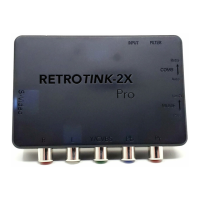
Details the various ports and controls on the RetroTINK-5X unit, including status LED, buttons, inputs, and outputs.
Cycles through each of the input ports. The detected source resolution is shown on the second line for informational purposes.
Sets the scaled output. Depending on the input resolution, not all of the modes will be available.
The RT5X uses a combination of its flexible video ADC plus polyphase scaler to produce various horizontal sampling options.
The RT5X's FPGA is capable of multiple high-quality and advanced deinterlacing modes.
The RT5X contains an experimental 240p downscale option that will output 240p from 480i, 480p and 720p sources.
The RetroTINK-5X (RT5X) Pro is an advanced video scaler designed to connect retro gaming consoles to modern high-definition televisions (HDTVs). It acts as a bridge, converting analog video signals from older consoles into digital formats compatible with contemporary displays, while also enhancing the video quality through various scaling and processing techniques. The device aims to provide a low-lag gaming experience with outputs up to 1440p, ensuring that classic games look their best on modern screens.
The primary function of the RT5X Pro is to digitize and scale analog video signals from retro consoles. It supports multiple input options, including component (YPbPr), SCART RGB, composite (CVBS), and S-video (Y/C). This broad compatibility allows users to connect a wide array of classic gaming systems. The device's standard definition processor can decode various formats such as NTSC, PAL, and PAL-60, making it versatile for consoles from different regions. Additionally, its component and RGB ports are capable of digitizing analog high-definition video up to 720p and 1080i.
At its core, the RT5X Pro utilizes a custom scaler engine implemented on an FPGA (Field-Programmable Gate Array). This hardware-based scaling ensures minimal processing lag, which is crucial for responsive retro gaming. The device offers a range of output resolutions, including 240p, 480p, 720p, 768p, 1080p, 1200p, and 1440p, allowing users to choose the best fit for their display and preferences.
The RT5X Pro also incorporates advanced deinterlacing modes to handle interlaced signals (like 480i and 576i) common in older consoles. These modes, such as Motion Adaptive, Weave, Blend, Bob, Linear, and CRT Simulation, are designed to produce flicker-free and low-artifact video, significantly improving the visual quality of interlaced content. For users who prefer a classic look, scanline effects can be applied, with options for Polyphase 50%, Polyphase 90%, and Integer modes, simulating the appearance of CRT displays.
Horizontal sampling options are available to ensure correct aspect ratios and pixel-perfect output. The RT5X Pro's flexible video ADC and polyphase scaler work together to offer various sampling modes, including generic 4:3 and 16:9, as well as console-specific modes for systems like SNES/PCE/PS1 256, Gen/PS1/Sat 320, N64 320, NEOGEO 320, Saturn 352, and PS1 384. These optimal modes sample the horizontal direction at the same rate as the original console, with the FPGA automatically interpolating and selecting the best phase for sharp output.
Vertical interpolation is handled by an advanced polyphase scaler, offering "Sharp" and "Soft" kernels. The Sharp kernel, a Bilinear Sharp type, is ideal for 2D graphics and maintains high quality even with non-integer scaling. The Soft kernel, a standard Bilinear type, may be preferred for 3D games to reduce aliasing.
The device also includes Y/C filter options (4-Line COMB and Notch) to improve composite video quality, and Colorspace settings (RGB Full and RGB Limited) to ensure proper color representation on different displays. An SDTV Low-Pass Filter (LPF) can be enabled or disabled to clean up noisy standard definition sources, with the option to bypass it if the source already has a built-in LPF. For users of Sinden lightguns, a 20-pixel wide white outer border can be enabled.
An experimental 240p downscale option is available, allowing the RT5X Pro to output 240p from 480i, 480p, and 720p sources. This feature is particularly useful for connecting to CRTs, though users are cautioned about connecting to standard definition CRTs with non-240p resolutions to prevent damage.
The RT5X Pro is designed for ease of use, with minimal adjustment required for an excellent picture.
 General
| Output | HDMI |
|---|---|
| Latency | Less than 1 frame |
| Image Adjustments | Brightness, contrast, saturation, hue |
| Color Space Conversion | Yes |
| Firmware Upgradable | Yes |
| Input | Composite, S-Video, Component |
| Output Resolution | 480p, 720p, 1080p, 1440p |
| Supported Resolutions | 240p, 480i, 480p, 576i, 576p, 720p, 1080i |
| Deinterlacing | Motion-adaptive deinterlacing |
| Scanline Options | Adjustable scanlines |
| Aspect Ratio Correction | 4:3, 16:9, custom |
| Power Supply | 5V DC |

 To Next Page