Need help?
Do you have a question about the RF-Star RF-BM-BG22A3 and is the answer not in the manual?
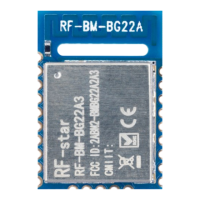
Details the RF-BM-BG22A3(I) module's core, features, interfaces, and capabilities.
Details key parameters like chipset, voltage, frequency, memory, and dimension.
Table detailing the function, type, and description of each module pin.
Specifies voltage, frequency, and temperature ranges for optimal module operation.
Common issues like transmission distance, module vulnerability, and bit error rate.
Precautions for handling modules to prevent static damage.
The RF-BM-BG22A3(I) is a Bluetooth 5.2 Low Energy module designed for a wide range of applications, including asset tags and beacons, consumer electronics remote controls, portable medical devices, sports, fitness, and wellness devices, connected home solutions, and building automation and security systems. This module is based on the Silicon Labs EFR32BG22 SoC series, featuring a 32-bit ARM® Cortex®-M33 core with a maximum operating frequency of 76.8 MHz. Its design emphasizes low power consumption, a compact size, robust connection distance, and rigid reliability, making it suitable for various demanding environments.
The RF-BM-BG22A3(I) module serves as a versatile RF solution, integrating essential components such as a 38.4 MHz crystal, matching networks, a low-pass filter, and antenna options. It supports Bluetooth 5.2 Low Energy, enabling efficient and secure wireless communication for battery-powered devices. A key feature is its support for Bluetooth Mesh Low Power Node functionality, which allows for the creation of large-scale, self-healing mesh networks with extended battery life for individual nodes.
One of the advanced capabilities of this module is direction finding using Angle-of-Arrival (AoA) and Angle-of-Departure (AoD). This enables precise location services and enhanced spatial awareness for applications requiring accurate positioning. In addition to standard Bluetooth protocols, the module also supports proprietary communication protocols, offering flexibility for custom applications and specialized data transmission needs.
The module provides a rich set of analog and digital interfaces, including PRS (Peripheral Reflex System), ADC (Analog-to-Digital Converter), UART (Universal Asynchronous Receiver/Transmitter), SPI (Serial Peripheral Interface), I2C (Inter-Integrated Circuit), PWM (Pulse Width Modulation), ISO 7816, IrDA (Infrared Data Association), I2S (Inter-IC Sound), EUART (Enhanced Universal Asynchronous Receiver/Transmitter), and PDM (Pulse Density Modulation) for digital microphones. These interfaces allow for seamless integration with various sensors, actuators, and other components in an embedded system.
Security is a paramount aspect of the RF-BM-BG22A3(I). It incorporates robust security features such as Secure Boot with Root of Trust and Secure Loader (RTSL), ensuring the integrity and authenticity of the firmware. Hardware cryptographic acceleration is provided for algorithms like AES128/256, SHA-1, SHA-2 (up to 256-bit), ECC (up to 256-bit), ECDSA, and ECDH, enabling fast and secure data encryption and authentication. A True Random Number Generator (TRNG) compliant with NIST SP800-90 and AIS-31 is included for generating high-quality random numbers essential for cryptographic operations. ARM® TrustZone® technology further enhances security by creating isolated execution environments for sensitive code and data. Secure Debug with lock/unlock mechanisms protects against unauthorized access during development and deployment.
The module's integrated PA (Power Amplifier) allows it to achieve a TX power of up to 6 dBm, contributing to its robust connection distance. It is available in a 1.27-mm pitch stamp stick package, facilitating easy assembly and cost-effective PCB design. For simplified programming, the module can be preprogrammed with an RF-star BLE5.0 serial communication protocol.
The RF-BM-BG22A3(I) is designed for ease of use and integration. It supports a wide operation range with a single power supply, operating in DC-DC mode from 2.2 V to 3.8 V and in bypass mode from 1.8 V to 3.8 V. The recommended supply voltage is 3.3 V for optimal performance. The module operates across a broad temperature range of -40 °C to +85 °C, with a storage temperature range of -40 °C to +125 °C, making it suitable for industrial and outdoor applications.
The module offers flexible antenna options. The RF-BM-BG22A3 variant includes an onboard PCB antenna and a half-hole ANT pin, while the RF-BM-BG22A3I variant features an IPEX connector and a half-hole ANT pin. The default delivery for RF-BM-BG22A3 is the onboard PCB antenna, with a 0 Ω resistor (R1) welded. To use an external antenna via the ANT pin, R1 must be disconnected. For RF-BM-BG22A3I, the default delivery is the IPEX connector, and to use an external antenna via the ANT pin, the capacitor connected to the IPEX must be removed and the solder joint shifted to the left.
For optimal antenna performance, specific layout recommendations should be followed. The antenna should be placed on the edge or corner of the PCB, and there should be no signal lines or copper foil in any layer below the antenna. It is also recommended to hollow out the PCB area beneath the antenna to minimize interference and ensure the S11 parameter of the module is minimally affected. When designing with an external antenna using the half-hole ANT pin, a Π-type matching circuit is reserved, and 50 Ω impedance control should be applied to the RF traces. Traces should be as short as possible, use 135° or arc traces, and avoid changing layers with vias. Placing multiple GND vias around the RF traces is also recommended.
The module's firmware can be customized by modifying the frequency offset register. This involves locating the sl_device_init_hfxo_config.h file in the project and adjusting the CTUNE value. The default CTUNE value is 140, but RF-star changes it to 72 for its standard EFR32BG22 series modules, based on development board hardware RF requirements. Users can modify this value within a range of 0 to 255 to fine-tune the frequency offset.
To ensure the long-term reliability and performance of the RF-BM-BG22A3(I) module, several maintenance and handling considerations are important.
Power Supply: It is crucial to provide the module with a DC stabilized power supply that has a tiny power supply ripple coefficient and a reliable ground. Incorrect polarity can cause permanent damage. The supply voltage must remain within the recommended range (2.2 V to 3.8 V in DC-DC mode, 1.8 V to 3.8 V in bypass mode) and be stable, without frequent fluctuations. When designing the power supply circuit, it is advisable to reserve more than 30% margin to ensure stable operation over time. The module should be kept away from power electromagnetic sources, transformers, high-frequency wiring, and other components that generate significant electromagnetic interference.
PCB Layout: The bottom of the module should avoid high-frequency digital, analog, and power routing. If routing is necessary on the bottom layer (assuming the module is soldered to the top layer), copper must be spread on the connection part of the top layer and the module, and routed close to the digital part of the module in the bottom layer, with all copper well-grounded. Random routing on bottom or other layers can affect spurs and receiving sensitivity.
Electromagnetic Interference (EMI): Devices generating large electromagnetic interference near the module can significantly impact its performance. It is recommended to maintain distance from such devices based on the interference strength. If circumstances permit, appropriate isolation and shielding should be implemented. Similarly, high-frequency digital, analog, and power routings around the module should be kept away to prevent performance degradation. Devices using TTL protocol at the 2.4 GHz physical layer, such as USB 3.0, should also be avoided near the module.
Transmission Distance and Bit Error Rate: Unsatisfactory transmission distance can be caused by linear communication obstacles, temperature, humidity, co-channel interference, and ground absorption/reflection of radio waves. Metal objects near the antenna or placing the module inside a metal shell will significantly attenuate the signal. Incorrect power register settings or high data rates can also shorten the communication distance. Low power supply voltage can reduce output power. Mismatched or poor-quality antennas will also affect communication range.
High bit error rates can result from co-channel signal interferences, an unreliable power supply, or poor-quality/long extension/feeder wires. To mitigate these issues, it is recommended to move away from interference sources, modify frequency and channel settings, ensure a reliable power supply, and use high-quality, short antenna cables.
Electrostatic Discharge (ESD) Warnings: The module is susceptible to damage from static discharge. To prevent this, all modules should be handled with anti-static measures. Bare hands should not touch the modules, and they must be placed in anti-static areas. Product designs should incorporate anti-static circuitry, especially when dealing with high voltage (HV) or very high frequency (VHF) inputs. Static discharge can lead to performance degradation or even module failure.
Soldering and Reflow Conditions: For soldering, conventional convection or IR/convection heating methods are recommended. The solder paste composition should be Sn96.5/Ag3.0/Cu0.5. The module can withstand reflow soldering up to two times, following a specific temperature profile. The peak temperature should not exceed 245 °C. Adhering to the recommended temperature table for soldering and reflow is essential to prevent damage to the module.
Packaging: The default packaging method is by tray, with each tray holding a maximum of 100 pieces. For larger quantities, modules are shipped in corrugated cardboard boxes, with a maximum of 7500 pieces per box. If tape and reel packaging is preferred, customers should contact RF-star in advance. Tape and reel packaging includes double protection with protective tape and foam, and modules are stored in aluminum moisture barrier bags with humidity cards and desiccant to protect against moisture-sensitive components.
By following these guidelines, users can ensure the optimal performance, longevity, and reliability of the RF-BM-BG22A3(I) module in their applications.
 General
| Category | Bluetooth Module |
|---|---|
| Chip | Silicon Labs EFR32BG22 |
| Frequency | 2.4 GHz |
| Bluetooth Version | Bluetooth 5.2 |
| Transmit Power | Up to +6 dBm |
| Operating Voltage | 1.71 V to 3.8 V |
| Antenna | PCB Antenna |
| Flash Memory | 512 KB |
| RAM | 32 KB |
| Operating Temperature | -40°C to 85°C |
| Interfaces | UART, I2C, SPI, GPIO |

 To Next Page