Ricoh 500 Owner’s Manual Page 6 of 14
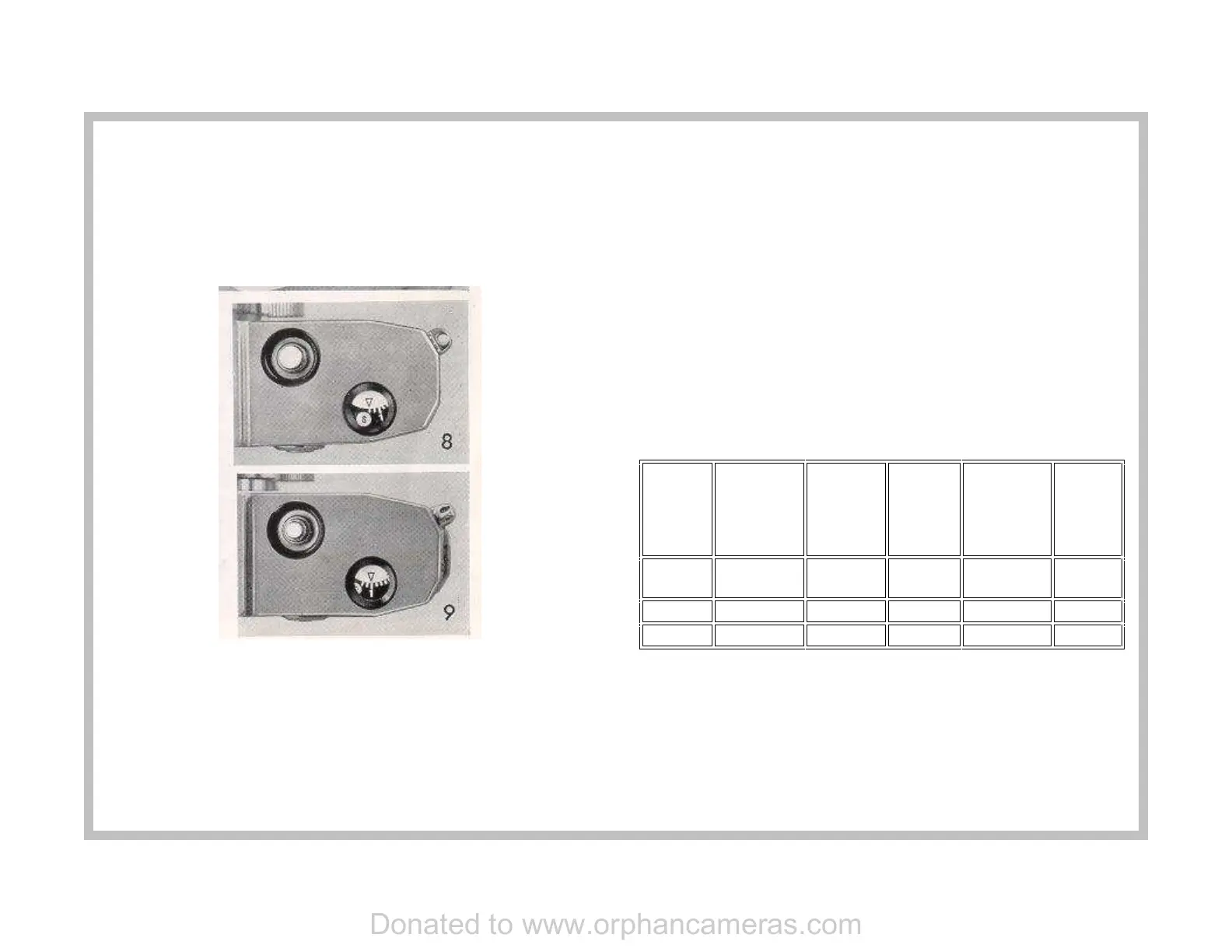
Release the shutter again and advance the film once more,
and you will find that the arrow in the film counter is opposite
a point closer to "1" than to "S". When the film is advanced
for the 3rd time, the arrow points at "1". Then set the LIGHT
VALUE required and take your first picture.Anything taken
on a frame before the arrow points at "1" is likely to be on an
exposed part of the film, and therefore to be useless.
EXPOSURE AND LIGHT VALUE
In taking a picture a certain amount of light must pass through the
lens and reach the film. This is what is called an exposure. If the
amount of exposure is too great or too little, the picture will be no
good. In the conventional type of camera one has to set the shutter
speed and the required f stop separately. The LIGHT VALUE device
eliminates all this trouble, since any change in the shutter speed due
to any change in the f stop or any change in the f stop due to any
change in the shutter speed is done AUTOMATICALLY. It must of
course be understood that the amount of light is about the same.
(Webmaster: this does not mean you have an Automatic camera or
light meter. It just means if you go by the estimates of the lighting,
this camera will allow you to somewhat get your exposure close. A
light meter is suggested)
This is the first Japanese camera which makes AUTOMATIC the
giving and ensuring of the correct exposure by simply setting the
LIGHT VALUE indicator. This is a mechanical brain that computes
the correct exposure for you, provided you know what the LIGHT
VALUE is.
LIGHT VALUE TABLE
ASA/DIN
Index
Snow,
mountain,
scenery
Light
Subject,
Distance
scene
shade,
open
Dark
Subjects,
shade,
building
Among
room
DIN)
14 13 12 11 10
100 (21) 15 14 13 12 11
200 (24) 16 15 14 13 12
a. For mornings and evenings subtract 2 from figures indicated.
b. When slightly cloudy subtract 1, cloudy 2 and rainy 3.
c. For color film you are strongly advised to use an electric
exposure meter.
Donated to www.orphancameras.com


 To Next Page
 Loading...