Page / Seite 17
Für die ersten Flüge empfehlen wir eine lange Start- und Landebahn zu benutzen, vor allem,
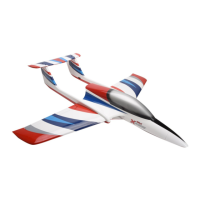
wenn dies Ihr erstes Jet-Modell ist, das Sie fliegen. Die Mini Xcalibur E verfügt über eine gute Größe
mit passender Leistung, so kann großräumig geflogen werden - eine lange Start - und Landebahn
und ein genügend großer Luftraum macht die ersten Flüge viel sicherer und angenehmer.
Führen Sie einen gründlichen Reichweitentest vor dem Flug durch. Testen Sie die Reichweite mit
abgeschaltetem Impeller sowie mit eingeschaltetem Impeller in allen Drehzahlbereichen. Überprüfen
Sie alle Steuerelemente, um sicherzustellen, dass diese in die richtige Richtung und mit den richtigen
Ausschlägen arbeiten, und dass kein Spiel, oder Verlust in der Bewegung in einer den Anlenkung
verloren geht. Überprüfen Sie alle Gabelköpfe und Kugelgelenke, ob diese gesichert sind. Jeder
Gabelkopf der verwendet wird, muss mit einer Sicherung versehen werden. Danach überprüfen Sie
das Einziehfahrwerk auf einwandfreie Funktion.
Rollen Sie das Modell zur Start- und Landebahn - obwohl die Klappe beim Start verwendet wird,
empfehlen wir Ihnen, dies nicht bei den ersten Flügen zu tun. Ist das Bugrad richtig getrimmt, sollten
keine Ruderbewegungen während des frühen Stadiums bei Starten erforderlich sein. Es sei denn
es zieht Seitenwind auf. Einmal Abfluggeschwindigkeit aufgenommen, wird nur etwas Höhenruder
hinzugefügt. Dies ist erforderlich. damit das Modell abheben kann. Wir empfehlen Ihnen das
Fahrwerk einzufahren, und das Modell auf Flughöhe zu bringen. Nachdem Sie eine komfortable
Höhe erreicht haben sollten Sie die Leistung reduzieren, da das Modell sehr schnell Geschwindigkeit
aufbauen kann. Normalerweise reicht 75% der Leistung, um die komfortable Reisegeschwindigkeit
zu halten.
Sie können jetzt mit der Feintrimmung beginnen. Sobald das Modell richtig ausgetrimmt ist,
elevator is all that is required to allow the model to lift off, whereupon we suggest that the landing
gear be retracted and the model allowed to climb to circuit height. Once at a comfortable height
power should be reduced, generally around 75% power is ample to maintain a comfortable cruise
speed.
Fine trimming can now be carried out, and once the model is correctly trimmed we suggest that
a few handling manoeuvres are performed at a safe height, for example turns in both directions,
slow flight, a clean stall etc. When happy with the handling of the model it is recommended that
the model be slowed down, the undercarriage lowered and flap applied into landing configuration.
Perform a practice landing approach at a safe height. This will help you understand the descent
rates and flight characteristic and lower speeds.
The Mini Xcalibur E is a fairly simple model to land, a normal approach should be flown to stabilise
the model and slow it enough to lower the undercarriage, once aligned with the runway the flap
can be lowered in stages until full flap is applied – note that more power will be required due to
the increased drag of the flap. You will find that the Mini Xcalibur E is very stable in the landing
configuration and it should be relatively simple to position the model for an accurate touchdown, the
stability once on the ground being excellent due to the wide track of the main wheels.
Thanks to the sleek design the Mini Xcalibur E it is a pleasure to fly through most aerobatics, and
rolls, loops, spins etc are all easily performed, as can be slow flight. The model is very stable and
smooth to fly and we hope that you enjoy flying your Mini Xcalibur E as much as we enjoy flying
ours!


 To Next Page
 Loading...