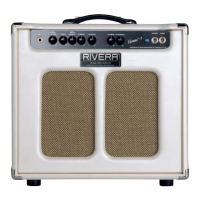
RIVERA VENUS 3 COMBO £1,166
GUITAR AMPS
The Rivals
Vox’s AC15H1TV 1 x 12 combo
(£895) is a reworking of its
classic small amp with plenty of
great modern tones lurking
inside. Good value for money,
but where the build quality is
concerned Rivera is in a
different league. Fender’s ’57
Tweed Deluxe re-issue
(£1,449) costs a fair bit more,
but this is a faithful recreation of
the archetypal small valve
combo – one of the most
recorded amps of all time. Larry
Carlton used one of these
throughout his studio career.
Wonderful tone and bulletproof
build quality – for great
recorded guitar sounds, this is
one of the classics. Cornford’s
Carrera combo (£999) is pure
Class A single-ended luxury; the
flexibility to swap the valves in
preamp and power amp makes
the Carrera a superlative
recording tool and, yes, even at
around eight watts you can use
this one live too.
T
o the vast majority of us,
Paul Rivera needs no
introduction. For well over
30 years he’s been one of rock
guitar’s most influential amp
designers with a CV that includes
credits for Yamaha, Music Man
and, of course, Fender where he
revitalised that company’s range
during the early eighties with
such classics as the legendary
Super Champ. Today Rivera is
one of the most coveted backline
names, with an incredibly diverse
list of users. There aren’t many
amp companies who can include
Nashville legends like Doyle
Dykes and Vince Gill alongside
monster metal players such as
Slipknot’s Jim Root and Mick
Thomson, or legendary session
artists such as Steely Dan alumni
Jeff ‘Skunk’ Baxter and Jay
Graydon among their customers.
The current flagship of Paul’s
popular two-channel line is the
recently-introduced Class A
Venus 6 (reviewed in issue 292),
which has now been joined by a
single-channel version, the
Venus 3, that’s threatening to
become one of the best recording
amps money can buy. Can this
little combo live up to the hype
though? Let’s take a closer look…
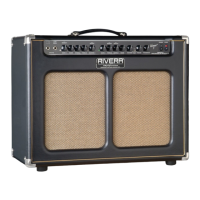
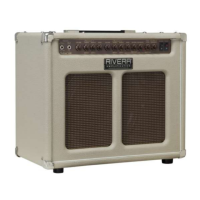
Like all Riveras, the Venus 3 is
built to a higher standard than
many of its competitors, with a
tough ply cabinet, a removable
speaker grill and a rear panel
that’s bolted into place – there are
no flimsy woodscrews here. Look
closely at the Venus’s trademark
pearlescent cream vinyl covering
and you’ll notice there are no cuts
to be seen anywhere, even on the
radiused inside corners of the
speaker grill – that’s not easy to do
and few companies match this
standard. The gold piping, split
straw grill and old-style control
knobs all work to accentuate that
popular retro-modern vibe.
The front panel is
straightforward enough, with
controls for gain, volume, and a
three-band EQ. There are also
level controls for presence and the
Venus’s built-in spring reverb. No
Rivera would be complete without
at least one pull switch, and the V3
has two: the first is a pull boost on
the gain control; the second is a
pull notch on the mid-range,
which works to approximate the
two classic American EQs – tweed
(more 1950s in influence) and
blackface (’60s).
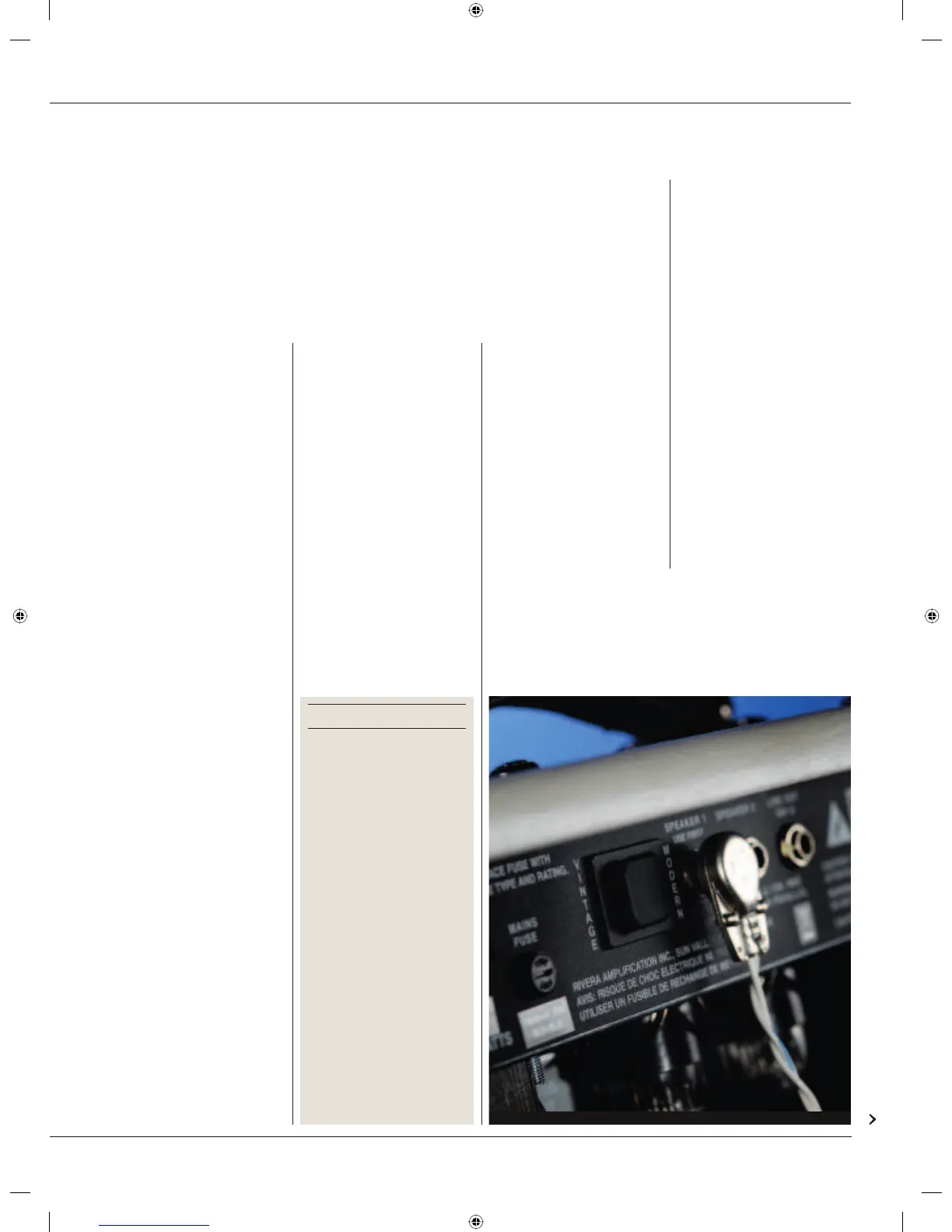
Move around to the rear and
you’ll find a simple series effects
loop (meaning no level control),
a fixed line out and a Vintage/
Modern switch that rewires the
output valves in triode mode,
dropping the power to around
seven watts and enhancing even
harmonics – perfect for home use
or recording. Inside the sturdy
steel chassis – even though it’s
smaller and simpler – everything
is still unmistakeably Rivera, with
most of the electronics on a top-
quality aerospace grade PCB,
securely held in place by metal
standoffs. Overall, the V3 retains
Rivera’s typical pro power tool
vibe, while that classy vinyl finish
looks equally at home in a living
room as it does in a recording
studio.
Sounds
But good looks aren’t enough to
give this diminutive combo a place
on our hot-list. How well does the
Venus 3 perform in the demanding
environment of the recording
studio? It’s pretty obvious that
this amp doesn’t have the
immediate flexibility of the
footswitching dual-channel
Venus 6, but after a few minutes
experimenting with the tone
controls it’s also obvious that in
a studio, where you don’t need to
access sounds instantly, the V3 is
easily capable of providing the
same instantly gratifying Class A
vibe. There’s some of the natural
squeezing of bandwidth that you
get when using a smaller driver –
less bass tends to accent the
mid-range frequencies, which can
make 1 x 10s sound a little nasal
and boxy – but Rivera counters
this with a very flexible EQ and a
nicely-voiced custom Eminence
loudspeaker, making it quick and
easy to get some great rhythm and
lead tones for a simple 16-track
commercial mix.
The range and quality of
distortion is what most people will
buy this amp for – it’s easy to pile a
lot of gain into a preamp, but very
difficult to take that and make it
stable and dynamically
responsive. Very few amp
designers do this trick as well
Rivera Venus 3 combo £1,166
The Venus 3 sets out to prove that the best things really do
come in the smallest packages – but does it sound as good
as it looks? by Nick Guppy
It’s easy to pile a lot of gain into a preamp,
but very difficult to make it stable and
dynamically responsive. Few designers
do this trick as well as Paul Rivera
The rear Vintage/Modern switch rewires the output valves and drops the power
GIT304.rev_rivera 115 16/5/08 13:52:58


 To Next Page
 Loading...