Features
Startup tuning eliminates time required for conventional
autotuning as it calculates optimum PID values by temperature
characteristics at start up.
It is useful in applications which require a long time for
conventional autotuning.
The timing of activation of start-up tuning can be selected from
at power-up, at setpoint change, and at power-up/setpoint
change. It is also settable to Only-once or always-ON.
Simple program control
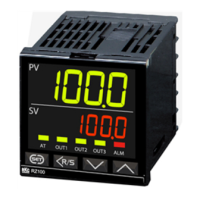
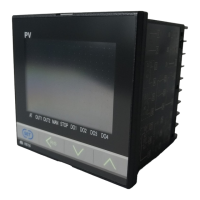
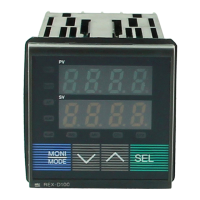
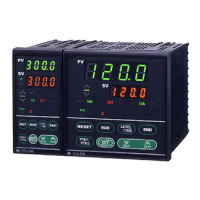
Process/Temperature Controller RB100/400/500/700/900
SV1
SV2
SV3
SV4
Simple program control using a timer function / setting change
proportion limiter
Power ON or RUN
Timer setting
Control stop/continuous
Ramp-to-setpoint (Up)
Repeat
Ramp-to-setpoint (Down)
SV
SV
Calculates optimum PID values to stabilize
control faster than ever
The improved autotuning algorithm calculates optimum PID
values that shortens the time to reach stable control at the set
value as well as eliminating overshoot/undershoot.
The new PID algorithm also suppress overshoot/undershoot
against external disturbance.
PID control with the conventional AT
PID control with the improved AT
SV
Easy Fine tuning with 6-level of control
response adjustment
After the PID values have been autotuned, the Fine tuning (FT)
function allows the operator to adjust the control response speed
with a 6-level adjustment parameter (-3 to +3) without changing
PID value.
6-stage Fine tuning (-3 to +3) to adapt to the control object
Controllability with the PID
values obtained with the AT.
Slow the response
Quicken the response
-3 to -1: Faster response
1 to 3: Slower response
0: Function OFF
Fine tuning
(+) side setting
Fine tuning
(-) side setting
Startup tuning
The RB series has a standard loader port to connect to a PC
USB port via COM-K2 (USB communication converter).
Using Win-UCI software on the PC, parameter settings can be
easily saved on the PC in CSV format, and the same parameter
settings are easily copied to other controllers.
• Startup tuning function can be set ON/OFF.
• Heater power needs to be turned on simultaneously with or before turning on power to the
temperature controller.
• If startup tuning does not calculate suitable PID values due to characteristics of application,
use Autotuning function.
SV
Startup-tuning at power-up
Startup-tuning at SV change
Startup-tuning at both power-up
and SV change
Power ON
SV2
SV1
SV2
SV1
SV change
Tuning
ON
Tuning
ON
Tuning
ON
Tuning
ON
Power ON
SV change
USB port
Upload
Download
COM-K2
70
Unit : mm
26
RS-422A/485
USB
39
Easy parameter setup via USB loader port
A communication protocol converter becomes a Master Unit to
PLC, and automatically stores temperature data into registers in
a PLC. This enables easy handling of temperature control
system to the exiting PLC system is available.
• The power to COM-K2 is supplied
from the PC via the USB port so
no power supply is necessary.
USB communication
converter
Loader Port
• The loader port is only for
parameter setup.
USB communication converter
COM-K2
Model code :
COM-K2-1
COM-K2-N
(With loader communication cable)
(Without loader communication cable)
Connector (Phoenix contact)
(Included in a converter package)
Loader communication
Cable length : 1.5m
(Optional)
Cable length : 1m
(Standard accessory)
RS-485
A
62P
A
3
N
CPU
SYSMAC C200HX
PROGRAMABLE CONTROLLER
CPU85-Z
PA204
RUN
ERR
INH
COMM
RDY
COMB
COMA
RS-422A
RS-485
PLC Communication
Protocol Converter
COM-JE
RB100/400/900
Mitsubishi
MELSEC series
Omron
SYSMAC series
Available PLC
MODBUS
Protocol
PLC
Communication
(Mapman Function)
TEMP.
PLC
Mapman Function
enables PLCs and
RKC temperature controllers
to act as one.
PLC Communication Protocol Converter
: COM-JE
2
RB_02E



 To Next Page
 Loading...