9
DE/EN/FR
Abkürzungen: Mittelüssiger Sekundenkleber (SK), Holzleim (HL), 10min EpoxyHarz (EH)
Abbreviations: Medium-bodied superglue (SK), wood glue (HL), 10min epoxy resin (EH)
Abréviations: Colle cyanoacrylate mi-liquide (SK), colle à bois (HL), résine époxyde (EH) 10min.
BAU- UND BETRIEBSANLEITUNG / INSTRUCTIONS AND USER MANUAL / MANUEL D´UTILISATION
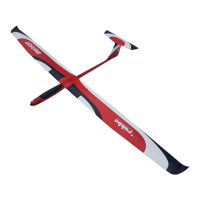
Der Marabu 6 ist ein richtiges Retro-Modell und stammt ursprünglich aus
den frühen 70er Jahren. Die zeitlose Optik und die damals schon überra-
gende Thermikleistung wurden zum Anlass genommen, dass Modell wieder
auferstehen zu lassen. Die Konstruktion wurde vom Ursprungsplan soweit
übernommen, dass äußerlich keine Unterschiede zum damaligen Modell
feststellbar sind. Der innere Aufbau wurde dem heutigen Fertigungsstandard
so gut wie möglich angepasst.
Durch das steckbare Pendelhöhenleitwerk und die 2-teilige Tragäche ist
das Modell sehr transportfreundlich. Die Tragäche wird nach wie vor mit
Gummiringen am Rumpf gehalten. Dies verhindert bei unsanften Lan-
dungen, dass das Modell einen Schaden erleidet.
Der Bausatz und die Flugeigenschaften sind auch für Anfänger geeignet!
Der Rumpfausbau wurde so gestaltet, dass ausgesuchte Komponenten Platz
nden. Daher ist es ratsam, die empfohlenen Komponenten zu verwenden,
um hier einen zusätzlichen Bastelaufwand zu vermeiden. Eigeninitiative ist
jedoch gerne willkommen.
Der Marabu 6 eignet sich besonders gut für Thermiküge in der Ebene. Der
Start erfolgt hier nach alter Väter Sitte am einfachsten mit einem Hoch-
startgummi. Mit einer Ausgangshöhe von ca. 90m ist bei entsprechender
Wetterlage, Thermikanschluss garantiert.
Je nach Lust und Laune ist es aber auch möglich, den Marabu mit einem
Nasenantrieb auszustatten. Die zusätzlichen Bauteile hierfür sind im Bausatz
enthalten. Eine Motorempfehlung ist am Bauplan bzw. weiter unten ver-
merkt.
Als Prol wird nun ein cr001sm verwendet, das dem originalen aus den 70ern
optisch sehr ähnlich, jedoch mit 7,3% deutlich dünner ist. Damit bleiben die
ursprünglich sehr angenehmen Langsamugeigenschaften erhalten, und es
kann damit vorzüglich in der Thermik gekreist werden. Mit einem Flugge-
wicht von etwa 900g liegt die Stärke des Modells eindeutig im Thermikug.
Hangug ist bei entsprechend leichten Windbedingungen natürlich auch
möglich.
Die Tragäche wird komplett in Holz, mit Kieferholm und einer Nasenbeplan-
kung aus 1,5mm Balsaholz, in zweiteiliger Bauweise erstellt. Die Fläche wird
aufgrund der konkaven Prolform auf dem Rücken liegend aufgebaut. Die
Rippen haben an der Endleiste entsprechende Füße und somit geht der
Aufbau recht einfach von der Hand. Auch ist die vorgesehene Schränkung
in der Fußhöhe der Rippen bereits berücksichtigt.
Die Anleitung ist so aufgebaut, dass die Bauschritte verständlich für den
fortgeschrittenen Modellbauer dargestellt sind. Bilder der Baustufen verdeut-
lichen die Schritte noch zusätzlich und lassen hoffentlich keine Fragen offen.
Besondere Tipps, werden optisch hervorgehoben.Besondere Tipps, werden optisch hervorgehoben.
Als Servos empfehlen wir:
• 2 Stk Robbe FS66 BB MG # 9105 oder FS166 BB MG HV # 9123
Als Empfängerakku/Antriebsakku empfehlen wir:
• 5-zelligen NiMH Akku mit AA-Zellengröße (ca. 2000mAh) oder einen 2s
Lipo
• 2s 1300-5000mAh (zB. RO-POWER ULTRA LiIo 4200MAH 7,4V #7419 für HV
Betrieb)
Als Antriebsset empfehlen wir:
• RO-Power Torque LS 3223/10 # 5832
• Mittelstück „schmal“ 28mm für 4mm Motorwellen
• 16x8 Klappluftschraube
• 2s Lipo Flugakku 1300mAh (z.B. Ro-Power Ultra Maxamp 1300mAh # 7355)
• 30A Regler
EINFÜHRUNG / GENERAL ABOUT THE MODEL / GÉNÉRALITÉS SUR LE MODÈLE
The Marabu 6 is a real retro model and originally dates back to the early
70s. The timeless look and the outstanding thermal performance at that time
were taken as an opportunity to resurrect the model.
The design was adopted from the original plan to such an extent that
no external differences to the original model are discernible. The internal
structure has been adapted as closely as possible to today‘s manufacturing
standards.
Thanks to the plug-in pendulum tailplane and the 2-piece wing, the model is
very easy to transport. The wing is still held to the fuselage with rubber rings.
This prevents the model from suffering damage during rough landings.
The kit and the ight characteristics are also suitable for beginners!
The fuselage extension has been designed to accommodate selected
components. It is therefore advisable to use the recommended compon-
ents in order to avoid additional tinkering. However, your own initiative is
welcome.
The Marabu 6 is particularly ideal for thermal ights on at terrain. The easiest
way to launch it is with a high start with rubber cord. With a starting altitude
of approx. 90m, thermal access is guaranteed in appropriate weather
conditions.
Depending on your mood, it is also possible to equip the Marabu with a
nose drive. The additional components for this are included in the kit. A
motor recommendation is noted on the construction plan or below.
A cr001sm prole is now used, which looks very similar to the original from the
70s, but is signicantly thinner at 7.3%. This retains the original very pleasant
slow-ying characteristics and allows excellent thermal circling. With a ying
weight of around 900g, the model‘s strength lies clearly in thermal ight.
Slope ying is of course also possible in light wind conditions.
The wing is made entirely of wood, with pine spars and a nose planking of
1.5mm balsa wood, in a two-piece construction. Due to the concave prole
shape, the wing is built lying on its back. The ribs have corresponding feet on
the end strip, which makes assembly quite simple. The planned setback in
the foot height of the ribs is also already taken into account.
The instructions are structured in such a way that the construction steps are
clearly presented for the advanced model builder. Pictures of the construc-
tion stages further illustrate the steps and hopefully leave no questions
unanswered.
Special tips are highlighted visually.Special tips are highlighted visually.
We recommend the following servos:
• 2 pcs Robbe FS166 BB MG # 9105 or FS166 BB MG HV # 9123
We recommend the following as receiver battery/drive battery:
• 5-cell NiMH battery with AA cell size (approx. 2000mAh) or a 2s Lipo
• 2s 1300-5000mAh (e.g. RO-POWER ULTRA LiIo 4200MAH 7.4V #7419 for HV
mode)
We recommend the following drive:
• RO-Power Torque LS 3223/10 # 5832
• Center piece „ slim“ 28mm for 4mm motor shafts
• 16x8 folding prop
• 2s Lipo Flight battery 1300mAh (e.g. Ro-Power Ultra Maxamp 1300mAh #
7355)
• 30A controller
Le Marabu 6 est un modèle vraiment rétro qui date du début des années
70. Son aspect intemporel et ses performances thermiques déjà excepti-
onnelles à l‘époque ont été l‘occasion de ressusciter ce modèle.
La construction a été reprise du plan d‘origine de telle sorte qu‘il n‘y a pas
de différences extérieures avec le modèle de l‘époque. La structure interne
a été adaptée autant que possible aux normes de fabrication actuelles.
Le modèle est très facile à transporter grâce à l‘empennage pendulaire et
à l‘aile en deux parties. L‘aile est toujours maintenue au fuselage par des
anneaux en caoutchouc. Cela évite que le modèle subisse des dommages
en cas d‘atterrissage brutal.
Le kit et les caractéristiques de vol conviennent également aux débutants !
L‘aménagement du fuselage a été conçu de manière à pouvoir accueillir
des composants sélectionnés. Il est donc conseillé d‘utiliser les composants
recommandés an d‘éviter un bricolage supplémentaire. Les initiatives
personnelles sont toutefois les bienvenues.
Le Marabu 6 est particulièrement bien adapté aux vols thermiques en
plaine. Le décollage s‘effectue ici selon la vieille coutume des pères, le plus
simplement avec un élaastique de décollag. Avec une altitude de départ
d‘environ 90 m, la connexion aux thermiques est garantie si les conditions
météorologiques le permettent. Selon l‘envie et l‘humeur, il est également
possible d‘équiper le Marabu d‘une propulsion. Les éléments supplémen-
taires pour cela sont inclus dans le kit. Une recommandation de moteur est
indiquée sur le plan de construction ou plus bas.
Le prol utilisé est maintenant un cr001sm, visuellement très proche de
l‘original des années 70, mais nettement plus n (7,3%). Les caractéristiques
de vol lent, très agréables à l‘origine, sont ainsi conservées et il est possible
de faire des cercles dans les thermiques. Avec un poids en ordre de vol
d‘environ 900 g, la force du modèle réside clairement dans le vol ther-
mique.
Le vol de pente est bien sûr aussi possible avec des conditions de vent
légères.
L‘aile est entièrement construite en bois, avec un longeron en pin et un
bord d‘attaque en balsa de 1,5 mm, en deux parties. L‘aile est construite
sur le dos en raison de la forme concave du prol. Les nervures ont des
pieds correspondants au niveau de la baguette d‘extrémité, ce qui rend le
montage assez facile. De plus, l‘inclinaison prévue est déjà prise en compte
dans la hauteur des pieds des nervures.
Les instructions sont conçues de manière à ce que les étapes de construc-
tion soient compréhensibles pour les modélistes avancés. Les images des
étapes de construction illustrent encore davantage les étapes et ne laissent,
nous l‘espérons, aucune question sans réponse.
Les conseils particuliers sont mis en évidence.Les conseils particuliers sont mis en évidence.
Comme servos, nous recommandons:
• 2 pcs Robbe FS166 BB MG # 9105 ou FS166 BB MG HV # 9123
Nous recommandons l‘utilisation d‘un accu de réception/d‘entraînement :
• un accu NiMH à 5 cellules de taille AA (env. 2000mAh) ou un Lipo 2s
• 2s 1300-5000mAh (par ex. RO-POWER ULTRA LiIo 4200MAH 7,4V #7419
pour un fonctionnement HV)
Comme set de propulsion, nous recommandons:
• RO-Power Torque LS 3223/10 # 5832
• Pièce centrale „étroite“ 28mm pour arbres moteur 4mm
• Hélice repliable 16x8
• Accu de vol Lipo 2s 1300mAh (par ex. Ro-Power Ultra Maxamp 1300mAh
# 7355)
• Régulateur 30A


 To Next Page
 Loading...