MAINTENANCE
• BLADE
The quality of the cut depends mainly on the
sharpness of your blades and the degree of wear.
The blades are actually wearing parts, which should
be replaced occasionally to ensure consistent qua-
lity in the final product.
• SCRAPER ARM
To clean the scraper arm, dismantle it as follows.
Hold the scraper arm in one hand and the hub
in the other hand (drawing1). Press the two pieces
one on the other, and turn the handle of 45°
anticlockwise (drawing 2). Then it is possible
to pull out the two pieces (the scraper arm
and the handle) from the lid and clean them
(drawing 3).
Drawing 1
CLEANING
• MOTOR BASE
Never immerse the motor base in water. Clean
using a damp cloth or sponge.
• BOWL
After removing the lid, remove the bowl from the
motor base by pushing the trigger fitted in the han-
dle. Pull up to disengage, leaving the blade in the
bowl in order to prevent any spillage when working
with liquids.
If the food has a solid consistency, remove the
blade and empty the bowl.
Replace the bowl, place the blade back on the shaft
and switch on the machine in order to remove any
mixture which may have stuck to the blade.
If you wish, you can rinse the bowl by filling it with
hot water and switching on for a few minutes.
• BLADE
The stainless steel blade of BLIXER
®
6 and BLIXER
®
6 V.V. is easy to dismantle and to clean.
After cleaning the blade, always dry the blades well
to prevent rusting.
Drawing 2
Drawing 3
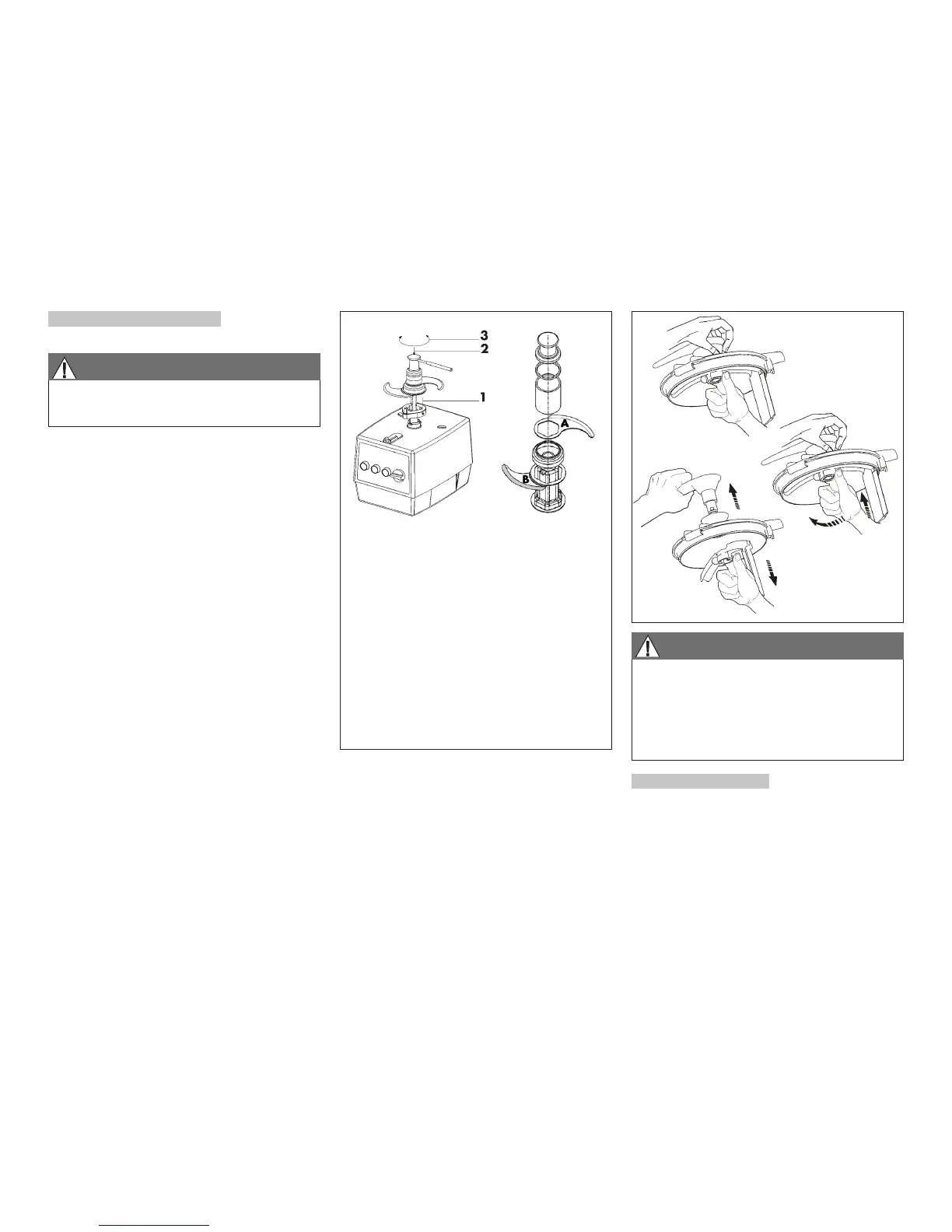
Ensure power supply to machine is disconnected.
1 - Place blade dismantling tool over shaft onto
motor base.
2 -
Fit blade onto shaft ensuring it is correctly
positioned.
3 - Insert bar into blade cap and turn anti-
clockwise to dismantle .
When re-assembling do not over tighten.
A - Upper blade with sharp edge away from you.
B - Lower blade with sharp edge towards you.
As a precaution, always unplug your appliance
before cleaning it (risk of electrocution).
WARNING
Check that your detergent is suitable for
cleaning plastic parts. Some washing agents
are too alkaline (e.g. high levels of caustic
soda or ammonia) and totally incompatible
with certain types of plastic, causing them to
deteriorate rapidly.
IMPORTANT



 To Next Page