This document provides operating instructions for RÖDA STANDARD series electric wall convectors, including models RSP-500, RSP-1000, RSP-1500, RSP-2000, RSP-2500, and their EU variants.
Function Description
The RÖDA STANDARD series electric convectors are designed for primary and supplementary heating of buildings and structures in domestic and similar conditions. They are intended for stationary installation in a vertical position on a wall or on the floor using the included support kit.
These convectors are equipped with a thermostat for setting and maintaining the desired room temperature. A key feature is the "anti-freeze" function, which maintains a room temperature between +5°C and +7°C to prevent freezing with minimal energy consumption. They also feature a step-by-step power regulator (or no regulator for 500W and 1000W models), overheat protection, and tip-over protection. The convectors are designed for continuous, unattended operation.
The operating principle involves a heating element (1) that warms cold air (2) entering through the air intake grille (8). The heated air (3) rises due to natural convection, exits through the air outlet grille (7), and heats the room.
Important Technical Specifications
- Supply Voltage: 230±10 V
- Current Frequency: 50 ± 1 Hz
- Moisture Protection Class: IP20
- Electric Shock Protection Class: II
| Nominal Power Consumption (kW) |
0.5 |
1.0 |
1.5 |
2.0 |
2.5 |
| Nominal Current Consumption (A) |
2.1 |
4.3 |
6.5 |
8.7 |
10.8 |
The length (L) of the convector varies by power:
- 0.5 kW: 156 mm
- 1.0 kW: 288 mm
- 1.5 kW: 408/276 mm
- 2.0 kW: 540/396 mm
- 2.5 kW: 660 mm
Usage Features
Preparation for Operation:
- Unpack the convector and retain the packaging for future storage.
- If stored or transported at low temperatures, allow the convector to acclimatize at room temperature for at least 2 hours before use.
- Verify that your electrical network matches the convector's technical data (voltage, protective device capacity, wiring, and socket current capacity). Consult a specialist if needed.
- Choose a suitable installation location. Avoid drafts, areas under forced ventilation systems, or direct sunlight.
- For wall mounting, mark and securely fix the brackets according to the provided diagrams and table. Ensure minimum distances from surrounding objects (furniture, curtains, etc.) of at least 15 cm from the back wall.
- For floor use, attach the supports as shown in the figures.
- To mount the convector, align the rectangular holes on its back with the upper hooks of the brackets and hang the convector. Pull it upwards until the lower hooks of the brackets lock into the air intake grille holes.
Operation:
- Before connecting, ensure the convector is securely mounted on the wall or floor.
- Set the power switch (or step regulator switches) to "0" and the thermostat knob to "" (align "" on the knob with the mark on the control panel).
- Plug the convector into the mains socket.
- Set the thermostat knob to "MAX" and turn on the convector by setting the power switch to "I" (or step regulator switches to "I" and "II").
- Once the desired room temperature is reached, slowly turn the thermostat knob towards lower values until the heating mode switches off with a "click." The convector will then automatically maintain this temperature.
- To reduce power (for models with step regulators), set one of the regulator switches to "0".
- To activate the anti-freeze function, set the thermostat knob to "*" and turn on the convector. It will maintain a temperature of +5°C to +7°C.
- To disconnect, set all switches to "0", set the thermostat knob to "*", and unplug the power cord.
- For prolonged absence (more than 24 hours) or during summer, set the thermostat to "*". If multiple convectors are used in a room, synchronize their thermostat settings.
Safety Requirements:
- Visually inspect the power cord and convector for damage before connecting. Do not use if damaged; contact an authorized service center.
- Disconnect the convector from the mains during maintenance or wet cleaning near the unit. Always pull the plug, not the cord.
- Prevent moisture, paper, or foreign objects from entering the convector.
- Do not use the convector for purposes other than heating (e.g., outdoors).
- Do not operate with a damaged power cord. Ensure the cord does not touch sharp edges or hot surfaces.
- In case of power cord damage, replacement must be performed by the manufacturer, service agent, or similarly qualified personnel.
- This appliance is not intended for use by persons (including children) with reduced physical, sensory, or mental capabilities, or lack of experience and knowledge, unless supervised or instructed by a responsible person.
- Children under 3 years old should be kept away unless continuously supervised.
- Children aged 3 to 8 years may only switch the appliance on/off if it has been placed in its normal operating position and they are supervised or instructed. They should not plug in, regulate, clean, or perform user maintenance.
- CAUTION: Some parts of the product can become very hot and cause burns. Pay particular attention when children and vulnerable people are present.
- WARNING: Do not cover the heater to avoid overheating. The warning symbol indicates that the heater must not be covered.
- PROHIBITED: Obstructing grilles (even partially), placing flammable materials near the convector, installing directly under a fixed power socket, installing where controls can be touched from a bath/shower, using near a bath/shower/swimming pool, or touching the plug/convector with wet hands.
Maintenance Features
- At least once a month, clean the air intake and outlet grilles of the convector from dust using a brush and vacuum cleaner.
- Clean the convector casing with a damp cloth. Do not use abrasive or aggressive materials that could damage the coating.
- Surface stains on the grilles due to a polluted atmosphere are not covered by warranty and are not grounds for convector replacement.

 Need help?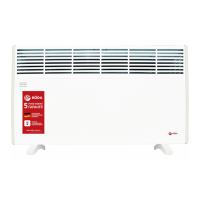

 To Next Page
 General