EasyManua.ls Logo

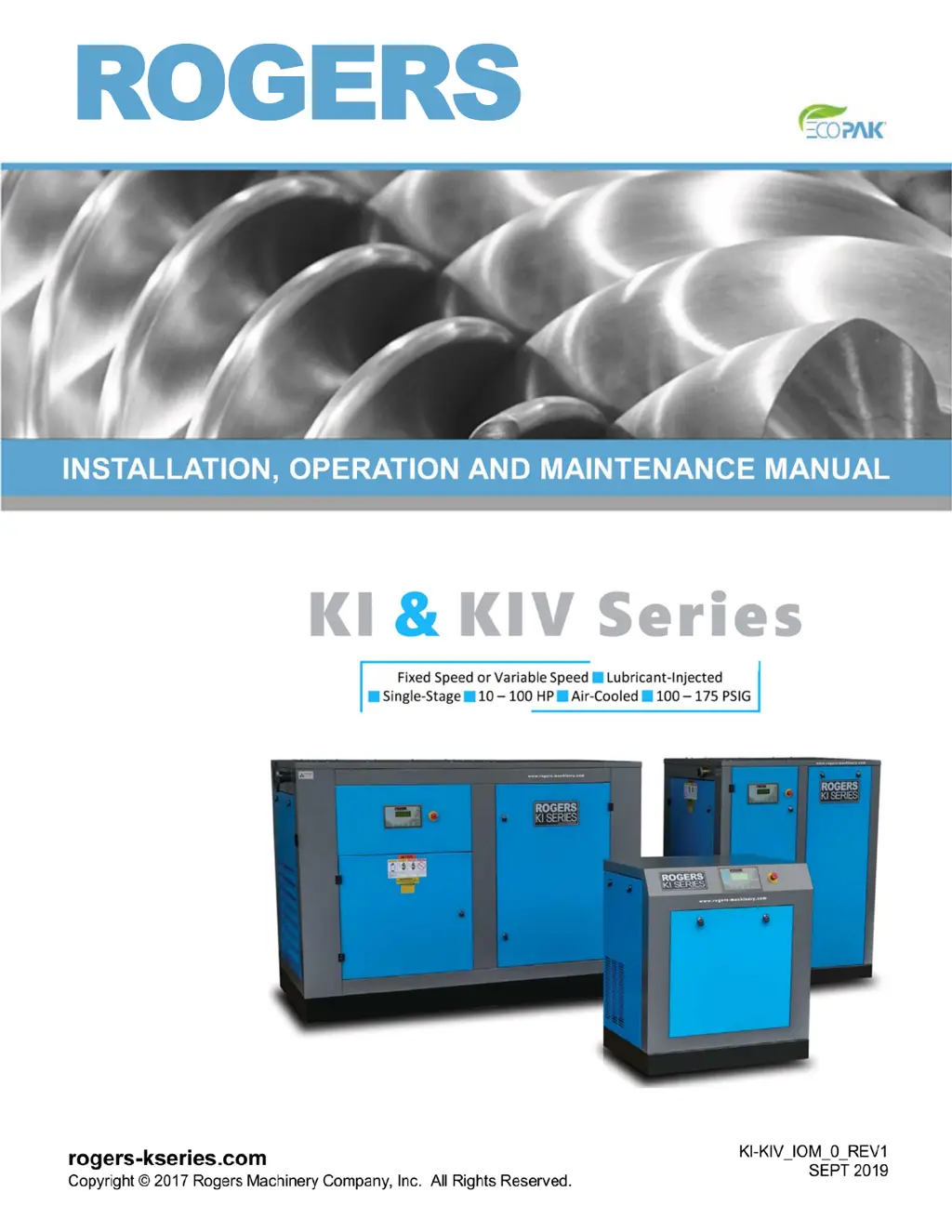
Rogers KI Series - User Manual

Rogers KI Series
66 pages
Print Icon
To Next Page IconTo Next Page
Loading...
1.
Model #: __________________ Serial #: __________________
®
Rotary Screw Air Compressors

Table of Contents

Questions and Answers

  • N
    Nancy ChaseAug 17, 2025
    How to fix a Rogers KI Air Compressor that fails to start?
    • J
      Joel CochranAug 17, 2025
      If your Rogers Air Compressor isn't starting, there are several potential causes. First, ensure the power is turned “ON” by closing the main disconnect. Check for blown fuses in the control circuit or the 460-volt Phase Protector and replace them after correcting the cause. See if the high air temperature switch is open. Overload relays might have tripped; reset them after addressing the overload condition, then press the reset keypad. Inspect the starter contactor for malfunctions, burnt contacts, or loose connections. Verify the incoming power supply and check pressure, temperature switches, or remote devices for defects. Ensure all wire connections are tight, and examine the 120 VAC and 24 VDC power supply. Reset any alarms and wait for the Start Delay Timer to finish counting down.
  • S
    stephaniewhiteAug 20, 2025
    Why is the overload relay tripping on my Rogers KI?
    • M
      marshallkevinAug 20, 2025
      Overload relay tripping in your Rogers Air Compressor can stem from several issues. Check for excessive discharge pressure and lower the full load pressure setting at the pilot valve or Compressor Display panel. Low voltage, power factor, or voltage imbalance can also cause this; verify voltage, amperages, and power factor while the unit operates at full load and pressure. Ensure the overload setting matches the motor nameplate within the Compressor Control panel. Faulty motor or loose motor or starter wiring could also be responsible. Check all wiring terminals for tightness and contact. If the motor is faulty, remove it and have it tested at a motor manufacturer repair center.
  • J
    joshua15Aug 22, 2025
    What to do if my Rogers Air Compressor experiences an unscheduled shutdown?
    • G
      gonzaleztravisAug 22, 2025
      An unscheduled shutdown of your Rogers Air Compressor can be due to several factors. Begin by checking the compressor display. A high air discharge temperature could be the cause. Also, verify the incoming power supply, and inspect pressure switches, temperature switches, or remote devices for any defects. Ensure all wire connections are secure and tight. High reservoir pressure or a faulty Compressor Control Display could also lead to shutdowns. Replace the display if necessary.
  • L
    Lisa RuizAug 27, 2025
    Why is my Rogers Air Compressor using excessive lubricant?
    • D
      Denise McknightAug 27, 2025
      Excessive lubricant consumption in your Rogers Air Compressor can be attributed to several factors: * A ruptured lubricant cooler may be leaking; check for leaks and replace if needed. * Leaks in lubricant tubing and connections should be inspected and repaired. * A seal failure may require seal replacement. Also, ensure you're using the correct, non-contaminated lubricant. A faulty or damaged separator element or leaks from lubricant filter gaskets or the reservoir cover can also contribute to high consumption. Inspect and replace gaskets and separator elements as necessary.
  • V
    Victoria MaySep 2, 2025
    How do I stop excessive lubricant carry-over in my Rogers KI Air Compressor?
    • B
      Brittany HallSep 2, 2025
      To address excessive lubricant carry-over in your Rogers Air Compressor, start by ensuring the lubricant level in the reservoir isn't too high; lower it to the recommended level after depressurization and check the drainage for condensation. Inspect the scavenging system for plugged or broken lines, cleaning or replacing them as needed. Excessive lubricant foaming, often due to water in the lubricant, can also cause carry-over; change the lubricant and consider increasing the operating temperature. Ensure the reservoir pressure doesn't fall below 80 PSIG when running loaded. Finally, verify the scavenging line is properly adjusted.
  • J
    John SanchezSep 5, 2025
    What causes frequent air/lubricant separator clogging in my Rogers Air Compressor?
    • A
      Alan LoweSep 5, 2025
      Frequent clogging of the air/lubricant separator in your Rogers Air Compressor can stem from several issues. Check for a faulty air filter or inlet line and replace elements or the air inlet connection as needed. A faulty lubricant filter or filter head can also cause clogging; replace the lubricant filter element and inspect the filter head for an open bypass. Lubricant breakdown or contamination can also lead to this issue; change the lubricant at prescribed intervals and ensure lubricant samples are analyzed frequently. Also, make sure you are using only Rogers’ replacement elements and do not attempt to clean separator elements. Mixing different grades or types of lubricant can cause separator clogging.
  • N
    Nicholas DukeSep 7, 2025
    Why is the discharge pressure high on my Rogers KI?
    • T
      Tiffany ArnoldSep 8, 2025
      High discharge pressure in your Rogers Air Compressor can occur if it fails to unload, often due to incorrectly set load/unload pressure settings; reset these to the desired levels. A faulty control line filter can also contribute; check for leaks, clean the filter, and replace the element. Ensure the inlet valve is fully closed; inspect and adjust it as necessary. Leaky control air lines can also cause high pressure; inspect and repair any leaks. Finally, a plugged separator can restrict flow; replace it with a new air/lubricant separator and determine the cause of the contamination.
  • C
    Christian KnightSep 12, 2025
    What should I do if my Rogers Air Compressor does not load?
    • J
      Jennifer RichardsSep 12, 2025
      If your Rogers Air Compressor isn't loading, start by checking for improper pressure settings and correct them. Look for loose wiring connections and tighten the wiring terminals. A faulty air inlet valve assembly or a faulty unloading solenoid valve could also be the cause; repair or replace these as necessary. Check for a faulty differential pilot valve, cleaning or replacing it if the orifice is plugged, or if there is ice in the valve. Also, check the control air regulator for faults, servicing, replacing, and/or setting the regulator as needed. Finally, inspect the control air filter for clogs and clean or replace the filter element.
  • R
    Ross DyerNov 24, 2025
    Why does my Rogers Air Compressor have low reservoir pressure or low air delivery?
    • K
      Katie HughesNov 24, 2025
      Low reservoir pressure or air delivery in your Rogers Air Compressor could be due to several reasons. Start by checking the air system for excessive leaks in service lines and fix them. Ensure the inlet valve is fully open; if not, replace the valve. A plugged air intake filter can also restrict airflow, so clean or replace it. Verify that the air pressure settings are correctly set to the desired load and unload pressure. Inspect the blowdown or unloading valve for faults and repair or replace if needed, ensuring correct control settings and wiring connections. Check for restrictions in the system, such as in the separator element, aftercooler, dryer, and filters, and watch out for ice formation inside the aftercooler. Repair or replace a faulty control line regulator or safety relief val...
  • J
    jose87Dec 1, 2025
    What causes high discharge air temperature in my Rogers Air Compressor?
    • T
      Tina PowellDec 1, 2025
      High discharge air or lubricant injection temperature in your Rogers Air Compressor can result from several issues. Ensure adequate circulation of cooling air at the cooler for air-cooled models. Check for a low lubricant level in the reservoir and add lubricant to the recommended level. Restrictions in the lubricant lines or a clogged lubricant filter can also cause this problem; clean or replace the filter as needed. Inspect the lubricant cooler for varnishing and deposits. High ambient temperatures may also contribute, so ventilate the room or relocate the compressor if necessary. Verify correct fan rotation, ensuring it pushes air through the cooler. Confirm you're using the recommended lubricant. A faulty temperature regulating valve or faulty sensors can also lead to high temperature...

Summary

Safety Warnings Summary

Manual Overview and Preface

Model and Serial Numbers

Location and recording of model and serial number for compressor identification.

General Information

Compressor Description

Overview of KI and KIV series air compressor design and features.

Compressor Operation Principles

Explanation of how the compressor works, including intake, compression, and discharge.

Air Flow Description

Details the path of air through the compressor system, from intake to discharge.

Lubricant Flow and Cooling System

Explains the circulation of lubricant and the cooling system's function.

Separator System Details

Details the function of the air/lubricant separator reservoir and elements.

Capacity Control System Description

Describes how the compressor's capacity is controlled (load/unload, VFD).

Maximum Operating Pressure

Lists maximum operating pressures based on motor horsepower.

Installation Instructions

General Installation Guidelines

General guidelines for receiving, inspecting, and preparing the compressor for installation.

Installation Location

Recommendations for selecting an appropriate installation site for the compressor.

Foundation Requirements

Guidance on proper support and foundation requirements for the compressor unit.

Correct Compressor Rotation

Importance of correct rotation direction for compressor bearings and clearances.

V-Belt Drive System (10-50 HP)

Details on the V-belt drive system, including tension adjustment and alignment.

D-Face Drive System (60-100 HP)

Information on the D-Face mounted drive system for larger HP units.

Cooling System Details

Considerations for compressor cooling, airflow, and heat dissipation.

Blowdown System Function

Explanation of the blowdown system and its function after shutdown.

Optional Moisture Separator;Drain

Information on installing and using optional moisture separators and drains.

Discharge Service Valve

Importance and function of the discharge service valve for safety and servicing.

Air Piping Installation

Guidelines for air piping installation, material selection, and connection.

Air Receiver Requirements

The necessity and proper sizing of an auxiliary air receiver for compressor applications.

Electrical Information

Starter and Wiring Procedures

Guidance on following wiring diagrams and pre-wired control panels.

Motor Rotation Verification

Critical importance of correct motor rotation for preventing damage.

Blowdown Valve Function

Description of the sump blowdown valve and its function.

Compressor Drive Motor Details

General information and considerations for the compressor drive motor.

Local Display Information

Reference to the manual for features, parameters, and navigation of the local display.

Electrical Schematic Location

Location of the specific electrical schematic for the compressor assembly.

Compressor Lubrication

Lubricant General Information

Initial lubricant fill, handling, and consequences of improper lubricant use.

Lubricant Service Intervals

Recommended intervals for lubricant changes and sampling.

Lubricant Level Check Procedure

Procedure for checking the lubricant level in the reservoir.

Lubricant & Cooling Data

Table providing data on system capacity, cooling, and heat rejection.

Special Lubricant System Maintenance

Procedures for special maintenance, including cleaning and dealing with deposits.

Lubricant Filter Details

Details on the spin-on lubricant filter and its purpose.

Separator Element Replacement

Instructions for replacing spin-on and top-hat style separator elements.

Lubricant Scavenging System

Description and cleaning of the lubricant scavenging system.

Air Inlet Filter Service

Air Inlet Filter Service Procedure

Procedure for servicing the multi-stage dry type air filter element.

Compressor Operations

Initial Start-Up Procedures

Comprehensive checklist for correctly installing and starting the compressor for the first time.

Starting Unit (Post Initial)

Steps for starting the compressor after initial setup and during normal operation.

Normal Unit Shutdown

Procedure for safely shutting down the compressor during normal operation.

Maintenance Service Intervals

Schedule of maintenance tasks based on daily, monthly, and hourly intervals.

Troubleshooting Guide

FAILURE TO START

Lists possible causes and corrections for the compressor failing to start.

UNSCHEDULED SHUTDOWN

Lists possible causes and corrections for unexpected compressor shutdowns.

OVERLOAD RELAY TRIPPING

Troubleshooting steps for overload relay tripping issues.

EXCESSIVE LUBRICANT CONSUMPTION

Identifies causes and solutions for high lubricant consumption.

EXCESSIVE LUBRICANT CARRY-OVER

Troubleshooting steps for excessive lubricant carry-over.

FREQUENT AIR; LUBRICANT SEPARATOR CLOGGING

Solutions for frequent clogging of air or lubricant separator elements.

LOW RESERVOIR PRESSURE; LOW AIR DELIVERY

Diagnoses and resolves issues with low reservoir pressure or air delivery.

HIGH DISCHARGE PRESSURE

Addresses causes and solutions for high discharge pressure.

HIGH DISCHARGE AIR TEMPERATURE AND;OR HIGH LUBRICANT INJECTION TEMPERATURE

Troubleshoots high discharge air and lubricant injection temperatures.

COMPRESSOR DOES NOT LOAD

Solutions for the compressor failing to load properly.

EXCESSIVE CYCLING BETWEEN LOAD AND UNLOAD

Addresses issues of excessive cycling between load and unload states.

EXCESSIVE WATER IN PLANT AIR DISTRIBUTION SYSTEM

Solutions for excessive water in the plant air system.

FREQUENT LUBRICANT FILTER CLOGGING

Troubleshooting steps for frequent lubricant filter clogging.

SAFETY VALVE OPENS

Explains why the safety valve might open and how to address it.

VIBRATION

Identifies causes of vibration and provides solutions.

ERRATIC INLET VALVE OPERATION

Troubleshooting for erratic operation of the inlet valve.

FREQUENT INLET AIR FILTER CLOGGING (ALARMS IN <1,000 HRS. SERVICE)

Addresses frequent inlet air filter clogging and related alarms.

COMPRESSOR DISPLAY PANEL (CDP) IS NOT ON OR NOT RESPONDING

Solutions for issues with the compressor display panel.

HIGH RESERVOIR PRESSURE

Troubleshooting steps for high reservoir pressure.

Forms, Records, and Schematics

Rogers KI Series Specifications

General IconGeneral
BrandRogers
ModelKI Series
CategoryAir Compressor
LanguageEnglish

Related product manuals