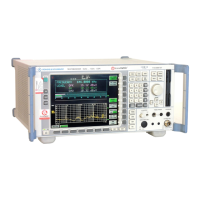
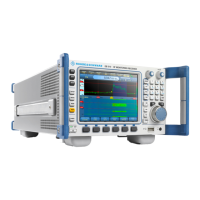
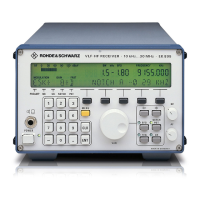
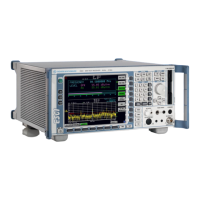
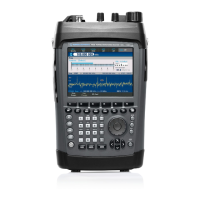
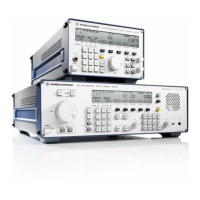
The R&S ESL is an EMI Test Receiver designed for electromagnetic interference measurements. It is available in two main models: R&S ESL3 and R&S ESL6, with specific order numbers 1300.5001K03, 1300.5001K13, 1300.5001K06, and 1300.5001K16.
Function Description
The R&S ESL operates as an EMI test receiver, capable of measuring electromagnetic interference across a frequency range of 9 kHz to 6 GHz. Its primary function is to detect and analyze signals, providing detailed information on frequency, level, and other relevant parameters. The device supports various measurement modes, including Peak, CAV (Continuous Average), CRMS (CISPR RMS), and Min Peak, as shown in the front panel display. It features a limit check function, allowing users to compare measured signals against predefined limits. The instrument is equipped with both front and rear panel connectors for signal input and output, as well as for connecting external devices.
Important Technical Specifications
- Frequency Range: 9 kHz to 6 GHz.
- Measurement Modes: Peak, CAV, CRMS, Min Peak, Average, Quasipeak, CISPR RMS.
- Bandwidth: Adjustable, e.g., RBW 120 kHz.
- Sweep Time: Configurable, e.g., MT 100ms.
- Preamp: Switchable (ON/OFF).
- Display: Features a graphical display for spectrum analysis, showing frequency and amplitude.
- Connectivity: Includes USB ports, an external monitor connector, LAN interface, and GPIB interface (optional R&S FSL–B10).
- Power Supply: Supports AC power connection and can be optionally equipped with a battery pack (R&S FSL–B31).
- Operating System: Runs on Windows XP, with specific software approved for the R&S ESL.
- Physical Characteristics: The instrument has a weight indication for units >18 kg, requiring careful handling.
Usage Features
The R&S ESL offers a comprehensive set of features for ease of use and detailed analysis:
- Front Panel Controls: A user-friendly interface with function keys, a rotary knob, arrow and position keys, and softkeys for intuitive navigation and parameter setting.
- Parameter Setting: Parameters can be entered using a keypad, rotary knob, or through dialog boxes for numeric and alphanumeric inputs.
- Measurement Examples: The manual provides basic measurement examples, including:
- Performing level and frequency measurements of sinusoidal signals.
- Measuring harmonics of sinusoidal signals and their suppression.
- Analyzing signal spectra with multiple signals, including separation by resolution bandwidth.
- Measuring modulation depth of AM-modulated carriers.
- Measurements in Zero Span, such as power characteristics of burst signals (e.g., GSM bursts), signal-to-noise ratio, and FM-modulated signals.
- Instrument Configuration: Users can store and load instrument settings, including traces, and configure automatic loading.
- Help System: A built-in help system provides context-sensitive and non-context-sensitive assistance, with navigation options through a table of contents, help topics, and search functionality.
- Display Customization: Screen colors can be adjusted, with options for default settings, predefined color sets, or user-defined color schemes. The automatic display off function can also be configured.
- External Device Connectivity: Supports connection to USB devices and external monitors for extended display.
- Network Integration: Configurable LAN interface for connecting the instrument to a network, including setting IP addresses and network protocols (TCP/IP). Remote operation via XP Remote Desktop is also supported.
- Printer Support: Allows selection and configuration of printers, including printout colors.
- Firmware Management: Provides procedures for firmware updates and activation of firmware options.
Maintenance Features
The R&S ESL is designed with maintenance in mind, ensuring longevity and reliable operation:
- Self-Alignment and Self-Test: The instrument can perform self-alignment and self-tests to ensure optimal performance and accuracy.
- Fuse Replacement: Instructions are provided for replacing fuses, which are critical for electrical safety.
- Battery Pack Charging: For models with the optional R&S FSL–B31 battery pack, charging procedures are detailed.
- Cleaning: Guidelines for cleaning the outside of the instrument are provided, emphasizing the use of soft, non-linting cloths and avoiding chemical cleaning agents.
- Calibration: A recommended calibration interval is specified to maintain measurement accuracy.
- Safety Instructions: Extensive safety instructions cover various aspects, including:
- General safety precautions for operation, handling, and installation.
- Warnings regarding electrical shock, hot surfaces, and electrostatic sensitive devices.
- Guidelines for handling heavy units and proper ventilation.
- Information on battery disposal, emphasizing that batteries containing harmful substances must not be disposed of as normal household waste and should be handled by a service center or suitable depot.
- Precautions for using the product in vehicles and handling laser products (if integrated).
- Instructions for qualified personnel to perform adjustments, replacements, and repairs, using only original parts.
- Requirements for checking power cables, sockets, and ensuring proper earthing.
- Warnings against opening the housing or inserting objects into openings during operation.
- Guidance on preventing overvoltage and avoiding condensation.
- Information on potential hazardous substances released during improper processing or in case of fire.
The manual also includes information on open-source software packages used in the firmware, their licenses, and acknowledgments to the open-source community. It clarifies that R&S® is a registered trademark of Rohde & Schwarz GmbH & Co. KG.

 Need help?
 General

 To Next Page