
 Need help?
Do you have a question about the Roland V-Drums TD-17KV and is the answer not in the manual?
Lists all components included in the TD-17KV package, such as pads, module, cables, and accessories.
Step-by-step instructions for assembling the MDS-4V or MDS-Compact drum stand.
Guide for attaching the CY-5 hi-hat cymbal pad to the stand.
Instructions for attaching the two CY-8 V-Cymbal pads.
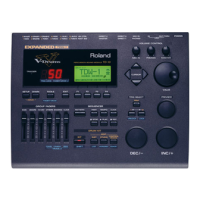
Procedure for mounting the TD-17 drum sound module onto its holder.
Instructions for positioning the FD-9 hi-hat control pedal.
Guide for attaching the KD-10 kick pad and ensuring proper placement.
Instructions for mounting the PDX-12 snare and PDX-8 tom pads.
Details on connecting cables from pads and pedals to the TD-17 module.
Instructions for reconfiguring components for a left-handed player.
Guide for connecting the AC adaptor, speakers, or headphones to the module.
Details on attaching the kick pedal, adjusting anchor bolts, and twin pedal use.
Instructions for adjusting the feeling and sensitivity of the FD-9 pedal.
Explanation of CY-5 component names and head tension adjustment.
Details on CY-8 component names, head tension, and securing cables.
Instructions for adjusting the head tension of the PDX-12 snare pad.
Instructions for adjusting the head tension of the PDX-8 tom pads.
The Roland V-Drums TD-17KV is an electronic drum kit designed for a realistic drumming experience, offering a blend of authentic feel, expressive sound, and practical features for practice and performance. This setup guide details the assembly, connection, and basic maintenance of the kit's various components.
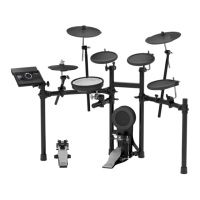
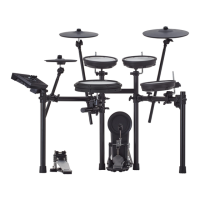
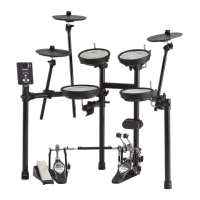
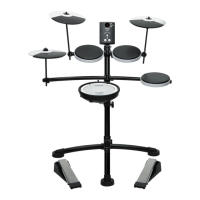
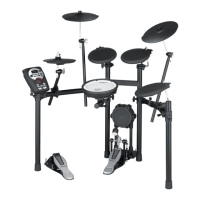
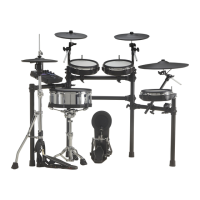
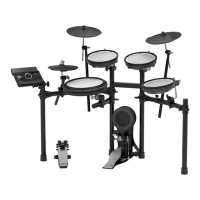
The TD-17KV functions as a complete electronic drum set, allowing drummers to practice and perform with a wide range of drum sounds without the acoustic volume of traditional drums. At its core is the TD-17/17-L drum sound module, which processes trigger signals from the pads and outputs high-quality drum and percussion sounds. The kit includes a snare pad (PDX-12), three tom pads (PDX-8), a kick pad (KD-10), a hi-hat cymbal pad (CY-5) with a hi-hat control pedal (FD-9), and two crash/ride cymbal pads (CY-8). These components are mounted on an MDS-4V or MDS-Compact drum stand, providing a stable and adjustable framework for the entire kit. The system is designed to replicate the feel and response of an acoustic drum set, making it suitable for drummers of all skill levels, from beginners to experienced players.
Assembly and Setup: The initial setup involves assembling the drum stand according to its owner's manual. The guide emphasizes careful handling due to sharp mount tips and avoiding pinched fingers. Once the stand is assembled, the various pads and cymbals are attached. The TD-17/17-L module slides onto its mount and is secured with a hand knob, allowing for angle adjustment.
Pad and Cymbal Attachment: Cymbals (CY-5, CY-8) are attached using stoppers, clutch felts, and cymbal nuts. The guide specifies orienting the "Roland" logo on the farther side for the crash/ride cymbals and tightening nuts to allow for appropriate sway or prevent wobbling, depending on the cymbal type. The hi-hat control pedal (FD-9) is placed on the floor, and its anchor bolts can be extended for stability on mats, noise eaters, or carpets. The kick pad (KD-10) is positioned for comfortable playing, and a kick pedal (not included) is securely installed. The snare (PDX-12) and tom (PDX-8) pads are attached to their respective mounts.
Cable Management: A dedicated connection cable, specifically designed for the TD, is used to link all pads to the sound module. Each cable segment is labeled to indicate which pad it connects to (e.g., RD for ride, CR1 for crash 1, T1 for tom 1, SNR for snare, KIK for kick, HHC for hi-hat control). The guide advises inserting plugs firmly and fastening cables with clips and ties to prevent obstruction during playing. It also notes that the RDB cable (for extension) should not be connected unless needed, and its cap should remain in place.
Left-Handed Setup: For left-handed drummers, the guide provides clear instructions for reconfiguring the kit. This involves exchanging curved and straight pipes, repositioning holders and the snare pipe, swapping pad and cymbal attachment mounts, and moving the TD sound module mount to the left side. Marks on the pipes help ensure correct holder placement.
Power and Audio Connection: After all physical connections are made, the AC adaptor is connected to power the TD module. Speakers or headphones can then be connected to the module for audio output. The guide stresses the importance of turning down the volume and turning off all units before making connections to prevent malfunction and equipment failure.
Head Tension Adjustment: For the PDX-12 snare and PDX-8 tom pads, maintaining proper head tension is crucial for optimal playability and response. The guide provides specific instructions for adjusting the tuning bolts with a drum key. It recommends adjusting each bolt gradually and in a cross pattern to ensure even tension across the head. This process helps replicate the feel of an acoustic drum and prevents damage from uneven stress.
Anchor Bolt Management: The KD-10 kick pad and FD-9 hi-hat control pedal feature anchor bolts that can be extended to provide stability on various surfaces like V-Drums mats, noise eaters, or carpets. The guide advises correctly adjusting these bolts to prevent the unit from shifting during play. It also includes a warning about the sharp tips of the anchor bolts and the potential for damage to flooring if not handled carefully.
Cable Management: Proper cable management is a key maintenance aspect. The guide instructs users to fasten cables using provided clips and ties, ensuring they do not obstruct playing. This not only keeps the setup tidy but also prevents cables from being snagged or damaged, which could lead to intermittent signals or component failure. The advice to leave the RDB cable cap in place when not in use also protects the connector from dust and damage.
General Care: The manual implicitly encourages careful handling of all components during assembly and disassembly, particularly when dealing with sharp edges or moving parts, to prevent injury and damage to the equipment. It also suggests referring to the respective owner's manuals for the stand and sound module for more detailed maintenance and troubleshooting information. The recommendation to turn down volume and power off units before making connections is a fundamental safety and maintenance practice to protect both the user and the equipment from electrical surges or damage.
 General
| Drum Kits | 50 |
|---|---|
| User Kits | 50 |
| Pads Included | 5 |
| Snare Pad | PDX-12 |
| Hi-hat Pad | CY-5 |
| Crash Pads | CY-8 |
| Ride Pad | CY-8 |
| Kick Pad | KD-10 |
| Hi-hat Control Pedal | FD-9 |
| Sound Module | TD-17 |
| Bluetooth | Yes |
| Type | Electronic Drum Kit |
| Drum Stand | MDS-Compact |
| Training Functions | Yes |
| Power Supply | AC Adaptor |
| Hi-Hat | CY-5 |
| USB | Yes |
| Connectivity | USB, MIDI, Bluetooth |
| Weight | 23.0 kg |
| Tom Pads | 3 x PDX-8 |
| Dimensions (W x D x H) | 1, 300 x 1, 200 x 1, 100 mm |


 To Next Page