up, use only the correct grade and type of oil,
as given in the “Lubricants, fluids and
capacities” Section of this Chapter; use a
funnel if necessary to prevent spills. After
adding the oil, refit the filler cap hand-tight.
Start the engine, and allow it to idle while the
oil is redistributed around the engine - while
you are waiting, look carefully for any oil leaks,
particularly around the oil filter or drain plug.
Stop the engine; check the oil level again,
after the oil has had enough time to drain from
the upper block and cylinder head galleries.
7 Checking the oil level is an important
preventive maintenance step. A continually-
dropping oil level indicates oil leakage through
damaged seals and from loose connections,
or oil consumption past worn piston rings or
valve guides. If the oil looks milky in colour, or
has water droplets in it, the cylinder head
gasket may be blown - the engine’s
compression pressure should be checked
immediately (see Chapter 2). The condition of
the oil should also be checked. Each time you
check the oil level, slide your thumb and index
finger up the dipstick before wiping off the oil.
If you see small dirt or metal particles clinging
to the dipstick, the oil should be changed.
Coolant
Warning: DO NOT attempt to
remove the expansion tank filler
cap, or to disturb any part of the
cooling system, while it or the
engine is hot, as there is a very great risk
of scalding.
8 All vehicles covered by this manual are
equipped with a sealed, pressurised cooling
system. A translucent plastic expansion tank,
located on the right-hand side of the engine
compartment, is connected by a hose to the
thermostat housing or radiator top hose. As
the coolant heats up during engine operation,
surplus coolant passes through the
connecting hose into the expansion tank. As
the engine cools, the coolant is automatically
drawn back into the cooling system’s main
components, to maintain the correct level.
9 While the coolant level must be checked
regularly, remember that it will vary with the
temperature of the engine. When the engine is
cold, the level should be up to the pipe outlet
on the side of the tank, but once the engine
has warmed up, the level may rise to above
this level.
10 For an accurate check of the coolant level,
the engine must be cold and the level must be
up to the pipe outlet. If it is below this level, the
coolant must be topped-up as follows.
11 First prepare a sufficient quantity of
coolant mixture, using clean, soft water and
antifreeze of the recommended type, in the
specified mixture ratio. If only a small amount
of coolant is required to bring the system up
to the proper level, plain water can be used,
but repeatedly doing this will dilute the
antifreeze/water solution in the system,
reducing the protection it should provide
against freezing and corrosion. To maintain
the specified antifreeze/water ratio, it is
essential to top-up the coolant level with the
correct mixture, as described here. Use only
ethylene/glycol type antifreeze, and do not
use supplementary inhibitors or additives.
Warning: Never remove the
expansion tank filler cap when
the engine is running, or has
just been switched off, as the
cooling system will be hot, and the
consequent escaping steam and scalding
coolant could cause serious injury.
12 If topping-up is necessary, wait until the
system has cooled completely (or at least 10
minutes after switching off the engine, if lack of
time means it is absolutely necessary to top-up
while the engine may still be warm). Wrap a
thick cloth around the expansion tank filler cap,
and unscrew it one full turn. If any hissing is
heard as steam escapes, wait until the hissing
ceases, indicating that pressure is released,
then slowly unscrew the filler cap until it can be
removed. If more hissing sounds are heard,
wait until they have stopped before unscrewing
the filler cap completely. At all times, keep your
face, hands and other exposed skin well away
from the filler opening.
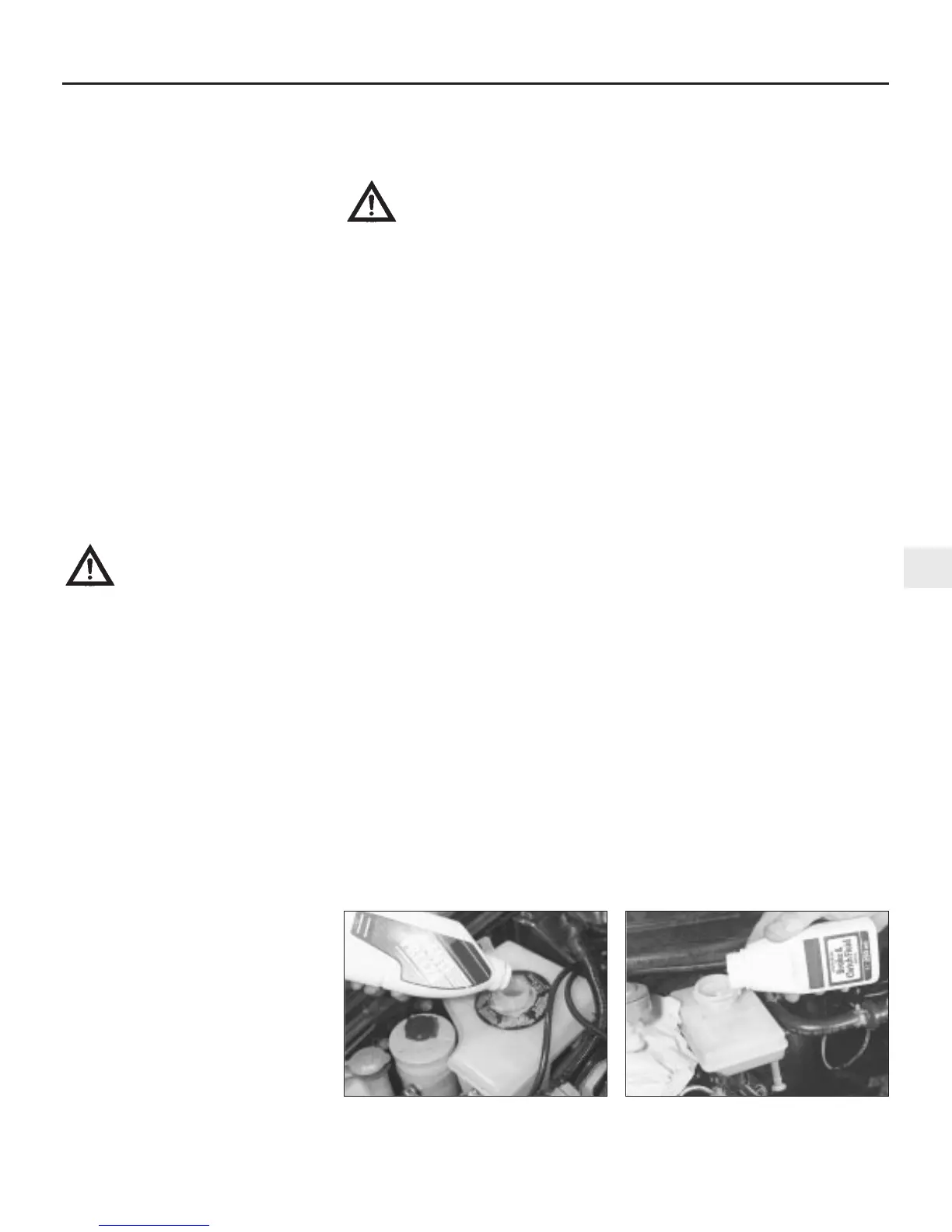
13 When the filler cap has been removed,
add coolant to bring the level up to the outlet
pipe level (see illustration). Refit the cap,
tightening it securely.
14 With this type of cooling system, the
addition of coolant should only be necessary
at very infrequent intervals. If topping-up is
regularly required, or if the coolant level drops
within a short time after replenishment, there
may be a leak in the system.
15 Inspect the radiator, hoses, expansion
tank filler cap, radiator drain plug and water
pump. If no leak is evident, have the filler cap
and the entire system pressure-tested by your
dealer or garage; this will usually show up a
small leak not otherwise visible.
Windscreen/tailgate and
headlight washer fluid
16 Fluid for the windscreen/tailgate/headlight
washer system is stored in a plastic reservoir,
the filler neck of which is located at the right-
hand front corner of the engine compartment.
17 To check the fluid level, release the cap
and observe the level in the reservoir by
looking down the filler neck. In milder
climates, plain water can be used to top-up
the reservoir, but the reservoir should be kept
no more than two-thirds full, to allow for
expansion should the water freeze. In colder
climates, the use of a specially-formulated
windscreen washer fluid, available at your
dealer or any car accessory shop, will help
lower the freezing point of the fluid. Do not
use regular (engine) antifreeze - it will damage
the vehicle’s paintwork.
Battery electrolyte
18 On models not equipped with a sealed
battery (see Section 9), check the electrolyte
level of all six battery cells. The level must be
approximately 10 mm above the plates; this
may be shown by maximum and minimum
level lines marked on the battery’s casing. If
the level is low, use a coin to release the
filler/vent cap, and add distilled water. Install
and retighten the cap.
Caution: Overfilling the cells may cause
electrolyte to spill over during periods of
heavy charging, causing corrosion or
damage. Refer to the warning at the
beginning of Section 9.
Brake fluid
19 The brake fluid reservoir is located on the
top of the brake master cylinder, attached to
the front of the vacuum servo unit. The “MAX”
and “MIN” marks are indicated on the side of
the translucent reservoir, and the fluid level
should be maintained between these marks at
all times.
20 The brake fluid inside the reservoir is
readily visible. With the vehicle on level
ground, the level should be on or just below
the “MAX” mark.
21 Progressive wear of the brake pad linings
causes the level of the brake fluid to gradually
fall; however, when the brake pads are
renewed, the original level of the fluid is
restored. It is not therefore necessary to top-
up the level to compensate for this minimal
drop, but the level must never be allowed to
fall below the minimum mark.
22 If topping-up is necessary, first wipe the
area around the filler cap with a clean rag before
removing the cap - do not invert the cap after
removal. When adding fluid, pour it carefully
into the reservoir, to avoid spilling it on
surrounding painted surfaces (see illustration).
Weekly Checks 1•9
3.22 Topping up the brake master cylinder
reservoir
3.13 Topping up the cooling system
1
1380 Rover 800 Series Remake


 To Next Page
 Loading...