cover or rubber protector, make sure that it’s
not torn or damaged. It should completely
cover the terminal. Look for any corroded or
loose connections, cracks in the case or
cover, or loose hold-down clamps. Check the
entire length of each lead for cracks and
frayed conductors.
6 If corrosion, which looks like white, fluffy
deposits is evident, particularly around the
terminals, the battery should be removed for
cleaning as described in Chapter 5, Section 2.
7 Clean the lead clamps thoroughly, using a
soft wire brush or a terminal cleaner, with a
solution of warm water and baking soda.
Wash the terminals and the top of the battery
case with the same solution, but make sure
that the solution doesn’t get into the battery.
When cleaning the leads, terminals and
battery top, wear safety goggles and rubber
gloves, to prevent any solution from coming in
contact with your eyes or hands. Wear old
clothes too - even when diluted, acid
splashed onto clothes will burn holes in them.
Wash all cleaned areas with plain water.
8 Make sure that the battery tray is in good
condition and the hold-down clamp nuts are
tight. If the battery is removed from the tray,
make sure no parts remain in the bottom of
the tray when the battery is refitted. When
refitting the hold-down clamp nuts, do not
overtighten them.
9 Information on jump starting can be found
at the front of this manual. For more detailed
battery checking procedures, refer to the
Haynes “Automobile Electrical and Electronic
Systems Manual”.
Cleaning
10 Corrosion on the hold-down components,
battery case and surrounding areas can be
removed with a solution of water and baking
soda. Thoroughly rinse all cleaned areas with
plain water.
11 Any metal parts of the vehicle damaged
by corrosion should be covered with a zinc-
based primer, then painted.
Charging
Warning: When batteries are
being charged, hydrogen gas,
which is very explosive and
flammable, is produced. Do not
smoke, or allow open flames, near a
charging or a recently-charged battery.
Wear eye protection when near the battery
during charging. Also, make sure the
charger is unplugged before connecting or
disconnecting the battery from the charger.
12 Slow-rate charging is the best way to
restore a battery that’s discharged to the
point where it will not start the engine. It’s also
a good way to maintain the battery charge in a
vehicle that’s only driven a few miles between
starts. Maintaining the battery charge is
particularly important in winter, when the
battery must work harder to start the engine,
and electrical accessories that drain the
battery are in greater use.
13 It’s best to use a one- or two-amp battery
charger (sometimes called a “trickle” charger).
They are the safest, and put the least strain on
the battery. They are also the least expensive.
For a faster charge, you can use a higher-
amperage charger, but don’t use one rated
more than 1/10th the amp/hour rating of the
battery (ie no more than 5 amps, typically).
Rapid boost charges that claim to restore the
power of the battery in one to two hours are
hardest on the battery, and can damage
batteries not in good condition. This type of
charging should only be used in emergency
situations.
14 The average time necessary to charge a
battery should be listed in the instructions that
come with the charger. As a general rule, a
trickle charger will charge a battery in 12 to
16 hours.
15 Seat belt check
1
1 Check the seat belts for satisfactory
operation and condition. Inspect the webbing
for fraying and cuts. Check that they retract
smoothly and without binding into their reels.
2 Check that the seat belt mounting bolts are
tight, and if necessary tighten them to the
specified torque wrench setting (see Chap-
ter 11).
16 Auxiliary drivebelts check
and renewal
2
General
1 The number and type of auxiliary drivebelts
depends on the engine, year of manufacture,
and whether or not the vehicle is equipped
with air conditioning. The belt will be either a
V-belt or a flat, multi-ribbed (or “polyvee”)
type. All the drivebelts are located on the
right-hand end of the engine and are driven
from the crankshaft pulley. Early “M” series
4-cylinder engines have an additional
drivebelt for the power steering pump, which
is driven from a pulley on the camshaft.
2 The good condition and proper tension of
the auxiliary drivebelts is critical to the
operation of the engine. Because of their
composition and the high stresses to which
they are subjected, drivebelts stretch and
deteriorate as they get older. They must,
therefore, be regularly inspected.
Check
3 With the engine switched off, open and
support the bonnet, then locate the auxiliary
drivebelts fitted to your car (Be very careful,
and wear protective gloves to minimise the
risk of burning your hands on hot
components, if the engine has recently been
running). For improved access, jack up the
front of the vehicle, support it securely on axle
stands, remove the roadwheel, then remove
the cover from inside the wheelarch.
4 Using an inspection light or a small electric
torch, and rotating the engine when necessary
with a spanner applied to the crankshaft
pulley bolt, check the whole length of the
drivebelt for cracks, separation of the rubber,
and torn or worn ribs. Also check for fraying
and glazing, which gives the drivebelt a shiny
appearance. Both sides of the drivebelt
should be inspected, and you will have to
twist the drivebelt to check the underside.
Use your fingers to feel the drivebelt where
you can’t see it. If you are in any doubt as to
the condition of the drivebelt, renew it.
Drivebelt tension - 4-cylinder
engines
Alternator drivebelt (early “M” series
engines)
5 Check that it is just possible to twist the
belt by hand through 90º at a point midway
between the two pulleys. If adjustment is
necessary, proceed as follows.
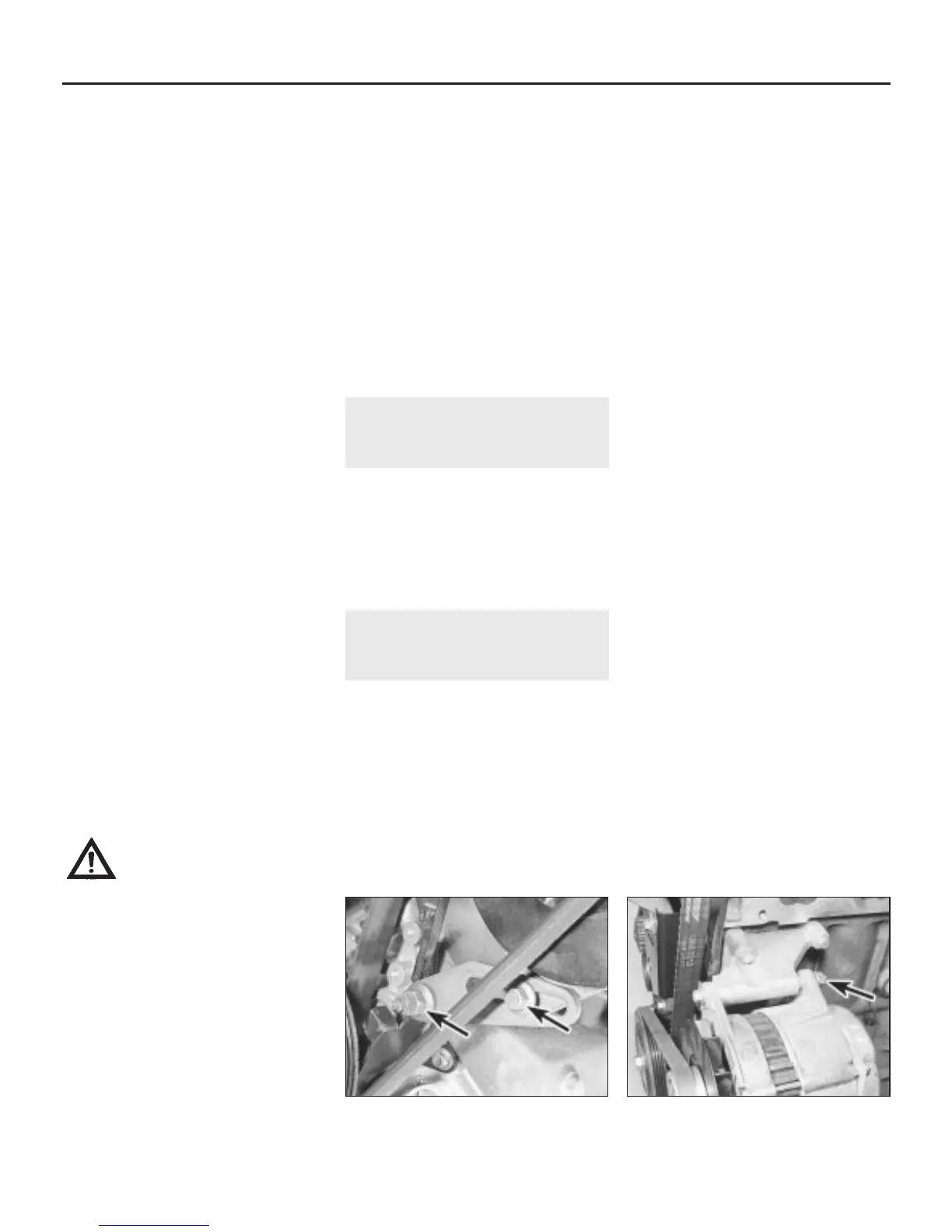
6 Slacken the two alternator adjustment
bracket bolts and the alternator pivot bolt and
nut (see illustrations).
7 Lever the alternator away from the engine
until the drivebelt is moderately tight. The
alternator must only be levered with care at
the drive end bracket. Hold the alternator in
this position and tighten the adjustment
bracket bolts and pivot nut and bolt.
1•16 Every 12 000 miles
16.6b . . . and pivot bolt retaining nut on
early “M” series 4-cylinder engines
16.6a Alternator adjustment bracket bolts
(arrowed) . . .
1380 Rover 800 Series Remake


 To Next Page
 Loading...