(a) Alternator and mounting brackets.
(b) Power steering pump and air conditioning
compressor.
(c) Distributor, HT leads and spark plugs.
(d) Thermostat and housing.
(e) Fuel injection system components.
(f) Inlet and exhaust manifolds and
turbocharger.
(g) Oil filter and housing.
(h) Engine mountings.
(i) Flywheel/driveplate.
(j) Water pump.
(k) All associated pipes, hoses and brackets.
Note: When removing the external
components from the engine, pay close
attention to details that may be helpful or
important during refitting. Note the fitting
positions of gaskets, seals, washers, bolts and
other small items.
4 If you are obtaining a short motor (which
consists of the engine cylinder block,
crankshaft, pistons and connecting rods all
assembled), the cylinder head(s), sump, oil
pump and timing belt will have to be removed
also.
5 If a complete overhaul is planned, the
engine can be dismantled and the internal
components removed in the following order.
(a) Inlet and exhaust manifolds.
(b) Timing belt, tensioner and sprockets.
(c) Cylinder head(s).
(d) Flywheel/driveplate.
(e) Sump.
(f) Oil pump.
(g) Pistons (with connecting rods).
(h) Crankshaft.
6 Before starting the dismantling and
overhaul procedures, make sure that you have
all of the correct tools for the jobs to tackled.
Refer to the introductory pages at the start of
this manual for further information.
7 Cylinder head (4-cylinder
engine) - dismantling
4
Note: New and reconditioned cylinder heads
are often available from the manufacturers,
and from engine overhaul specialists. Due to
the fact that some specialist tools are required
for the dismantling and inspection
procedures, and new components may not be
readily available, it may be more practical and
economical for the home mechanic to
purchase a reconditioned head, rather than to
dismantle, inspect and recondition the original
head.
1 With the cylinder head on the bench,
remove the camshafts and tappets,
thermostat housing, inlet and exhaust
manifolds, and the spark plugs, referring to
the applicable Sections and Chapters of this
manual as necessary.
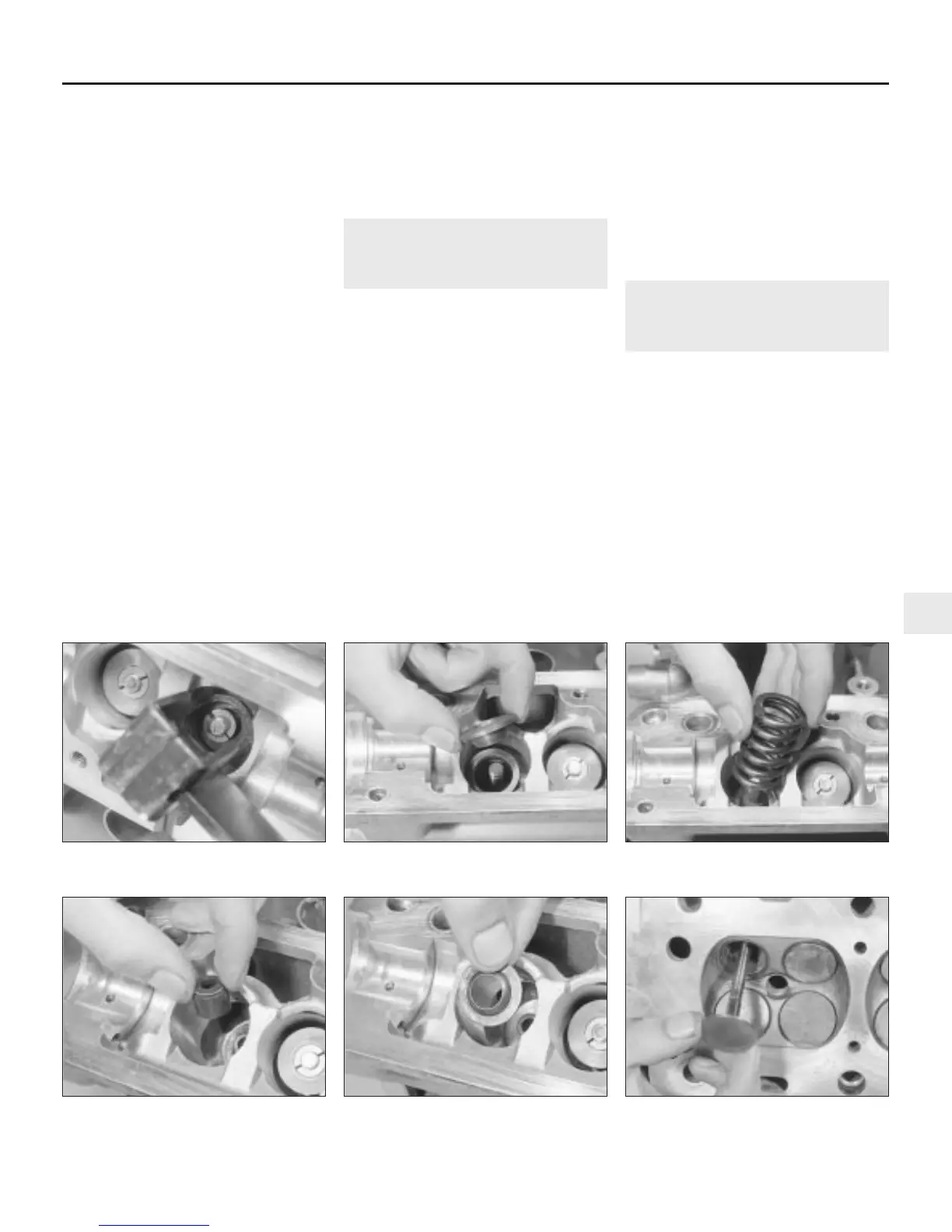
2 To remove the valves, compress each
spring in turn with a universal valve spring
compressor, until the two retaining collets can
be removed (see illustration).
3 Release the compressor, and lift off the
spring top cup, valve spring, oil seal, valve
spring seat and the valve (see illustrations).
4 It is essential that the valves are kept in
their correct order, unless they are so badly
worn or burnt that they are to be renewed. If
they are going to be refitted, place them in
their correct sequence, along with the
camshaft tappets removed previously. Also
keep the valve springs, cups, seats and
collets in the same order.
8 Cylinder head and rocker
gear (V6 engine) - dismantling
4
Note: Refer to the introductory note
concerning reconditioned cylinder heads at
the beginning of Section 7.
1 With the cylinder head on the bench,
remove the camshafts and tappets, the
exhaust manifold, and the spark plugs,
referring to the applicable Sections and
Chapters of this manual as necessary.
2 If working on the front cylinder head, undo
the two bolts and remove the crank/angle
sensor (where fitted) (see illustration).
3 Unscrew the two blanking plugs from the
cylinder head and collect the sealing washers.
4 Screw a cylinder head bolt into the now
exposed transmission end of the rocker shaft
and pull the shaft out of the cylinder head.
5 As the shaft is removed, collect the rocker
Engine removal and general engine overhaul procedures 2C•9
7.3b . . . valve spring . . .7.3a Release the compressor, and lift off
the spring top cup . . .
7.2 Compress the valve springs with a
universal valve spring compressor
7.3e . . . and the valve7.3d . . . spring seat . . .7.3c . . . oil seal . . .
2C
1380 Rover 800 Series Remake


 To Next Page
 Loading...