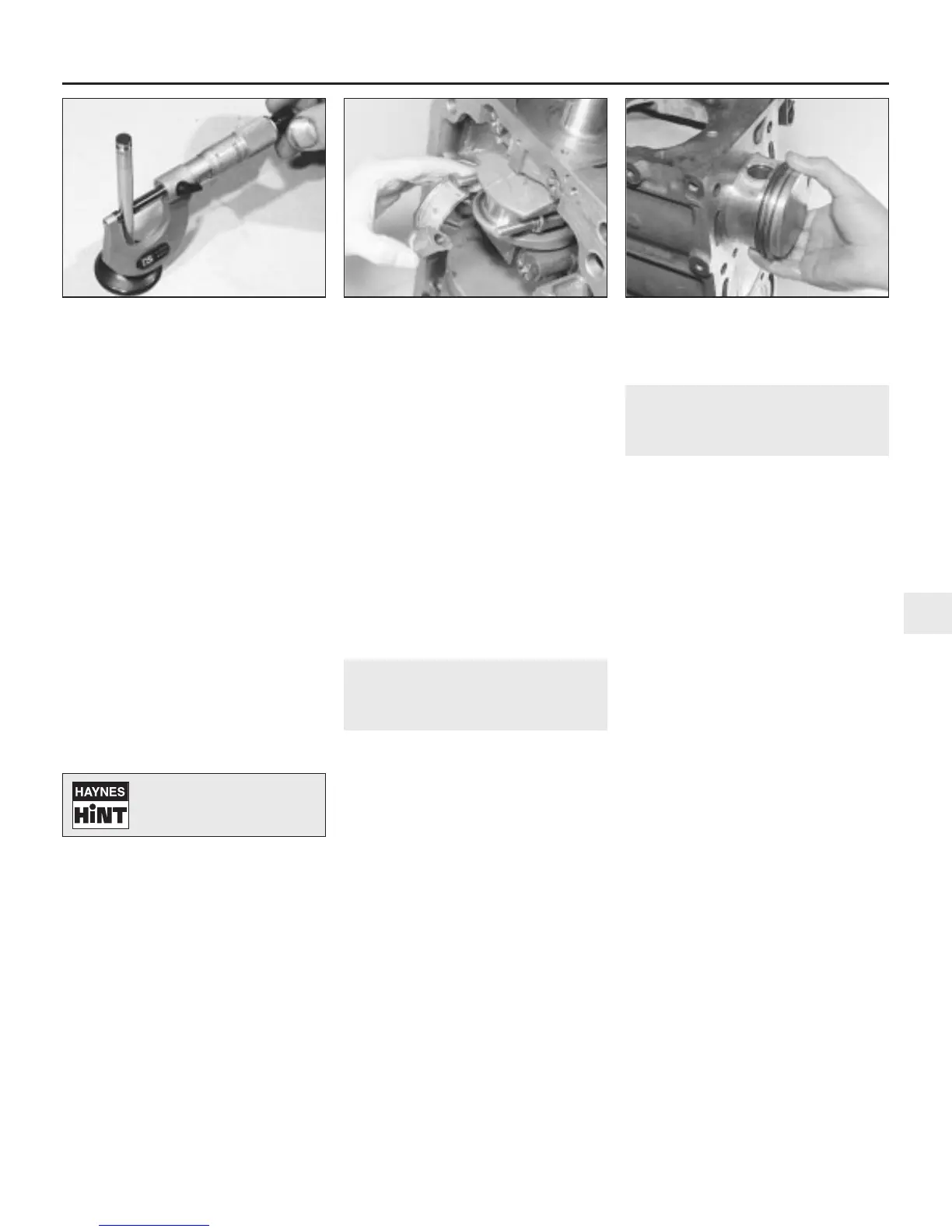
several points, using a micrometer (see
illustration). Any significant difference in the
readings obtained indicates wear of the valve
stem. Should any of these conditions be
apparent, the valve(s) must be renewed.
13 If the valves are in satisfactory condition,
they should be ground (lapped) into their
respective seats, to ensure a smooth gas-tight
seal. If the seat is only lightly pitted, or if it has
been re-cut, fine grinding compound only
should be used to produce the required finish.
Coarse valve-grinding compound should not be
used unless a seat is badly burned or deeply
pitted; if this is the case, the cylinder head and
valves should be inspected by an expert, to
decide whether seat re-cutting, or even the
renewal of the valve or seat insert, is required.
14 Valve grinding is carried out as follows.
Place the cylinder head upside-down on a
bench, with a block of wood at each end to
give clearance for the valve stems.
15 Smear a trace of (the appropriate grade
of) valve-grinding compound on the seat face,
and press a suction grinding tool onto the
valve head. With a semi-rotary action, grind
the valve head to its seat, lifting the valve
occasionally to redistribute the grinding
compound.
16 If coarse grinding compound is being
used, work only until a dull, matt even surface
is produced on both the valve seat and the
valve, then wipe off the used compound, and
repeat the process with fine compound. When
a smooth unbroken ring of light grey matt
finish is produced on both the valve and seat,
the grinding operation is complete. Do not
grind in the valves any further than absolutely
necessary, or the seat will be prematurely
sunk into the cylinder head.
17 When all the valves have been ground-in,
carefully wash off all traces of grinding
compound, using paraffin or solvent, before
reassembly of the cylinder head.
Valve components and rocker gear
18 Examine the valve springs for signs of
damage and discolouration, and also measure
their free length by comparing each of the
existing springs with a new component.
19 Stand each spring on a flat surface, and
check it for squareness. If any of the springs
are damaged, distorted, or have lost their
tension, obtain a complete set of new springs.
20 Check the spring upper seats and collets
for obvious wear and cracks. Any
questionable parts should be renewed, as
extensive damage will occur if they fail during
engine operation. Any damaged or
excessively-worn parts must be renewed; the
valve spring lower seat/stem oil seals must be
renewed as a matter of course whenever they
are disturbed.
21 Check the rocker shaft on V6 engines for
straightness and for any obvious sign of
scoring where the rockers contact. Similarly
check the rocker bore and the fit of the rocker
on the shaft. Renew any suspect parts.
10 Cylinder head -
reassembly
4
1 Before reassembling the cylinder head, first
ensure that it is perfectly clean and no traces
of grinding paste are left in the head or on the
valves and guides. Use compressed air, if
available, to blow out all the oil holes and
passages.
2 Commence reassembly of the cylinder
head by lubricating the valve stems and
guides with clean engine oil.
3 With the valves and valve seats prepared,
and with the valves in their correct order,
commence reassembly, starting with the first
valve of No 1 cylinder as follows.
4 Place the valve spring seat in position, then
fit a new oil seal over the valve guide, pushing
it fully into position.
5 Lubricate the valve stem with engine oil,
then insert the valve into its guide.
6 Fit the valve spring(s), and place the top
cup over the spring and valve.
7 Using the compressor tool, compress the
valve spring until the two collets can be slid
into position. Release the compressor
carefully, in order not to displace the collets.
8 Refit the remaining valves in the same way.
When they are all fitted, tap the end of each
valve stem with a plastic mallet to settle the
components.
11 Piston/connecting rod
assemblies (4-cylinder
engine) - removal
3
Note: Always check first what replacement
parts are available before planning any
overhaul operation. A Rover dealer, or a good
engine reconditioning specialist/automotive
parts supplier, may be able to suggest
alternatives which will enable you to overcome
the lack of replacement parts.
1 Remove the cylinder head, the sump, and
the oil pick-up pipe as described in Part A of
this Chapter.
2 Turn the crankshaft by means of the pulley
bolt, until No 1 and No 4 pistons are at the
bottom of their stroke.
3 Using a knife or scraper, clean the carbon
ridge from the top of the cylinder bore, to
facilitate removal of the piston.
4 Mark the No 1 cylinder connecting rod and
cap on their sides, using a centre-punch and
hammer, to indicate the cylinder the assembly
is fitted to, and also the fitted relationship of the
cap to the rod. Note: Any markings that may
appear on the rod and cap are often cylinder
bore size codes and not necessarily the
position of the assembly in the engine. Always
make your own marks to avoid confusion.
5 Undo the big-end cap nuts on No 1
connecting rod, then remove the cap,
complete with the lower bearing shell (see
illustration). If the cap is difficult to remove,
tap it from side to side with a plastic mallet.
6 Push the piston/connecting rod upwards
with the aid of the wooden handle of a
hammer or similar tool, then withdraw the
assembly from the top of the cylinder bore
(see illustration).
7 Refit the bearing cap and shell to the
connecting rod after removal.
8 Repeat paragraphs 3 to 7 for No 4
connecting rod.
9 Turn the crankshaft back through half a
turn, until No 2 and No 3 pistons are at the
bottom of their stroke.
10 Repeat paragraphs 3 to 7 for No 2 and
No 3 connecting rods.
Engine removal and general engine overhaul procedures 2C•11
11.6 Removing the piston and connecting
rod assembly
11.5 Removing the connecting rod cap
and big-end bearing shell
2C
1380 Rover 800 Series Remake
9.12 Measuring the valve stem diameter
A light spring placed under
the valve head will greatly
ease the grinding operation.


 To Next Page
 Loading...