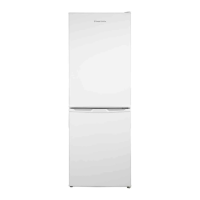
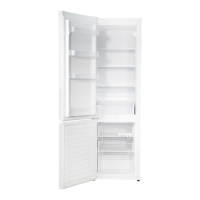
This document provides the instruction manual for the Russell Hobbs 50cm Wide Low Frost Fridge Freezer.
Function Description:
The Russell Hobbs 50cm Wide Low Frost Fridge Freezer is a household appliance designed for storing fresh and frozen food. It features separate compartments for refrigeration and freezing, controlled by a thermostat dial. The appliance utilizes R600a (Isobutene) as a natural refrigerant gas, which is environmentally friendly. It includes a "Super Freeze" mode for rapid freezing of fresh food and is designed for adult use in household and similar applications such as staff kitchen areas, farmhouses, hotels, motels, bed and breakfast establishments, and catering.
Important Technical Specifications:
- Model Number(s): RH145FF501E1 W/B/S
- Rated Voltage: 220V - 240V AC; 50Hz
- Capacity: 173L* (113L Fridge & 61L Freezer)
- *Fridge and freezer volume can be rounded up, but the total volume must be rounded down. Regulation (EU) 2019/2019 / Regulation: (EU) 2019/2016.
- External Dimensions (HxWxD): 1450mm x 497mm x 560mm
- Net Weight: 41.5 kg
- Rated Current: 0.8A
- Energy Efficiency Rating: E
- Airborne Acoustical Noise Emissions: 41 dB
- Airborne Acoustical Noise Emission Class: C
- Annual Energy Consumption: 196 kWh/a (actual consumption may vary)
- Climate Class: N (Temperate)
- Ambient Temperature Range:
- Extended Temperate (SN): +10°C to +32°C
- Temperate (N): +16°C to +32°C
- Subtropical (ST): +16°C to +38°C
- Tropical (T): +16°C to +43°C
- Minimum Ambient Temperature for Refrigerating Appliance: 16°C
- Maximum Ambient Temperature for Refrigerating Appliance: 32°C
- Light Source Type: LED
- Light Source Energy Efficiency Class: N/A
- Design Type: Freestanding
- Freezing Capacity: 3.2 kg/24h (for 4-Star Compartments)
- Defrosting Type: Manual (for freezer), Manual (for fresh food compartment)
- Guarantee: 12 months from the date of original purchase.
Usage Features:
- Temperature Control: The appliance's temperature is controlled by a thermostat dial located inside the fridge compartment. Settings range from 1 (warmest) to 5 (coldest), with 4 recommended for normal use in most UK homes.
- Super Freeze Switch: This switch activates the "Super Freeze" mode, which should be turned on 24 hours before placing fresh food in the freezer for maximum freezing capacity. It is recommended to turn it off after 24 hours to save energy.
- Initial Setup: After transportation, the appliance should stand for a minimum of 3 hours before plugging in to allow the coolant to settle. The interior should be cleaned with bicarbonate of soda and warm water before first use.
- Door Reversal: The appliance's doors can be reversed to open from the opposite side. This process requires a cross-headed screwdriver and a flat-headed screwdriver, and it is recommended that a minimum of two people perform the task due to the appliance's weight.
- Food Storage Guidelines: The manual provides specific recommendations for storing different types of food in various compartments (door balconies, crisper drawer, different shelves, freezer drawers) to maintain freshness and safety.
- Freezer Storage Advice: Fresh food should be stored in airtight containers or wrapped for freezing. Pre-frozen food should be placed in the freezer quickly after purchase. Maximum storage times at -18°C (4-star freezer rating) are suggested for various foods, e.g., fresh meat & poultry (up to 12 months), cooked meat (up to 2 months), fresh fish (up to 6 months), fruit & vegetables (up to 12 months), and bread & cakes (up to 6 months).
- Energy Saving Advice: Tips include avoiding installation near heat sources, ensuring good ventilation, minimizing door opening duration, maintaining clean and intact door seals, storing perishable foods in the coldest part of the fridge, not overloading the appliance, and allowing hot food to cool before placing it in the fridge or freezer.
- Power Failure: In case of a power failure, keep the door closed. If the freezer temperature rises, check the condition of frozen food before refreezing. Specific advice is given for different food types (e.g., ice cream should be discarded, fruit and vegetables cooked if soft).
- Noise: Faint gurgling or bubbling sounds from the refrigerant and a slight whirring or pulsating noise from the compressor are normal operational sounds.
Maintenance Features:
- Internal Cleaning: The interior should be cleaned periodically with a solution of bicarbonate of soda and lukewarm water. Accessories should be cleaned separately with soap and water. Ensure the appliance is disconnected from power during cleaning.
- External Cleaning: The outer cabinet can be washed with warm soapy water. Sharp edges underneath the product should be cleaned carefully. The rear of the appliance and compressor should be dusted regularly to prevent dust accumulation, which can affect performance and energy consumption.
- When Not in Use: If the appliance is left empty for long periods, it should be switched off, defrosted, cleaned, dried, and the door left open to prevent mold development.
- Defrosting: The appliance is low frost, so regular defrosting of the freezer is not typically required. However, if defrosting is needed, the manual outlines steps including consuming as much frozen food as possible, wrapping remaining food, switching off and unplugging the appliance, opening the freezer door, and collecting defrost water. Defrosting can be accelerated by placing bowls of hot (not boiling) water inside and loosening frost with a plastic scraper. Sharp metal tools or electrical heaters should not be used for defrosting.
- Light Replacement: The LED light is energy efficient and long-lasting. If replacement is needed, it must be done by a qualified engineer.
- Troubleshooting: A dedicated section provides solutions for common issues such as the appliance not working (check power, fuse, voltage, socket), insufficient cooling (check food load, thermostat setting, ambient temperature, door opening frequency), excessive cooling (adjust thermostat), wet inner surfaces (condensation), wet outer surfaces (condensation), and unusual noises (normal refrigerant flow, compressor operation).
- Disposal: The 'crossed-out wheelie bin' symbol indicates that the product/batteries should not be disposed of with general household waste. Electrical/electronic/battery items should be discarded in separate collection schemes for recovery and recycling.

 Need help?
 General



 To Next Page