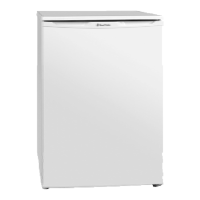
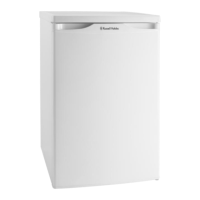
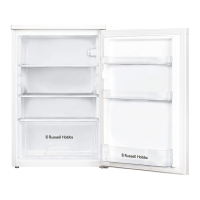
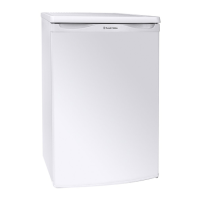
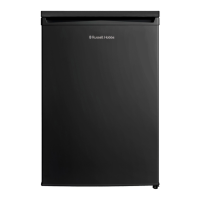
This document is an instruction manual for the Russell Hobbs Under Counter Larder Fridge, model number(s) RH55UCLF4 (B) (S).
Function Description
The Russell Hobbs Under Counter Larder Fridge is a refrigeration appliance designed for domestic use. Its primary function is to store food and beverages at cool temperatures, preventing spoilage. It operates as a larder fridge, meaning it is primarily for fresh food storage and does not include a freezer compartment for freezing fresh food, though some models may have two-star frozen-food compartments suitable for storing pre-frozen food, ice-cream, and making ice cubes. The appliance features a temperature control dial to regulate the internal temperature, with settings ranging from 1 (warmest) to 6 (coldest), and an "Off" setting. It is designed to be placed under a counter, making it suitable for kitchens with limited space.
Important Technical Specifications
- Model Number(s): RH55UCLF4 (B) (S)
- Rated Voltage: 220V – 240V ~ 50Hz
- Capacity: 131L (Total Storage Volume and Fresh Food Storage Compartment Volume)
- External Dimensions (HxWxD): 845mm x 553mm x 574mm
- Energy Consumption: 113 kWh/year (based on standard test results for 24 hours)
- Energy Rating: F
- Defrosting Type: Static
- Climate Class: N/ST (Normal/Subtropical), meaning it is intended to be used at ambient temperatures between 16°C and 38°C. Extended temperate (SN) and Tropical (T) ranges are also detailed, indicating suitability for ambient temperatures from 10°C to 32°C, and 16°C to 43°C respectively, depending on the specific climate class of the appliance.
- Airborne Acoustical Noise: 39 dB
- Rated Current: 0.55A
- Net Weight: 26.2 KG
- Refrigerant Gas: R600a (Isobutene), a natural and environmentally friendly but combustible gas.
- Light: Energy-efficient, long-life LED.
Usage Features
- Installation: The appliance requires a minimum of 3 hours to stand upright before being plugged into the mains to allow the coolant to settle. It should be placed on a flat, firm, and well-ventilated surface, at least 10cm away from heat sources and other freezers, and with at least 30cm clearance above. It is not suitable for outdoor use or placement on carpeted surfaces. Adjustable feet are provided for leveling.
- Temperature Control: The internal temperature is controlled by a dial inside the fridge. For normal conditions, the temperature control should be set between 5 and 6. Setting 6 can be used as a rapid cool setting for approximately 2 hours before placing a large amount of food inside, then returned to 5 or 6 to prevent temperatures from falling below 0°C. The standard operating temperature for the fridge compartment is between 0°C and 4°C.
- Door Reversal: The door can be reversed to open from the opposite side, requiring a Phillips head screwdriver, flat-headed screwdriver, and hexagonal spanner. This process involves removing the top cover, swapping a plastic blocking clip, detaching and reattaching hinges, and swapping door stoppers and hinge plugs. A minimum of 2 people are recommended for this task. After door reversal, the appliance must remain upright for at least 3 hours before being switched on.
- Food Storage Guidelines:
- Door or balconies: Foods with natural preservatives (jams, juices, drinks, condiments). Perishable foods should not be stored here.
- Crisper drawer (salad drawer): Fruits, herbs, and vegetables. Bananas, onions, potatoes, and garlic should not be stored in the refrigerator.
- Bottom shelf: Raw meat, poultry, fish (for short-term storage).
- Chiller (box/drawer): Dairy products, eggs.
- Middle shelf: Foods that do not require cooking (ready-to-eat foods, deli meats, leftovers).
- Top shelf: Foods that do not require cooking (ready-to-eat foods, deli meats, leftovers).
- Energy Saving Advice:
- Avoid installing near heat sources.
- Ensure good ventilation and clear air vents.
- Minimize door opening frequency and duration.
- Ensure door seals are clean and intact.
- Store perishable foods in the coldest part of the fridge (bottom shelf), and vegetables/salads/fruits in the crisper box (warmest part).
- Do not overload the appliance to allow proper air circulation.
- Allow hot food to cool down before placing it in the fridge.
- The factory-set shelf placement provides the most energy-efficient usage.
Maintenance Features
- Internal Cleaning: Disconnect from power before cleaning. Use a soft cloth or sponge with a solution of two tablespoons of baking soda and a quart of warm water (5ml to 0.5 litre of water) to clean the interior. Rinse with clean water and dry. For hard-to-reach areas, use a soft rag, soft brush, or auxiliary tools. Do not use soap, detergent, scrub powder, or spray cleaner that may cause odors. Clean bottle frames, shelves, and drawers with mild detergent and dry with a soft cloth; do not put them in a dishwasher.
- External Cleaning: Disconnect from power before cleaning. Do not use hard brushes, steel balls, wire brushes, abrasives (toothpastes, organic solvents like alcohol, acetone, banana oil), boiling water, acid, or alkaline items, as these can damage surfaces. Wipe the outer surface with a soft cloth dampened with soapy water or detergent, then wipe dry. Do not rinse with water to avoid affecting electrical insulation. Be cautious of sharp edges on the underside during cleaning.
- Dust Removal: Dust behind the refrigerator and on the compressor should be cleaned once or twice a year with a brush or vacuum cleaner to improve cooling efficiency and save energy.
- When Not in Use: For long periods of disuse, disconnect from the electricity supply, empty all food, clean the interior, and leave the door open to prevent odor build-up.
- Defrosting: Do not use mechanical devices or artificial means (heater, hair dryer) to accelerate defrosting.
- Bulb Replacement: The LED light is designed for long life and should not require replacement. If it does, it must be replaced by a qualified engineer. Contact customer service for assistance.
Safety Instructions
- Ensure the supply cord is not trapped or damaged during positioning.
- Do not locate multiple portable socket-outlets or power suppliers at the rear.
- The appliance uses R600a refrigerant gas, which is combustible; handle with care to avoid damaging refrigeration circuit components.
- Do not obstruct ventilation openings.
- Do not place or rest the appliance on its power cord.
- Do not use electrical appliances inside the refrigerator compartment.
- If replacing an old refrigerator with a lock, remove the lock as a safety measure.
- Dispose of old refrigerators and freezers properly, contacting local authorities or dealers for guidance, and ensure the scrap unit is not damaged prior to pick-up.
- Do not use adaptors or extension leads.
- Do not plug in damaged plugs or handle the plug with wet hands.
- Do not pull, twist, or damage the power cable.
- Children aged 8 and above, and persons with reduced physical, sensory, or mental capabilities, can use the appliance with supervision and instruction. Children aged 3 to 8 are allowed to load and unload. Do not allow children to play with the appliance or hang on the door.
- Do not place explosive or flammable materials inside.
- Seal bottles containing high percentages of alcohol and place them vertically.
- Do not cover the body or top of the appliance.
- Fix accessories during transportation to prevent damage.
- Clean surfaces regularly that come into contact with food and accessible drainage systems.
- Store raw meat and fish in suitable containers to prevent contact or dripping onto other food.
- One-, two-, and three-star compartments (if present) are not suitable for freezing fresh food.
- The appliance must be plugged into an earthed socket.
- Before switching on, verify that the voltage matches the rating plate (220-240V AC; 50Hz).
- The plug may be non-rewireable; if the fuse needs changing, refit the fuse cover. If the plug needs changing, it must be done by a qualified electrician, and the old plug disposed of safely.
- The appliance is heavy; ensure adequate people are present for moving.
- Pay attention to the fire warning symbol (yellow or orange) on the rear of the appliance, indicating flammable materials in refrigerant pipes and compressor. Keep away from fire sources.
Troubleshooting
The manual provides a comprehensive troubleshooting guide for common issues such as:
- Fridge not working: Check power, plug, fuse, voltage, and socket.
- Temperature not cold enough: Check food quantity, thermostat setting, placement (direct sunlight, heating source), ambient temperature, and door opening frequency.
- Temperature too cold: Adjust thermostat to a lower setting.
- Wet inner/outer surfaces: Caused by condensation; dry carefully.
- Smell/odor: Check food packaging, expiry dates, and for spillages. Clean the drainage pipe.
- Doors not closing properly: Check for obstructions, correct placement of compartments/shelves, door seal condition, appliance level, and surrounding spacing.
- Unusual noises: Bubbling and gurgling sounds are normal from coolant fluid. Water flowing sounds are normal during defrosting. Compressor noise is normal when operating.

 Need help?
 General


 To Next Page