
 Need help?
Do you have a question about the Russell Hobbs RHCF103-MD and is the answer not in the manual?
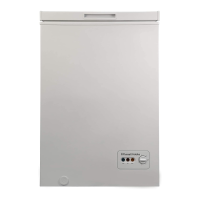
This document is an instruction manual for the Russell Hobbs Chest Freezer, model number RHCF103-MD. It provides comprehensive information on the appliance's function, technical specifications, usage, and maintenance.
The Russell Hobbs Chest Freezer (RHCF103-MD) is designed for freezing and storing food items. It operates as a standalone freezer unit, maintaining temperatures between -18°C and -30°C for optimal food preservation. The appliance uses natural refrigerant gas R600a (Isobutene) as part of its cooling system, which is environmentally friendly.
Installation and Initial Setup: Before plugging in, the appliance should stand for a minimum of 3 hours to allow the coolant to settle after transportation. The freezer must be placed on a flat, firm surface in a dry, well-ventilated room, away from direct sunlight and heat sources like stoves or radiators. A minimum clearance of 10cm from other heating cores or chest freezers, 5cm from kitchen cabinets, and 6cm from the back wall is recommended. There should be at least 30cm clearance above the appliance. It is suitable for placement in garages. The adjustable feet should be used to ensure stability and proper door operation.
Cleaning Before First Use: Before initial use, the interior should be wiped down with a solution of a teaspoon of bicarbonate of soda in warm water, followed by a clean damp cloth and drying. All transport tapes and foam protection pieces must be removed.
Temperature Control: The temperature is controlled by a knob located on the front face, at the bottom right-hand side. Settings range from 1 (warmest) to 6 (coldest). Under normal conditions, the recommended setting is 3. After setting the temperature and plugging in, the door should remain closed for at least 4 hours to allow the appliance to reach its standard operating temperature. The 'OFF' position provides automatic shutdown and initiates defrosting.
Indicator Lights: The freezer features indicator lights for operational status:
Food Storage Advice:
Power Failure: In case of a power failure, keep the door closed. If the internal temperature rises, do not refreeze food without checking its condition. Specific recommendations for thawed items include discarding ice cream, cooking and using soft fruits/vegetables, refreezing bread/cakes, refrigerating and quickly using shellfish, cooked dishes, large pieces of meat, small joints, and chicken.
Cleaning:
Defrosting: Defrosting should be performed twice a year or when a frost layer of approximately 7mm (1/4") has formed.
When Not in Use: For long periods of disuse, disconnect from the electricity supply, empty all food, clean the interior, and leave the door open to prevent odor build-up.
Troubleshooting: The manual includes a troubleshooting guide for common issues such as the freezer not working, insufficient cooling, excessive cooling, wet inner/outer surfaces, excess ice/frost, odors, doors not closing properly, and unusual noises (bubbling, gurgling, water flowing, compressor noise). Solutions range from checking power connections and thermostat settings to ensuring proper door sealing and cleaning.
Electrical Safety: The appliance must be plugged into an earthed socket (220-240V AC; 50Hz). Wiring instructions for a 13A (BS1363) fused plug are provided, detailing connections for GREEN/YELLOW (EARTH), BLUE (NEUTRAL), and BROWN (LIVE) wires. A 13amp fuse conforming to BS1362 and BSI or ASTA approval is required. Damaged plugs, power cables, adaptors, or extension leads should not be used. The appliance should not be plugged/unplugged with wet hands.
Environmental Information: The 'crossed-out wheelie bin symbol' indicates that the product and batteries should not be disposed of with general household waste. Electrical/electronic/battery items should be discarded in separate collection schemes for recovery and recycling. Further information on disposal facilities can be found at www.recycle-more.co.uk. The manufacturer is a member of SEDEX, promoting ethical performance in global supply chains (www.sedex.org.uk).
 General
| Brand | Russell Hobbs |
|---|---|
| Model | RHCF103-MD |
| Category | Freezer |
| Language | English |


 To Next Page