
 Need help?
Do you have a question about the Russell Hobbs RHCF60 and is the answer not in the manual?
Ensures safe use by addressing power cord placement, socket types, and plug integrity.
Guidance on choosing an optimal installation location ensuring proper ventilation and clearance from heat sources.
Mandates allowing the appliance to stand for at least 3 hours before plugging into the mains.
Explains how to use the temperature control knob and recommended operating temperature range.
Instructions on how to manage frozen food during a power failure and guidelines for refreezing thawed items.
Detailed steps for cleaning the appliance interior, including cavity, accessories, and safe handling of the plug.
Step-by-step guide for defrosting the appliance, including preparation, draining, and safety warnings.
Checks to perform if the freezer fails to operate, covering power, plug, voltage, and socket issues.
Addresses problems with the appliance not being cold enough or being too cold, linking to thermostat and placement.
Details the correct wiring procedure for the mains plug, emphasizing earthing and terminal connections.
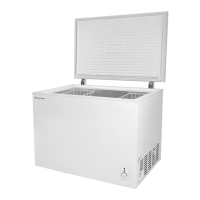
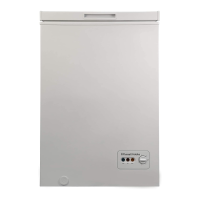
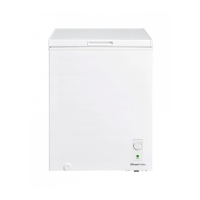
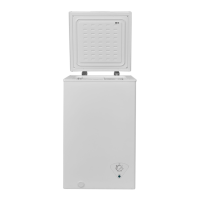
The Russell Hobbs Chest Freezer (model RHCF60) is an appliance designed for freezing and storing food. It utilizes natural refrigerant gas (R600a Isobutene) as part of its cooling system, which is environmentally friendly but combustible, requiring careful handling during transport and installation to avoid damaging refrigeration circuit components.
Before installation and use, it's crucial to read the entire instruction manual. The appliance should be positioned carefully to avoid trapping or damaging the supply cord. Multiple portable socket-outlets or power suppliers should not be located at the rear of the appliance. Ventilation openings must not be obstructed, and the appliance should not be placed or rested on its power cord. Mechanical devices or artificial means (like heaters or hair dryers) should not be used to accelerate defrosting. Electrical appliances are not to be used inside the freezer compartment. If replacing an old refrigerator with a lock, the lock must be removed for safety before disposal to prevent children from becoming trapped. Old refrigerators and freezers containing insulation gases and refrigerant must be disposed of properly, contacting local authorities or dealers for guidance and ensuring the scrap unit is not damaged. Adapters or extension leads should not be used for connection to the electrical power supply, and damaged plugs should not be used. The power cable should not be pulled, twisted, or damaged, and the appliance should not be plugged in or unplugged with wet hands to prevent electrical shock.
This appliance can be used by children aged 8 and above, and persons with reduced physical, sensory, or mental capabilities or lack of experience and knowledge, provided they receive supervision or instruction on safe use and understand the hazards. Children aged 3 to 8 are allowed to load and unload the appliance. It is designed for adult use; children should not play with it or hang on the door. Explosive or flammable materials should not be placed inside the appliance. Bottles with high alcohol content must be sealed well and placed vertically. The body or top of the appliance should not be covered. Accessories should be secured during transportation to prevent damage.
To avoid food contamination, the door should not be left open for long periods, as this can significantly increase the temperature. Surfaces that come into contact with food and accessible drainage systems should be cleaned regularly. Water tanks (if present) should be cleaned if unused for 48 hours, and the water system flushed if water has not been drawn for 5 days. Raw meat and fish should be stored in suitable containers to prevent contact or dripping onto other food. Two-star frozen-food compartments (if applicable) are suitable for storing pre-frozen food, making ice cream, and making ice cubes. One-, two-, and three-star compartments are not suitable for freezing fresh food. If the appliance is left empty for long periods, it should be switched off, defrosted, cleaned, dried, and the door left open to prevent mold development.
The appliance must be plugged into an earthed socket. Before switching on, verify that the electricity supply voltage matches the rating plate (220-240V AC; 50Hz). The product may have a non-rewireable plug; if the fuse needs changing, the fuse cover must be refitted. If the fuse cover is lost or damaged, the plug should not be used until a suitable replacement is obtained. If the plug needs changing due to incompatibility or damage, it should be cut off and replaced with an appropriate plug by a qualified electrician, and the removed plug disposed of safely to avoid electrical hazards.
For safe lifting, tilt the appliance backward by no more than 45 degrees, holding the base and rear corners. Do not use door handles for lifting. To move on a flat surface, tilt slightly backward and push. This unit is heavy, so adequate personnel should be present to move it to prevent injury.
The operating voltage is 220-240V at 50Hz. Ensure the plug is inserted into an efficient Ground (Earth) connection. If the socket lacks an Earth contact or the plug doesn't match, consult an authorized electrician. Place the appliance away from direct sunlight, at least 10cm from stoves, ovens, or other heating sources. It should not be used outdoors or left in the rain. If placed next to another chest freezer or freezer, maintain at least 10cm clearance to prevent outer surface humidity. Do not place anything on top of the appliance, and ensure at least 30cm clearance above it. If next to kitchen cabinets, leave 5cm. The rear should be at least 6cm from the back wall. The appliance must be used in a vertical position on a flat, firm surface. Use adjustable feet to level it. Do not place on carpet, as this hinders ventilation. Choose a dry, well-ventilated space. The plug should be easily accessible. For installation assistance, contact Customer Services.
Before use, wipe down all parts of the new appliance with a teaspoon of bicarbonate of soda in warm water, then with a clean damp cloth, and dry (ensure it's disconnected from power). Remove all transport tapes and foam protection. Clean the interior with a cloth dampened in lukewarm soap and water, then wipe with clean water and dry. An initial odor may be present but will dissipate as the appliance cools. Adjust the feet for stability, quiet running, and proper door opening/closing. Connect to the electrical socket but do not switch on for at least 3 hours to allow coolant to settle. After settling, set the thermostat knob (located on the front face, bottom right) between "2" and "3" and switch on. Close the door. Gurgling or bubbling sounds from refrigerant and slight whirring/pulsating from the compressor are normal. The thermostat controls compressor operation, and a slight click may be heard as it cycles. Minimize door opening frequency and duration to save energy.
The appliance features a handle, wire basket, power cord, temperature control dial & indicator light, adjustable feet, and a drainage hole.
Allow the appliance to stand for a minimum of 3 hours before plugging into the mains. The temperature is controlled by a knob on the front, bottom right. '1' is the warmest setting, '6' is the coldest. Under normal conditions, set the control between '3' and '2'. After setting, close the door and plug in. Do not open the door for at least 4 hours to allow it to reach operating temperature. The 'OFF' position is an automatic shutdown and will defrost. The standard operating temperature for the freezer compartment should be between -18°C and -30°C. The "Power" indicator light shows when the freezer is switched on.
Avoid installing near heat sources (cooker, dishwasher, radiator). Place in a cool, well-ventilated room with clear air vents. Minimize door opening to prevent warm air entry and ice build-up. Ensure door seals are clean and intact. Do not overload to allow proper air circulation. Allow hot food to cool before placing in the freezer.
Store fresh food in airtight boxes or suitable freezer bags/foil. Avoid direct contact between frozen and fresh food. Place pre-frozen food in the freezer quickly after purchase. Process fresh vegetables/fruits appropriately to prevent frost damage. Always follow food packaging storage guidelines. Suggested maximum storage times at -18°C (4-star freezer rating): fresh meat & poultry (up to 12 months), cooked meat (up to 2 months), fresh fish (up to 6 months), fruit & vegetables (up to 12 months), bread & cakes (up to 6 months).
During a power failure, keep the door closed. If the freezer temperature rises, do not refreeze food without checking its condition. Ice cream should be discarded if thawed. Soft fruit and vegetables should be cooked and used. Bread and cakes can be refrozen. Shellfish, cooked dishes, large pieces of meat, small joints, and chicken should be refrigerated and used quickly.
Disconnect from power before cleaning. Internal Cleaning: Do not pour water over the appliance. Clean the cavity periodically with a solution of bicarbonate of soda (5ml to 0.5 litre of water). Clean accessories separately with soap and water; do not use a dishwasher. Do not use abrasive products, detergents, or soaps. Rinse with clean water and dry carefully. Reconnect the plug with dry hands after cleaning. External Cleaning: Wash the outer cabinet with warm soapy water; do NOT use abrasive products. Be careful of sharp edges underneath. Dust the rear and compressor once or twice a year with a brush or vacuum cleaner to prevent dust accumulation, which affects performance and increases energy consumption.
For long periods of disuse, disconnect from electricity, empty all food, clean the inside, and leave the door open to prevent odor build-up.
Defrost twice a year or when a frost layer of approximately 7mm (1/4") has formed. 6 hours before defrosting, set the thermostat to "6" to ensure food is at its lowest temperature. Wrap all food in newspaper and store in a cool place. Switch off the appliance and unplug it. Remove the freezer basket and leave the lid open. Containers of warm (not hot) water can be placed inside to speed up defrosting. Never use hairdryers, electrical heaters, or other electrical appliances for defrosting. Once ice has melted, drain water from the bottom of the freezer by unscrewing the plastic stopper inside. Keep the stopper safe and replace it after defrosting. A small plastic drain cap is located at the front left bottom corner of the appliance (outside). Place a container underneath, unscrew the cap slowly to drain water, and replace it once draining is complete. Wipe up any spillages. Never use sharp metal tools as they can damage the appliance. Never use an electrical heater, as this can cause electric shock.
Freezer doesn't work: Check if switched on, for power cut, faulty plug, blown fuse, correct voltage, or faulty socket. Temperature not cold enough: Check for too much food, thermostat setting, direct sunlight/heating source, ambient temperature within limits, or frequent door openings (which increase humidity and moisture build-up). Temperature too cold: Increase working temperature by adjusting thermostat to a lower setting. Inner surfaces wet: Caused by condensation; dry the inside. Outer surfaces wet: Caused by condensation; dry the outside carefully. Excess ice/frost: Check if door was left open or if door gasket is clean and undamaged. Smell/odor: Check food packaging and dates; remove/repackage as needed. Check for spillages on shelves/racks/drawers and clean thoroughly. Doors don't close properly: Ensure no obstructions, compartments/shelves are correctly in place, door seal is not warped/torn, and appliance is level. Unusual noises: Bubbling and gurgling sound: Normal, from coolant fluid flowing through pipes. Water flowing sound: Normal, from water flowing into drain trough during defrosting. Compressor noise: Normal, indicates compressor is operating. May be noisier for a short period when energized.
Model number: RHCF60 Rated Voltage: 220V-240V ~ 50Hz Capacity: 60L External Dimensions (HxWxD): 858mm x 499mm x 537mm
This product has a 12-month guarantee from the original purchase date. For defects due to faulty materials or workmanship, contact Product Care with proof of purchase for replacement or refund. Refund or replacement is at Product Care's discretion. Conditions include valid proof of purchase, installation/use according to instructions, domestic use only, and it does not cover wear and tear, damage, misuse, or consumable parts. This does not affect statutory rights.
The appliance is imported by G2S LIMITED, WIGAN, WN2 4AY. The CE symbol and crossed-out wheelie bin symbol indicate that the product/batteries should not be disposed of with general household waste but in separate collection schemes for recovery and recycling. Visit www.recycle-more.co.uk for disposal facilities. The manufacturer reserves the right to alter the instruction manual without prior notice due to design changes.
 General
| Brand | Russell Hobbs |
|---|---|
| Model | RHCF60 |
| Category | Freezer |
| Language | English |

 To Next Page