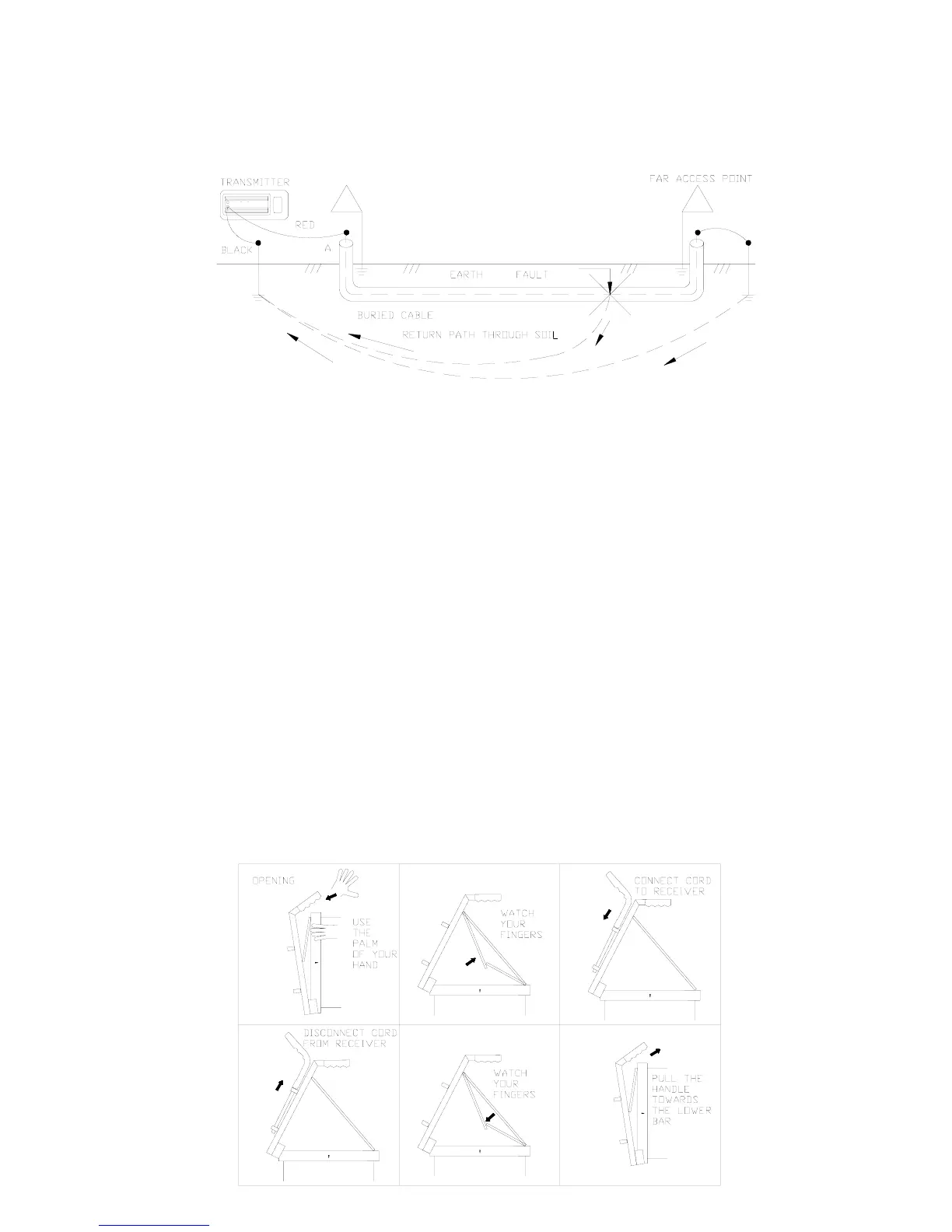
Fault locating determines the position of an insulated break on an underground conductor. In the case
of an insulation fault, some of the signal will return to the TRANSMITTER attached to the GROUND ROD
through a break in the insulation.
Fault Locating with the 8879
It is generally a good idea to locate the conductor path before attempting to fault locate. If, during the path
locate, an unusual amount of signal loss occurs, a part of the signal has escaped to ground in the last sev-
eral feet.
Note: Signal would go to ground at a grounded splice
point, which would act as a fault during the path
and fault locate.
Once the path is determined and there is a general area where a fault is expected, additional current can
be forced to flow through the fault by disconnecting and isolating the far access point. If the current has no
path to ground at the far access point, it will be forced to seek ground at the fault. This will increase the cur-
rent in the soil at the fault and detection of the fault.
Signal Return Through an Insulated Fault
To begin fault locating, open the G
ROUND RETURN
PROBE (GRP) and attach the 8879 RECEIVER as shown
below. Plug the G
ROUND RETURN PROBE CORD into the GRP handle with the straight connection. The
GROUND RETURN PROBE is collapsible for easy transport and storage.
Ground Return Probe
USE CAUTION WHEN OPENING AND CLOSING THE GRP
15


 To Next Page