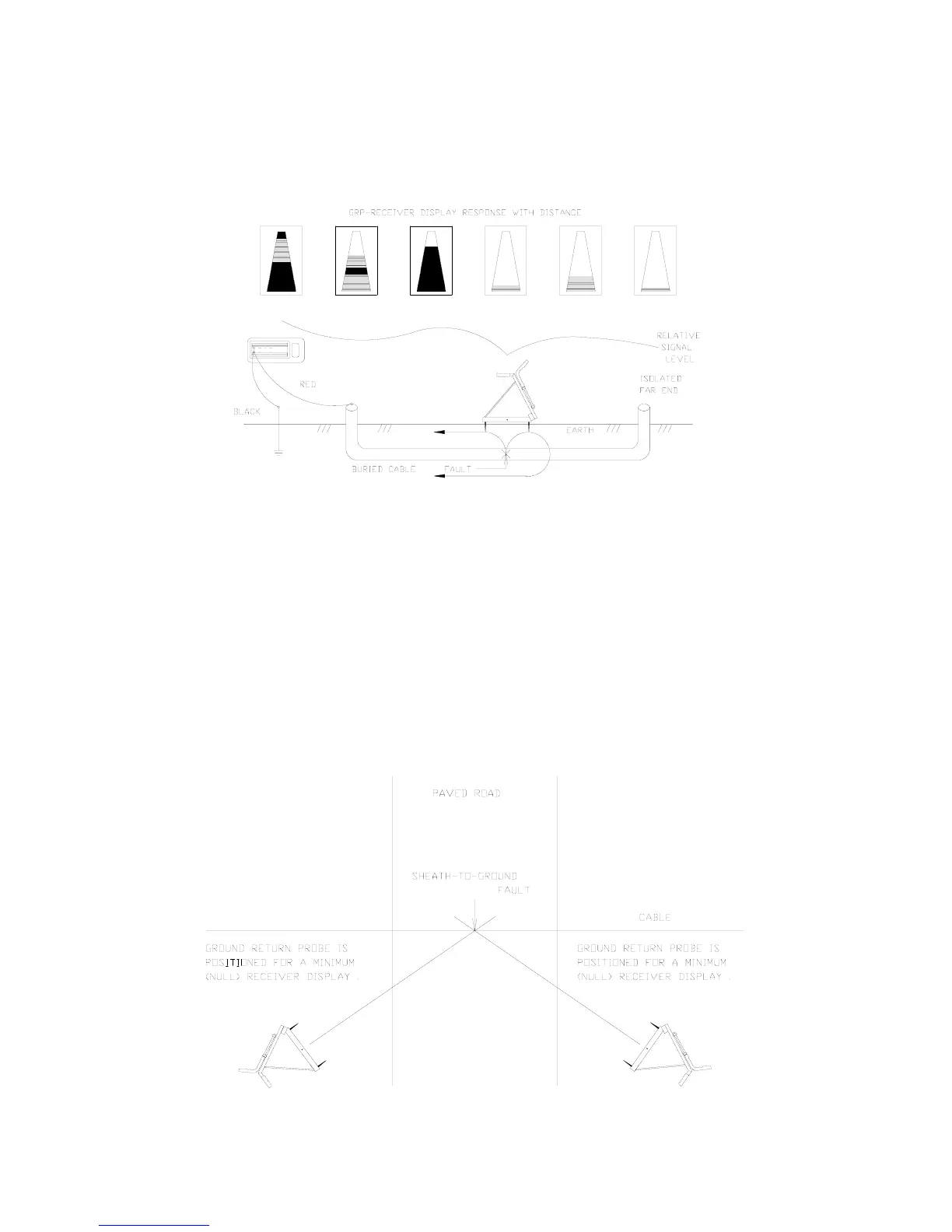
Notice in the figure below there is a RECEIVER signal level increase as the GROUND
RETURN PROBE approaches a fault and it moves away from the TRANSMITTER. A good cable will allow the
locating signal to slowly decrease with distance from the TRANSMITTER. While this signature pattern must be
recognized, this method is usually more accurate than phase responding to-from types of instruments.
GRP Receiver Meter Response with Distance
A potential problem could exist if a fault should lie beneath a paved surface. In this case, the G
ROUND
R
ETURN PROBE
will be used in the dirt at the side of the paved area. Since the return current in the soil
begins its return from the fault - like the spokes of a wheel laying on the ground - equal amounts of current
will enter the GRP if it is placed on the ground and positioned broadside to the fault. A NULL will be record-
ed when the exact broadside is accomplished. The GRP adjustments can be made by slightly rotating the
G
ROUND RETURN
PROBE to find the deepest NULL. The fault will lie on a straight line projected at a right
angle from the center of the GRP. The operator should record this line over the paved area. By repeating
this procedure from another location near the paved area, another line will be produced. The intersection
of the two lines is the location of the fault.
Faults Beneath Paved Surfaces
17


 To Next Page