800.851.7347 www.rycominstruments.com
Inductive Connection
This method is convenient to use, and services are not interrupted. No test cords
or connections are needed. The cable or pipe must have good insulation or non-
conductive coating, or the operating range will be short.
Turn the TransmiTTer ON. Press the 82 kHz button. Place TransmiTTer on iTs side as close
as possible to the path of the cable or pipe. Align the ARROWS on the SIDE OF THE
TRANSMITTER in line with the cable or pipe. First, locate the broad TransmiTTer Null,
then move toward the expected cable path while looking for the signal carried
by the cable.
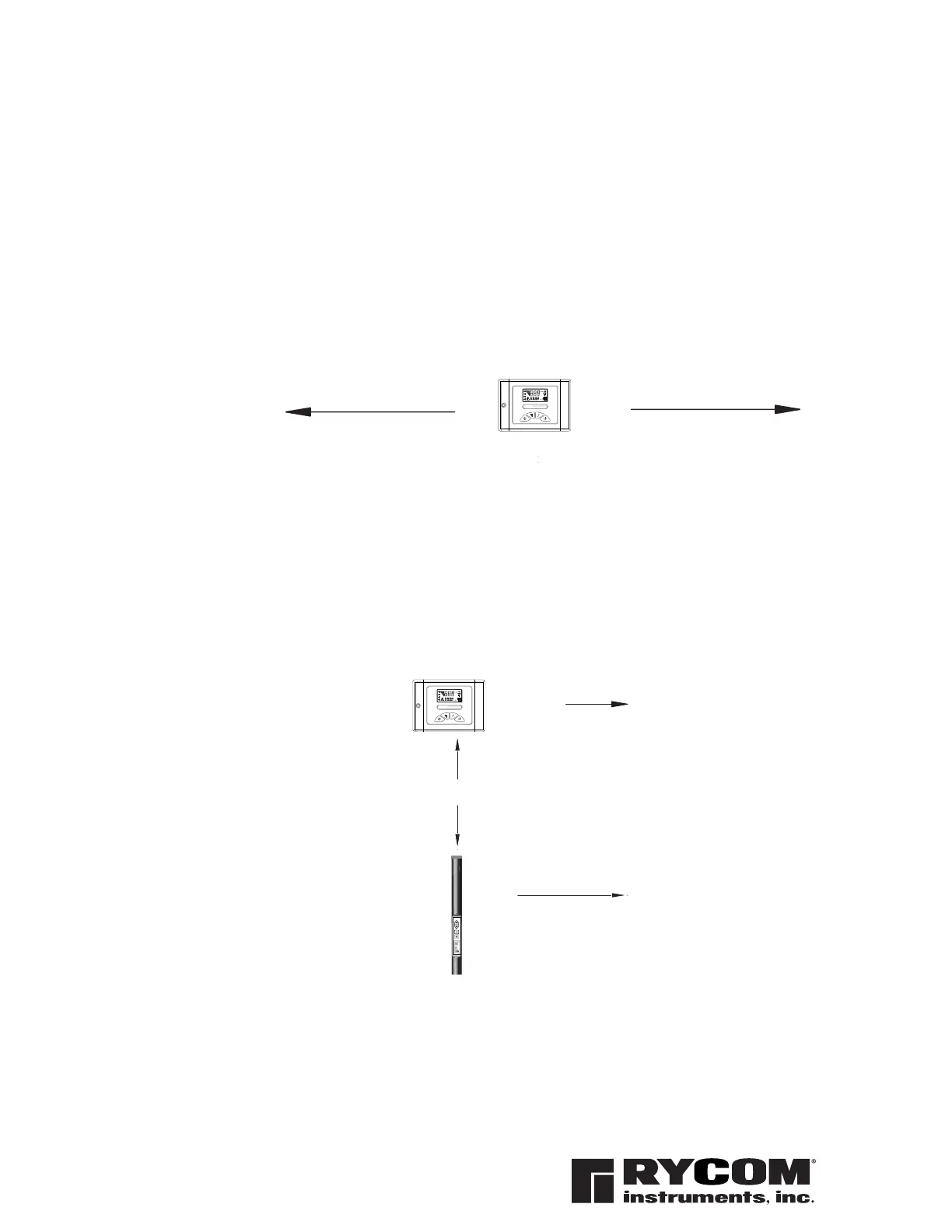
Start tracing the path with the receiver 25 feet from the TransmiTTer. Search in the
90º zone as shown above. Locate the cable or pipe, and follow the path. If the
signal becomes weak, move the TransmiTTer to a point 25 feet behind the last strong
signal, and continue searching.
The Blind Search locating techniques is used if the operator is not aware if a bur-
ied utility exists. Two people are needed for this technique. The TransmiTTer and the
receiver are Held 25 feet away from each other. Each operator walks at the same
speed keeping a distance of 25 feet from each other. When the receiver gives
an audio response, then a buried utility is present between the receiver and the
TransmiTTer.
Blind Search
TRANSMITTER
25 Feet (7.5 Meters) Between Transmitter and Reciever
RECEIVER
TRANSMITTER
25 Feet (7.5 Meters) Between Transmitter and Reciever
RECEIVER
TRANSMITTER
25 Feet (7.5 Meters) Between Transmitter and Reciever
RECEIVER
kM
v
mA
DFF
kHz
F.1
F.2
kM
v
mA
DFF
kHz
F.1
F.2
82
kHz
5


 To Next Page