Need help?
Do you have a question about the Ryobi CFS1503K and is the answer not in the manual?
Details the exchange policy for defective RYOBI® power tools within 30 days of purchase.
Outlines what defects in workmanship or materials are covered by the RYOBI® power tool warranty.
Provides instructions on how to obtain warranty service for RYOBI® power tools, including contact information.
Specifies conditions and actions that are not covered by the RYOBI® power tool warranty.
Addresses limitations on implied warranties and responsibility for indirect or incidental damages.
Guidelines for maintaining a safe and clean work environment during operation.
Precautions related to electrical connections, cords, and grounding to prevent shock.
Rules for operator alertness, protective gear, and safe operating practices.
Best practices for operating and maintaining the power tool safely and effectively.
Guidelines for servicing the power tool, emphasizing qualified personnel and original parts.
Detailed safety rules specific to operating the power tool, including cord, extension, and personal protection.
Explains the concept of double insulation in power tools and its safety implications.
Details the correct power supply requirements (voltage, frequency) for the electric motor.
Provides guidance on selecting and using appropriate extension cords for power tools, including wire gauge.
Lists technical specifications of the compact finish sander, including pad size and speed.
Advises users to familiarize themselves with the product's features and safety rules before operation.
Describes the sander's oscillating motion and its suitability for various tasks.
Explains the function of the dust bag in collecting sanding dust.
Highlights the GripZone™ feature for improved comfort and grip during use.
Details the use of the paper punch for proper sandpaper alignment.
Describes the hook-and-loop pad system for easy attachment and removal of sanding sheets.
Explains the Tri-Flex design of sanding sheets for extended life and even wear.
Instructions for carefully removing the product and accessories from the packaging.
A list of all items included in the product package.
Lists the intended uses and applications for the compact finish sander.
Guidance on choosing the correct grit and type of sanding sheet for different finishes.
Step-by-step instructions for attaching sanding sheets to the hook-and-loop pad.
Procedure for attaching the dust bag to the sander for dust collection.
Instructions on how to operate the ON/OFF switch for the sander.
Detailed guide on how to use the sander, including pressure, motion, and motor cooling.
Instructions for safely and efficiently emptying the dust bag.
Guidance on how to change sanding sheets and pads for various tasks.
Instructions on using the paper punch to prepare sandpaper for the sander.
Method for rotating sanding sheets to extend their lifespan.
Advice on cleaning plastic parts and avoiding harmful chemicals.
Information regarding the lubrication of the tool's bearings.
Steps for cleaning scrubbing pads to maintain performance and longevity.
Instructions for cleaning sanding sheets to ensure reusability.
Guidance on purchasing replacement parts through online channels or authorized service centers.
Information on finding the nearest authorized service center for repairs.
Contact methods for obtaining customer or technical assistance.
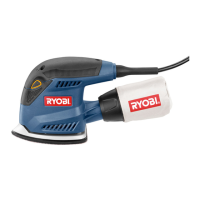
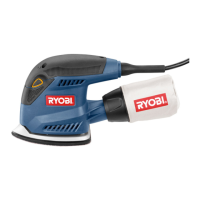
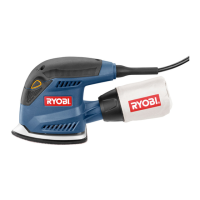
This document is the operator's manual for the Ryobi 5-1/2 inch Corner Cat® Compact Finish Sander, model CFS1503. This is a double-insulated power tool designed for various sanding, scrubbing, and polishing applications.
The Ryobi Corner Cat® Compact Finish Sander is engineered to provide a high standard of dependability, ease of operation, and operator safety for achieving fine finishes on various surfaces. Its primary function is to smooth surfaces through an oscillating sanding action. This compact finish sander is particularly effective for tasks requiring quick, small circular motions, making it suitable for producing fine finished grains or for removing light rust, paint, and other buildup from work surfaces when used with appropriate scrubbing pads. The tool is designed to collect dust generated during operation into a dust bag, minimizing airborne particles and maintaining a cleaner work environment.
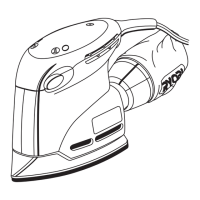
The sander incorporates several features to enhance its usability and performance. The Circular Sanding Action is central to its operation, providing the necessary motion for effective material removal and finishing. The Dust Bag is a key component for dust management, collecting debris through punched holes in the sandpaper and the hook-and-loop pad. For optimal dust collection, the dust bag should be emptied when it is no more than half full, and thoroughly cleaned after each use and before storage. The manual emphasizes the importance of emptying the dust bag frequently (every 10-15 minutes) when sanding certain surface coatings like polyurethanes or linseed oil, as collected dust from these materials can self-ignite.
The sander features GripZone™ Overmold Technology, which provides improved comfort and a positive grip during operation, contributing to better control and reduced user fatigue.
For attaching sanding sheets and pads, the sander utilizes a Quick Change Hook-and-Loop Pad design. This system allows for easy and rapid changes of sanding sheets and scrubbing pads, and also facilitates cleaning and reuse of these accessories. The manual details the process of aligning the holes in the sanding sheet with those in the pad and pressing the fuzzy side of the sheet firmly against the pad for secure attachment.
A Paper Punch is included with the sander, serving as a template to punch holes in standard sandpaper sheets. These punched holes must align with the holes in the sander pad to ensure proper dust extraction. The process involves installing sandpaper on the sander, aligning the sander pad over the paper punch, and pushing down on the sander to create the holes.
The sanding sheets themselves feature a Tri-Flex Pad Design. This innovative design allows the top two-thirds of each sanding sheet to be detached and rotated. This capability extends the life of the sanding sheet and promotes even wear, as users can rotate the sheet to utilize a fresh corner at the tip of the base where most wear occurs in precision sanding applications. Scrubbing and polishing pads, however, are not perforated and cannot be rotated.
Operating the sander involves a straightforward ON/OFF switch. Users are instructed to push the switch to the left to turn the sander on and to the right to turn it off. When operating, the sander should be held in front and away from the user, clear of the workpiece. It's recommended to start the sander and allow the motor to reach maximum speed before gradually lowering it onto the workpiece, ensuring the entire sanding disc surface is in contact. The sander should be moved slowly across the workpiece using small, circular motions. The manual advises against forcing the tool, as its weight provides adequate pressure; excessive pressure can slow the motor, wear out sanding sheets quickly, and potentially damage the motor from overheating, leading to inferior work. For detail sanding in corners and crevices, the tip of the sanding sheet should be used with small, back-and-forth motions.
The manual also provides guidance on Sanding Sheet Selection, emphasizing that choosing the correct grit and type of sanding sheet is crucial for achieving a high-quality finish. Aluminum oxide, silicon carbide, and other synthetic abrasives are recommended for power sanding due to their effectiveness compared to softer natural abrasives. Coarse grits are used for removing more material, while finer grits are used for producing smoother finishes and removing scratches left by coarser grits. Users should continue sanding with each grit until the surface is uniform.
Proper maintenance is essential for the longevity and performance of the Ryobi Corner Cat® Compact Finish Sander. The manual outlines several key maintenance practices.
General Maintenance advises against using solvents for cleaning plastic parts, as many plastics are susceptible to damage from commercial solvents. Instead, clean cloths should be used to remove dirt, dust, oil, and grease. A specific warning is issued against allowing brake fluids, gasoline, petroleum-based products, or penetrating oils to come into contact with plastic parts, as these chemicals can cause damage, weakening, or destruction of the plastic, potentially leading to serious personal injury.
The manual also notes that electric tools used on materials like fiberglass, wallboard, spackling compounds, or plaster are subject to accelerated wear and premature failure due to the abrasive nature of these materials. While not explicitly recommending against using the product for extended work on these materials, it stresses the importance of cleaning the product with compressed air if such work is performed.
Lubrication is simplified, as all bearings in the product are pre-lubricated with a sufficient amount of high-grade lubricant designed to last the life of the unit under normal operating conditions. Therefore, no further lubrication by the user is required.
Cleaning the Scrubbing Pads is crucial for maintaining their performance and extending their life. Periodically, users should clean all residue and foreign materials from the scrubbing pads by rinsing them with warm water until all foreign material is washed away. After cleaning, the pad should be gently squeezed to remove excess water and allowed to dry. Scrubbing pads and sanding sheets should always be stored flat in a cool, dry location.
Similarly, Cleaning the Sanding Sheets is recommended, as the provided sanding sheets are designed for reuse. To remove sanding residue and foreign material that accumulates over time, users can rub the sheets with a hard rubber block. A safety warning emphasizes removing the scrubbing pad or sanding sheet from the sander before cleaning to prevent serious personal injury.
For any service needs, the manual directs users to return the product to the nearest Authorized Service Center for repair, ensuring that only identical replacement parts are used to maintain the safety and integrity of the tool. This includes checking for misalignment or binding of moving parts, breakage, and any other conditions that might affect the tool's operation.
 General
| Voltage | 120V |
|---|---|
| Power Source | Corded Electric |
| Orbit Diameter | 1/8 inch |
| Dust Collection | Yes |
| Oscillations per minute | 12, 000 OPM (orbits per minute) |
| Pad Size | 5 inches |

 To Next Page